 By Alex
 Google Cloud revenue rose 82% to $24.8 billion
Alphabet's Q2 2026 results give Google's AI spending a stronger commercial story: Google Cloud revenue rose 82% to $24.8 billion, backlog reached $514 billion, and Gemini adoption expanded across enterprise and consumer products.
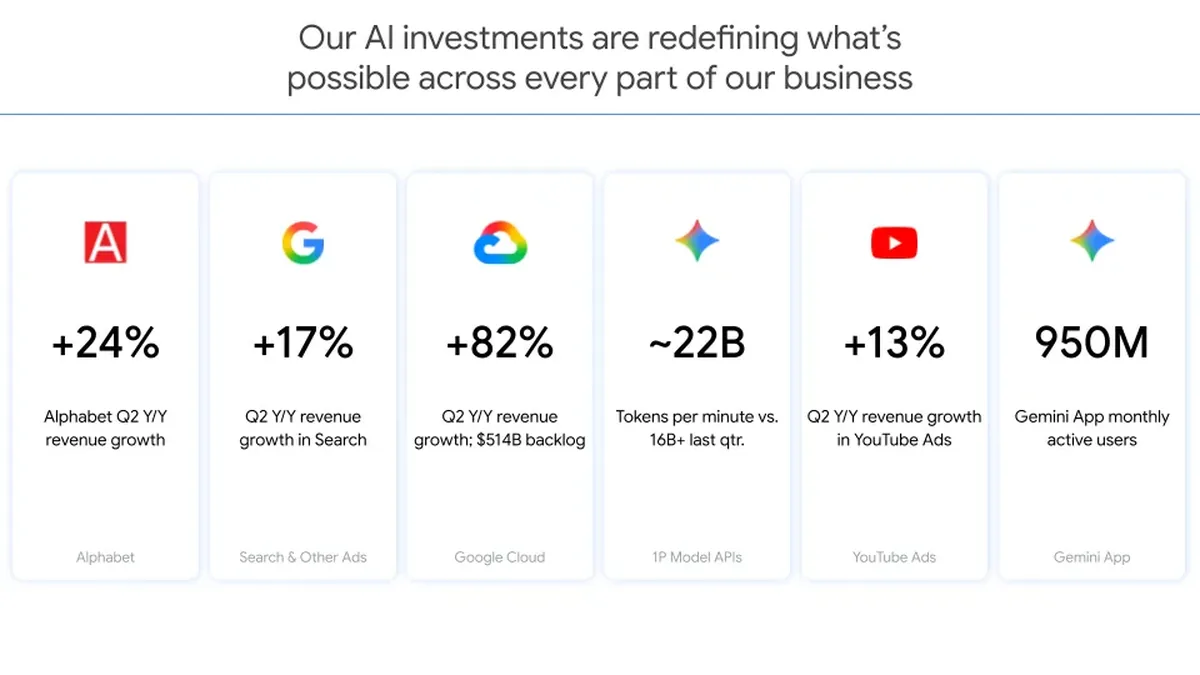
Alphabet's Q2 2026 results make Google's enormous AI buildout easier to defend commercially: Google Cloud revenue jumped 82% year over year to $24.8 billion, Cloud operating income reached $8.8 billion, and the division's backlog rose to $514 billion. The results do not prove that every dollar of AI capex will earn an attractive return, but they show a rapidly growing business attached to the infrastructure Google is building.
Definition: Google's AI spending thesis is the idea that data centers, chips, models, and software can become revenue through Cloud, enterprise products, advertising, and consumer AI.
Example: Google Cloud is selling AI infrastructure and enterprise AI solutions to organizations that need compute, models, security, and tools to build or run AI agents and automated workflows.
Key takeaway: Cloud is becoming the clearest public evidence that Google's AI investment is producing monetizable enterprise demand, not only research capability or consumer-product experimentation.
Business impact: Businesses evaluating Google Cloud should watch both the demand signal and the capacity question: the backlog is large, but Google must still deliver the infrastructure and preserve profitable growth as AI usage scales.
What did Google's Q2 2026 earnings show?
Alphabet's Q2 2026 results showed broad growth, but Google Cloud was the standout. In the quarter ended June 30, Alphabet revenue increased 24% to $119.8 billion, while Google Services revenue rose 15% to $94.5 billion. Google Cloud revenue increased 82% to $24.8 billion, according to Alphabet's official earnings release.
Google Cloud's operating income increased from $2.8 billion in Q2 2025 to $8.8 billion in Q2 2026. That combination—rapid revenue growth plus a much larger operating contribution—gives Alphabet a stronger answer to investors asking how AI infrastructure will eventually pay for itself.
| Metric | Q2 2025 | Q2 2026 | Change |
|---|---|---|---|
| Google Cloud revenue | $13.6B | $24.8B | +82% |
| Google Cloud operating income | $2.8B | $8.8B | +212% |
| Alphabet total revenue | $96.4B | $119.8B | +24% |
| Google Services revenue | $82.5B | $94.5B | +15% |
Why does the cloud backlog matter?
Google Cloud's backlog reached $514 billion, a future-revenue indicator that shows how much contracted work remains to be recognized. Alphabet said the backlog increased by more than $50 billion sequentially and that just over half should be recognized as revenue over the next 24 months.
Backlog is not the same as revenue, cash, or guaranteed profit. Customers can change plans, delivery can be delayed, and Google still has to supply the compute capacity behind the contracts. Even with those limits, a $514 billion backlog gives Alphabet more visibility into demand than a collection of AI demos or early user experiments would provide.
What is driving Google Cloud's AI demand?
Google says the acceleration is coming from a full-stack portfolio: Google Cloud Platform, enterprise AI solutions, enterprise AI infrastructure, and core cloud services. The company is selling more than model access; it is combining chips, data-center capacity, Gemini models, security, analytics, and enterprise software into one purchasing relationship. Background: 10 Cloud Platforms Built for AI Workloads.
Alphabet CEO Sundar Pichai said the company is seeing demand across products, customers, geographies, and industries. In his Q2 earnings-call remarks, Pichai said Google Cloud is winning new customers, expanding usage with existing customers, and growing through partners. He also described Gemini Enterprise as a platform for building agents, automating processes, connecting enterprise systems, managing costs, and applying governance controls.
That packaging matters for operators. A company deciding how to deploy an AI workflow is often buying an infrastructure-and-control plane, not just a chatbot. The commercial opportunity is therefore spread across model usage, storage, networking, security, developer tooling, and the ongoing operation of the workflow.
How large is Gemini adoption?
Google reported adoption at both the enterprise and consumer layers. Nearly 90% of the Fortune 100 are using Gemini Enterprise, according to Alphabet. The company also said the Gemini app reached 950 million monthly active users and that its model APIs were processing approximately 22 billion tokens per minute, up from 16 billion one quarter earlier.
These are company-reported adoption metrics, not independent audits of usage quality or economic return. Still, they show why Alphabet can spread AI infrastructure costs across multiple demand channels: Cloud customers consume compute and enterprise tools, developers use model APIs, and consumers use Gemini features inside Google's broader product ecosystem.
What does Google's spending still need to prove?
Google's Q2 results improve the revenue side of the AI investment argument, but the spending side remains enormous. TechCrunch reported that Alphabet's annual capital-expenditure estimate was between $180 billion and $190 billion and that analysts pressed Pichai on when those investments would pay off.
The central risk is not whether customers want AI compute today; the results suggest they do. The harder question is whether Alphabet can keep expanding capacity, meet contracted demand, maintain margins, and earn an attractive return as hardware cycles, model economics, and customer usage patterns change.
Google also has to distinguish between revenue that benefits from AI demand and revenue that directly pays back a particular infrastructure investment. Cloud growth can support the overall strategy while individual data-center projects, accelerator purchases, or model launches still have different economics.
What should enterprise buyers watch next?
Enterprise buyers should treat Google's results as a demand signal, not as a reason to skip their own deployment analysis. The most useful questions are operational:
- Which workflows require dedicated AI infrastructure rather than a standard model API?
- How will usage scale if an agent, search feature, or automation becomes popular?
- Which costs are variable with tokens, storage, and tool calls, and which are committed in advance?
- What security, governance, and evaluation controls are included in the platform?
- How easily can a team move a workload if a model, accelerator, or pricing assumption changes?
Google's integrated stack can reduce the number of vendors an enterprise has to connect, but it can also increase platform dependence. The right decision depends on workload predictability, data boundaries, latency, portability requirements, and the cost of operating the system after the pilot.
What Google's cloud boom changes about the AI spending debate
Google's AI spending is no longer supported only by a promise that better models will eventually create value. Google Cloud's 82% growth, $8.8 billion operating profit, and $514 billion backlog show a measurable enterprise business forming around AI infrastructure and solutions. More on this: Google Ads AI tools speed up marketing analysis. Related reading: Google AI Targets the Forward-Deployed Bottleneck. More on this: Google AI Agents Target Forward-Deployed Engineering Work.
The evidence is encouraging, but it is not a blank check. Alphabet still has to convert contracted demand into delivered revenue, protect margins while expanding capacity, and show that its full-stack approach creates durable returns rather than simply moving money between its own products. For the rest of the market, Google's quarter is an important test case: AI capex looks easier to justify when cloud customers are paying for the infrastructure, but the payoff still has to survive the next investment cycle. More on this: AI’s finally expensive enough to make Wall Street nervous.
Frequently asked questions
Why is Google Cloud important to Google's AI spending story?
Google Cloud gives Alphabet a direct way to monetize demand for AI infrastructure and enterprise AI solutions. In Q2 2026, Google Cloud revenue increased 82% year over year to $24.8 billion, while its operating income reached $8.8 billion. The growth does not prove that every AI investment will pay off, but it shows that enterprise cloud demand is already becoming a material revenue and profit channel.
How fast did Google Cloud grow in Q2 2026?
Google Cloud revenue increased 82% year over year to $24.8 billion in the quarter ended June 30, 2026, up from $13.6 billion in the same quarter a year earlier. Alphabet attributed the acceleration to Google Cloud Platform, enterprise AI solutions, enterprise AI infrastructure, and core cloud services. Google Cloud operating income increased from $2.8 billion to $8.8 billion.
What does Google's $514 billion cloud backlog mean?
Google Cloud's $514 billion backlog represents contracted work that has not yet been recognized as revenue. Alphabet said the backlog grew by more than $50 billion sequentially and that just over half is expected to be recognized as revenue over the following 24 months. Backlog is not the same as cash already collected, so it provides visibility into future revenue but does not eliminate delivery, capacity, or customer-concentration risk.
Is Google's AI spending risk-free after this earnings report?
No. Strong Cloud growth improves the commercial case for Google's AI infrastructure, but Alphabet still has to keep investing heavily in data centers, chips, and compute capacity while converting demand into durable margins and cash flow. Investors also need to separate company-reported adoption metrics from independently verified returns on each AI investment.
Alex
Founder & Lead AI Writer
Alex is the founder of Yowox and lead AI writer since 2024, breaking down complex information into clear, actionable insights for thousands of readers every day. Alex has built AI automation systems for businesses since 2024, focusing on AI agents, workflow automation, and business process optimization.
Save hours. Save thousands.
Practical guides, real workflows, and the latest AI and automation news that matters — straight to your inbox.