 By Alex
 Google AI Targets the Forward-Deployed Bottleneck
Google says AI can automate part of the forward-deployed engineering job, while Google Cloud is still hiring engineers to turn enterprise AI pilots into production systems.
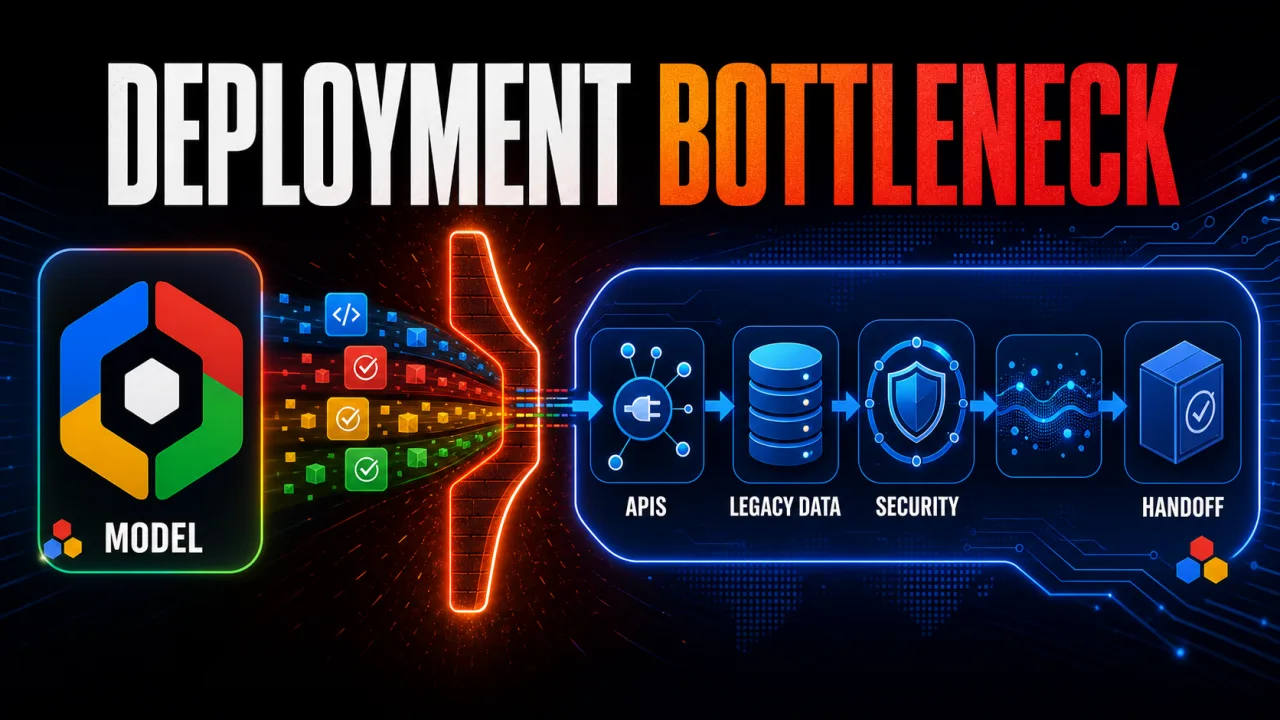
Google says AI can automate part of the work done by forward-deployed engineers, even as Google Cloud plans to hire hundreds of those engineers to help customers build AI applications, according to The Information. The tension is the story: AI may reduce the repeatable work inside deployment, but production adoption still has a customer-specific bottleneck.
Definition: A forward-deployed engineer is an embedded builder who connects an AI product to a customer's real systems and ships the result.
Example: Google Cloud's current job description says its FDEs code, debug and jointly deploy bespoke agentic solutions inside customer environments.
Key takeaway: Google's claim is about automating some FDE tasks, not proving that the whole role has disappeared.
Business impact: Companies buying enterprise AI should evaluate both the model and the deployment capacity needed to make that model reliable in their own workflows.
What is Google actually claiming?
The Information's report presents Google's position as an automation claim: AI can handle some work that forward-deployed engineers traditionally perform. The report does not, in the accessible material, establish a percentage of the job that AI can do or show that Google has eliminated the human role. Operators should therefore read the announcement as a claim about task substitution, not as evidence that customer-facing engineering has become fully autonomous.
That distinction matters because a forward-deployed engineer is not simply a person who writes code faster. The role sits between a frontier model and an enterprise's messy reality: incomplete data, existing APIs, security boundaries, internal approval paths and a business process that may not be documented. The difference between an AI agent and a chatbot is useful context here: taking action is only valuable when the action is connected to the right systems and constraints.
Why is Google still hiring FDEs?
Google Cloud's hiring push shows that Google still treats deployment as a human-intensive growth constraint. Channel Dive reported that Google Cloud listed 59 related roles across the United States and overseas, and quoted the company saying the expansion would provide engineers to move enterprises beyond experimentation into full-scale AI operations. The same report quoted CEO Thomas Kurian saying demand from customers and partners for Google enterprise AI products and help with agent development was growing rapidly. Channel Dive's report makes the hiring side explicit. Background: Google Cloud revenue rose 82% to $24.8 billion.
Google's own Forward Deployed Engineer III listing describes an embedded builder who bridges frontier AI products and production-grade reality inside customer organizations. The responsibilities include connecting Google's products to APIs, legacy data silos and security perimeters; building evaluation and observability systems; and turning repeated field problems into reusable modules or product requests. Those are concrete deployment tasks, not just sales support.
The two moves are compatible. Google can use AI to accelerate discovery, generate integration code, draft evaluations or document a deployment while keeping engineers responsible for architecture, security, testing and the final handoff. The enterprise agent deployment gap is exactly where that division becomes visible: a capable model does not remove the work of fitting an agent into a governed operating environment.
Which FDE tasks are easiest to automate first?
The most automatable FDE tasks are likely to be repeatable implementation steps rather than customer judgment. Google's job listing names data pipelines, agentic workflows, evaluation, observability and reusable modules; those descriptions point to work where an AI system could generate scaffolding, suggest mappings, create test cases or summarize recurring friction. This is an inference from the listed responsibilities, not a published Google measurement, so buyers should test it against their own deployment logs rather than assume the automation exists.
The harder layer is deciding what the system should do and whether it is safe to let it do it. A customer may need an engineer to resolve conflicting definitions, choose which legacy data is authoritative, negotiate access across security boundaries, or decide whether an evaluation result is good enough for production. Those decisions carry business and operational context that a generic model cannot infer reliably from a prompt. AI can shorten the path from a known requirement to a working artifact; it does not automatically supply the requirement or the accountability.
Does this mean the FDE role is disappearing?
Google's actions do not support that conclusion. The Information's reported automation claim sits beside an active recruiting push, while Google's public job descriptions continue to emphasize embedded engineering, customer discovery, production integration and feedback to product teams. That combination points to a role being reshaped around higher-leverage work, not a role already made redundant.
The longer-term question is whether repeated deployments become standardized enough for the engineering layer to shrink. If Google turns common integration patterns into reliable agent workflows, customers may need fewer hours of bespoke implementation per project. If every enterprise still brings different data, permissions and risk tolerances, human FDEs may remain the bridge between a general platform and a specific business. Businesses should plan for both possibilities: automate the repeatable layer, but keep an owner for production behavior and customer context.
What should enterprise AI buyers watch next?
The next useful evidence is not another statement that AI can help with deployment. Buyers should look for named production deployments, measured reliability and adoption, documented handoffs to customer teams, and a clear account of which tasks were automated. Google's hiring announcement establishes demand for deployment capacity; it does not by itself prove that AI has lowered the cost or time of deploying an agent.
For now, the practical conclusion is narrow but important: Google is treating forward-deployed engineering as both a bottleneck to automate and a capability to expand. Companies evaluating Google Cloud or another enterprise AI platform should ask who owns integration, data readiness, evaluation, observability and the production handoff. The answer will tell them more about delivery risk than the model name alone.
Frequently asked questions
What is a forward-deployed engineer?
A forward-deployed engineer is an embedded builder who works inside a customer's environment to turn an AI product into a production system. Google's job description says the role goes beyond high-level advice: the engineer codes, debugs, integrates live infrastructure and ships a bespoke agentic solution with the customer. The role also feeds field problems back into the product team, so it combines engineering, customer discovery and product feedback.
What did Google say AI can do for forward-deployed engineering?
The Information reported that Google says its AI can automate some of the work performed by forward-deployed engineers. That is a narrower claim than saying AI can replace the role. The available reporting does not establish that Google has removed the need for human engineers, nor does it provide a measured automation rate. The practical interpretation is that Google is testing how agents can absorb repeatable implementation work while people handle customer context, production risk and judgment.
Why is Google still hiring forward-deployed engineers?
Google is still hiring because enterprise deployment includes work that depends on a customer's systems and constraints. Google's listings name integration with APIs and legacy data, security perimeters, evaluation, observability, data readiness and state management. Those responsibilities are not solved by a model capability alone. For buyers, the hiring push is evidence that Google sees human deployment capacity as part of scaling AI, even while it explores automating pieces of that capacity.
What should businesses watch next?
Businesses should watch for evidence that Google can move from AI-assisted implementation to repeatable production outcomes. Useful signals include named customer deployments, measurable reliability or adoption results, clear handoff practices and fewer weeks spent on integration and data readiness. Until Google publishes that evidence, the responsible reading is that AI may reduce parts of forward-deployed work, not that it has made the customer-facing engineering role unnecessary.
Alex
Founder & Lead AI Writer
Alex is the founder of Yowox and lead AI writer since 2024, breaking down complex information into clear, actionable insights for thousands of readers every day. Alex has built AI automation systems for businesses since 2024, focusing on AI agents, workflow automation, and business process optimization.
Save hours. Save thousands.
Practical guides, real workflows, and the latest AI and automation news that matters — straight to your inbox.