 By Alex
 AI’s finally expensive enough to make Wall Street nervous
Alphabet’s higher AI infrastructure spending is forcing investors to ask whether the industry can turn larger data-center bills into durable revenue and cash flow.
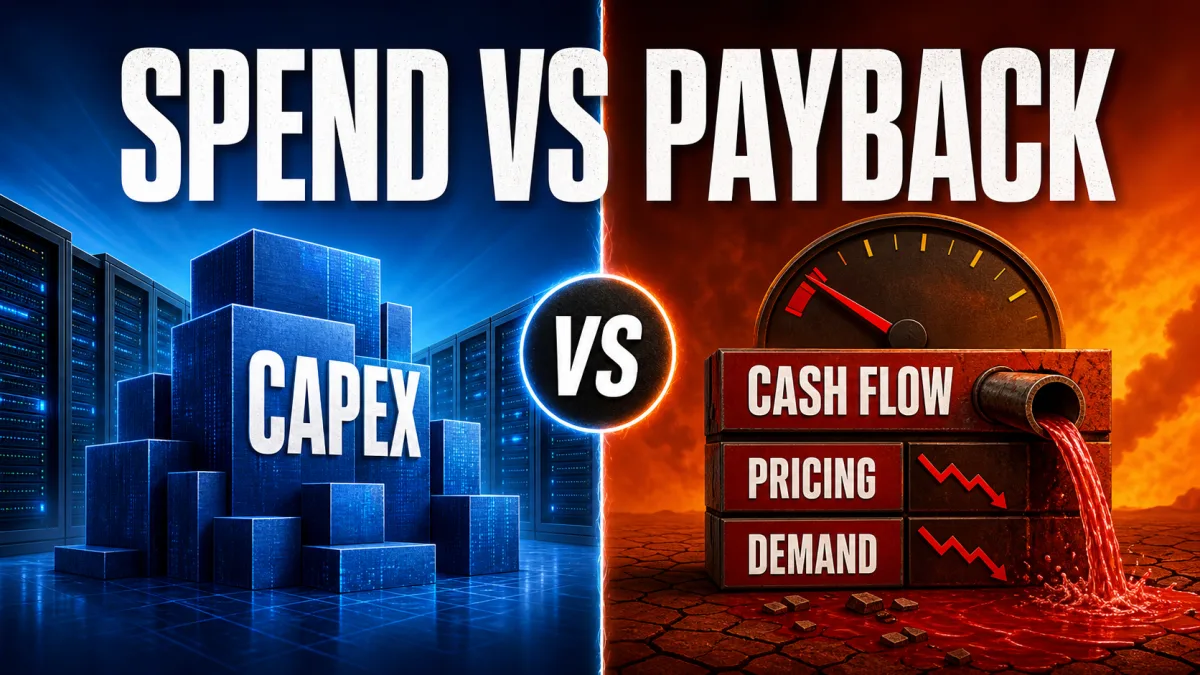
The AI infrastructure boom has reached the point where spending itself is becoming a market risk. Alphabet raised its 2026 capital-expenditure forecast to $195 billion–$205 billion, up from $180 billion–$190 billion, and the change made investors question whether the industry can convert ever-larger data-center bills into durable revenue and cash flow. The Verge’s report connects Alphabet’s higher forecast with pricing pressure, Chinese competition and a broader fear of overbuilding.
Definition: AI capex risk is the possibility that infrastructure spending grows faster than the revenue, margins and cash flow needed to justify it.
Example: Alphabet can unsettle investors when its spending range rises beyond the previous top end while cash flow turns negative.
Key takeaway: AI demand is no longer enough by itself; investors want evidence that new capacity earns an acceptable return.
Business impact: Companies planning AI infrastructure should treat utilization, workload economics and financing as operating metrics, not as details to review after the buildout.
Why did Alphabet’s capex increase unsettle investors?
Alphabet’s higher spending forecast unsettled investors because the company appeared to be revising its cost outlook while the economic payoff from the buildout was still being debated. The Verge reports that Alphabet moved its 2026 capex range to $195 billion–$205 billion from $180 billion–$190 billion and that even the new lower end exceeded the previous top end. The issue for shareholders is not that a profitable technology company is investing; it is that the investment is becoming harder to forecast and easier to compare against uncertain future returns.
Alphabet’s spending also arrived with a cash-flow problem. The Verge reports that Alphabet was spending more money than it was making. That combination changes the investor question from “Is AI demand real?” to “When does the demand pay back the infrastructure required to serve it?”
What does the market reaction say about AI infrastructure?
The market reaction says that hyperscaler capex is moving from a simple growth signal to a test of financial discipline. The Verge reports that investors were getting cold feet about the AI trade and that Meta, Amazon and Microsoft were due to report after Alphabet. A spending increase that once looked like proof of demand can now look like a commitment that needs to be financed and monetized.
Hyperscaler capex scrutiny does not mean the data-center buildout has stopped. It means the standard for a convincing result is changing. Investors want capacity to show up in revenue, profit and cash generation, not only in construction plans or management commentary about future demand. The same principle applies to enterprise AI: the cost of compute is useful only when tied to a completed workload and measurable outcome.
Why do model prices make the spending problem harder?
Model-price pressure makes the spending problem harder because infrastructure owners may be asked to invest more while customers expect the cost of using AI to fall. The Verge describes competitive pressure from Chinese AI tools and pressure to keep model prices low. If prices decline faster than utilization and demand increase, a company can spend more on the systems behind each model while collecting the same revenue per unit or less.
AI infrastructure can still produce weak returns even when demand is genuine. An AI data center can be full and still underperform if the services running inside it are priced below their total cost. The relevant unit is therefore not “how many GPUs were purchased” or “how many tokens were generated.” It is the margin and cash flow produced by the workloads those assets support.
What is circular financing, and why does it matter here?
Circular financing is a structure in which companies in the same AI ecosystem provide capital, guarantees or demand to one another, making the market’s underlying demand harder to read. The Verge points to Nvidia’s discussions around a combined three-quarters of a trillion dollars in deals and specifically describes a possible $250 billion guarantee for OpenAI debt as both a demand signal and a reminder of funding strain.
Circular financing is not automatically unsound. The concern is signal quality: if a chip supplier helps finance infrastructure bought by a major customer, reported demand can include a financial relationship between the supplier and the buyer. Investors therefore need to distinguish end-user demand from capital circulating inside the buildout.
What should businesses learn from the Wall Street reaction?
Businesses should learn that AI infrastructure needs an economic control layer before it needs another purchase order. That means measuring utilization, cost per completed task, model and API spend, storage, data transfer, engineering, monitoring, quality and human review. A useful AI automation ROI model counts the full operating cost rather than treating the model bill as the whole business case.
Businesses should separate a measured bottleneck from the assumption that more capacity must be better. A new cluster, provider or model is easier to justify when a business can state which measured constraint it removes, which workload it improves and what outcome will pay for it. Without that chain, AI infrastructure expansion is partly a market bet.
What happens next for the AI market?
The next test is earnings season. Meta, Amazon and Microsoft were due to report after the Alphabet result, and investors were watching for more upward capex revisions or evidence that existing commitments were producing enough revenue. Reassuring results could make the latest anxiety temporary. More spending with weaker cash conversion would make the concern harder to dismiss.
The current AI infrastructure market is no longer judged only by the size of the opportunity it serves. It is being judged by the quality of the financial machine underneath it. The companies that can connect compute to durable revenue, sensible pricing and cash flow will keep the benefit of the boom. The rest may discover that being early to build is not the same as being early to profit.
Frequently asked questions
Why are investors nervous about AI spending now?
Investors are nervous because Alphabet raised its 2026 capital-expenditure forecast to $195 billion–$205 billion after previously guiding to $180 billion–$190 billion, while also reporting a quarter with negative cash flow. The concern is not simply that AI infrastructure is expensive. It is that spending is accelerating while model prices face pressure and the return on new data centers remains uncertain. A larger budget therefore creates a higher proof requirement: companies must show that capacity becomes revenue, margin and cash generation rather than only a bigger construction program.
What did Google change in its AI capex forecast?
Alphabet increased its 2026 capital-expenditure range to $195 billion–$205 billion from the previous $180 billion–$190 billion range. The Verge reports that even the lower end of the new range was above the earlier top end. The change matters because it suggests the company is still revising its cost outlook upward as it expands AI data-center capacity. The updated forecast makes the timing and economics of that investment more visible to shareholders.
Is this evidence that the AI boom is over?
No. The market reaction is evidence of higher scrutiny, not proof that AI demand has disappeared. The Verge’s report does not say the AI market has ended; it describes a period in which investors are becoming more selective, while other large technology companies may report results that reassure investors. The narrower conclusion is that enthusiasm no longer protects every AI infrastructure investment from questions about utilization, pricing, financing and free cash flow. The next phase of the boom has to demonstrate operating economics, not only demand for compute.
What should businesses watch in the next AI infrastructure cycle?
Businesses should watch cost per completed workload, utilization, model pricing, data-center commitments, financing structure and the revenue attached to each infrastructure investment. A lower token price or a larger backlog is not enough on its own. The useful test is whether a real workload can be delivered at an acceptable quality and latency while producing measurable value after compute, storage, engineering, monitoring and human-review costs are included. That is the same discipline companies need before expanding their own AI stack.
Alex
Founder & Lead AI Writer
Alex is the founder of Yowox and lead AI writer since 2024, breaking down complex information into clear, actionable insights for thousands of readers every day. Alex has built AI automation systems for businesses since 2024, focusing on AI agents, workflow automation, and business process optimization.
Save hours. Save thousands.
Practical guides, real workflows, and the latest AI and automation news that matters — straight to your inbox.