 By Alex
 Ramp Router brings model routing to AI teams
Ramp Router gives U.S. developers one API for several AI models, routing requests by cost and performance while exposing spend, latency and fallback data in one dashboard.
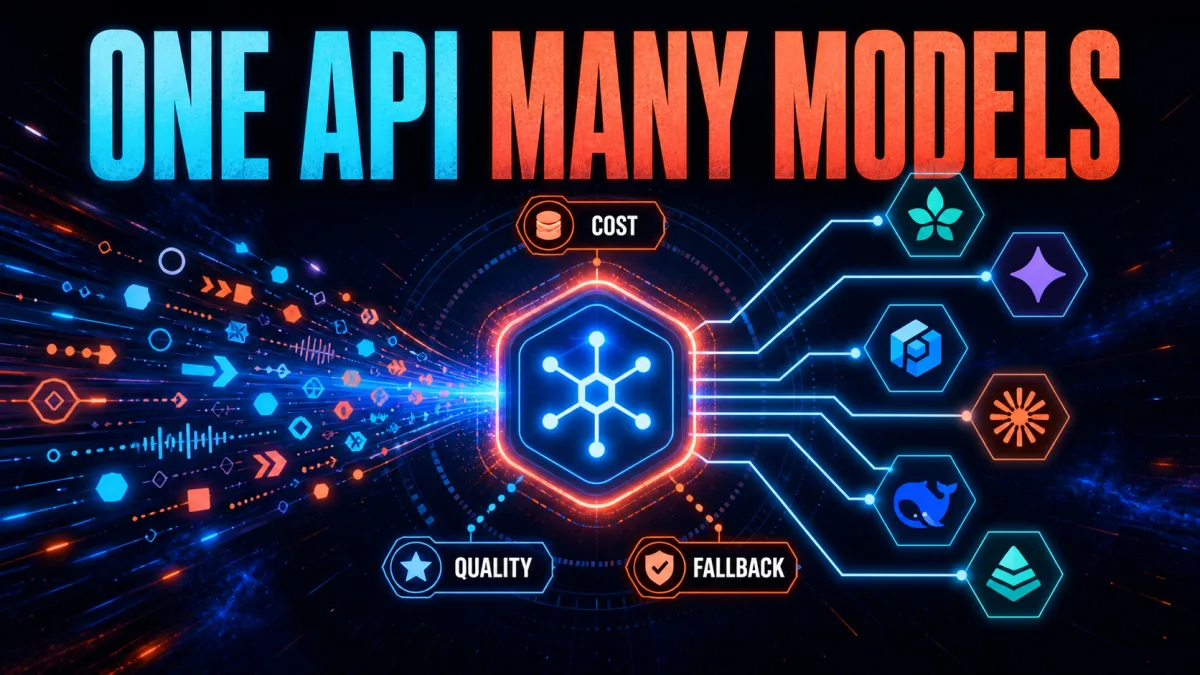
Ramp Router is a new AI model-routing service that lets developers and companies switch among large language models through one API. TechCrunch reports that Ramp opened Router in the United States after using the system for its own AI needs for three years; the practical takeaway is that teams can centralize model choice instead of wiring every application directly to one provider.
Definition: Ramp Router is an API layer for accessing and routing requests across multiple AI models.
Example: A team can route difficult requests to a more expensive model while testing or sending routine work through cheaper options.
Key takeaway: Router turns model selection into a configurable operating decision rather than a hard-coded integration.
Business impact: A single routing layer can give engineering and finance one place to inspect model usage, cost, latency and fallbacks.
What does Ramp Router change for model access?
Ramp Router changes model access by putting several providers behind one API for U.S. users and companies at launch. Ramp Router supports models from OpenAI, Anthropic, DeepSeek, Moonshot, Minimax, Nvidia, xAI and Z.ai, while TechCrunch notes that OpenRouter offers a broader catalog; teams evaluating the service should therefore treat Router as a focused alternative, not a complete replacement for every multi-model gateway.
The integration model matters because switching providers can otherwise spread credentials, request formats and monitoring across each application. Ramp Router gives a team one routing surface to evaluate, change and observe model traffic, while the application keeps using the routing layer; that is the same architectural separation described in the AI automation stack, where the model is one layer inside a larger production system. Related reading: Runway launches AI model router as generative media gets crowded.
Which routing strategies does Router offer?
Ramp Router offers routing strategies that let teams choose how requests should be assigned to models. The launch coverage describes a flexible-tier preference, benchmark-based selection using up to three user-specified benchmarks, difficult-problem escalation to expensive models, and model testing without changing the application route; the concrete takeaway is to choose a strategy that matches the workload's quality and cost constraints rather than relying on one global default. More on this: Cursor Router picks a model per request to cut cost.
| Router strategy described in the launch | What it is meant to do | Decision a team still needs to make |
|---|---|---|
| Flexible usage tiers | Prefer a provider tier when it fits the team's preference | Is lower price worth less predictable latency? |
| Benchmark routing | Choose among models using up to three selected benchmarks | Which quality signals represent the real workload? |
| Difficult-problem routing | Reserve expensive models for harder requests | How should difficulty be detected and reviewed? |
| Model testing | Compare models without changing the application route | Which result is good enough to move into production? |
These strategies place Router in the broader category of semantic routing, where a system dispatches work according to signals such as intent, complexity or cost. Ramp Router's documented launch examples are model- and provider-oriented, so teams should measure the complete path—route decision, selected model, fallback and final task result—rather than treating a cheaper backend call as automatic savings.
What can teams see in the Router dashboard?
Ramp Router includes a dashboard that shows token spend, cost, latency, fallback attempts and other request details. That visibility gives engineering teams evidence about how routing behaves and gives finance teams a way to inspect AI usage at the request layer; the practical next step is to review these fields against completed-task quality, not only against token volume.
A routing dashboard is useful only when it explains the trade-off behind a decision. If a cheaper model causes more retries, slower completion or additional human correction, the lower token bill may not reduce the cost of the finished workflow. Teams can use the measurement discipline in this AI automation ROI guide to compare route-level spend with review time, exceptions and accepted outcomes.
What are Router's launch terms?
Ramp Router is available only in the United States at launch and is free to use through the end of 2026, while customers still pay the underlying inference costs. TechCrunch also reports a $26 credit offer and says Ramp had not disclosed how much the service would cost in 2027; U.S. teams can test the integration during the free-routing period, but a production plan should not assume the introductory terms continue.
The launch terms lower the barrier to evaluating a multi-model route, but they do not remove the main procurement questions. A team still needs to check provider availability, model quality, data handling, fallback behavior and the cost of moving away if future pricing changes; the temporary offer is an evaluation window, not evidence of long-term economics.
How does Router connect to Ramp's existing business?
Ramp Router extends Ramp's existing focus on AI token usage monitoring and token-spend management into model selection. TechCrunch describes a two-sided opportunity: Ramp can participate in the AI inference market while offering its existing clients a routing service that fits with its spend-management products; the business implication is that model routing can become both an engineering control plane and a finance control surface.
That positioning also explains why Router is more than a list of model endpoints. Ramp is presenting the service as a way to choose models, observe the request economics and manage the resulting spend in one environment; companies should still verify whether that combined workflow fits their own finance controls instead of assuming that a provider gateway automatically solves governance.
What should operators check before using Router?
Operators considering Ramp Router should test the service on a fixed workload and compare it with the current provider route. The comparison should include accepted-task quality, token cost, total latency, fallback frequency, model availability and human correction; those measures reveal whether routing improves the completed workflow rather than only reducing the price of an individual inference call.
Data retention is another launch-level constraint for Ramp Router. TechCrunch reports that Router records model inputs, outputs and tool calls for one year by default under an opt-out retention policy, while Ramp says it removes personally identifiable information before using that content to improve the product; teams handling sensitive data should review the service terms and choose an appropriate retention posture before sending production traffic.
What remains uncertain about Ramp Router?
The main unanswered question is how Router's economics will look after the 2026 launch period. TechCrunch reports that Ramp had not said what the service will cost next year, while the current offer still leaves customers responsible for model inference; the sensible decision is to test Router now, record the route-level baseline and avoid treating the introductory credit as a permanent cost advantage.
Ramp Router's launch shows that model choice is becoming an operating layer for AI applications, but the product's value will depend on evidence from each workload. Teams that can connect model selection to quality, latency, fallbacks and spend will be better placed to decide when a router improves production—and when a direct provider integration remains simpler.
Frequently asked questions
What is Ramp Router?
Ramp Router is an AI model-routing service that gives developers and companies one API for using and switching between several large language models. Router can choose a model according to configured strategies, such as cost, performance benchmarks or task difficulty, instead of sending every request to one fixed provider. Ramp says it built the infrastructure for its own AI usage before opening the service to customers. The launch is initially limited to the United States.
Which models does Ramp Router support?
Ramp Router supports models from OpenAI, Anthropic, DeepSeek, Moonshot, Minimax, Nvidia, xAI and Z.ai, according to the launch coverage. Router currently offers fewer model options than OpenRouter, which provides a similar model-switching layer. The available catalog can change, so teams should verify the current supported-model list before designing a production dependency around a specific provider.
How does Ramp Router choose a model?
Ramp Router offers strategies that let users express different routing preferences. One strategy can favor providers' flexible usage tiers, another can rank models against up to three user-selected benchmarks, and others can reserve expensive models for difficult problems or make model testing easier without changing an application's integration. The right strategy depends on the workload's quality, latency and cost limits, so a team should compare routed results with its existing fixed-model route.
How much does Ramp Router cost?
Ramp Router is free to use in the United States for the remainder of 2026, but customers still pay the underlying AI model inference costs. The launch also includes a $26 credit offer. Ramp had not announced the service's pricing for the following year in the launch coverage, so teams planning a longer-term migration should treat the 2026 offer as temporary and confirm future terms before moving production traffic.
Alex
Founder & Lead AI Writer
Alex is the founder of Yowox and lead AI writer since 2024, breaking down complex information into clear, actionable insights for thousands of readers every day. Alex has built AI automation systems for businesses since 2024, focusing on AI agents, workflow automation, and business process optimization.
Save hours. Save thousands.
Practical guides, real workflows, and the latest AI and automation news that matters — straight to your inbox.