 By Alex
 Runway launches AI model router as generative media gets crowded
Runway is turning model selection into a product with Media Router, a developer tool that chooses image, video or audio models by balancing quality, speed and cost as generative media becomes more fragmented.
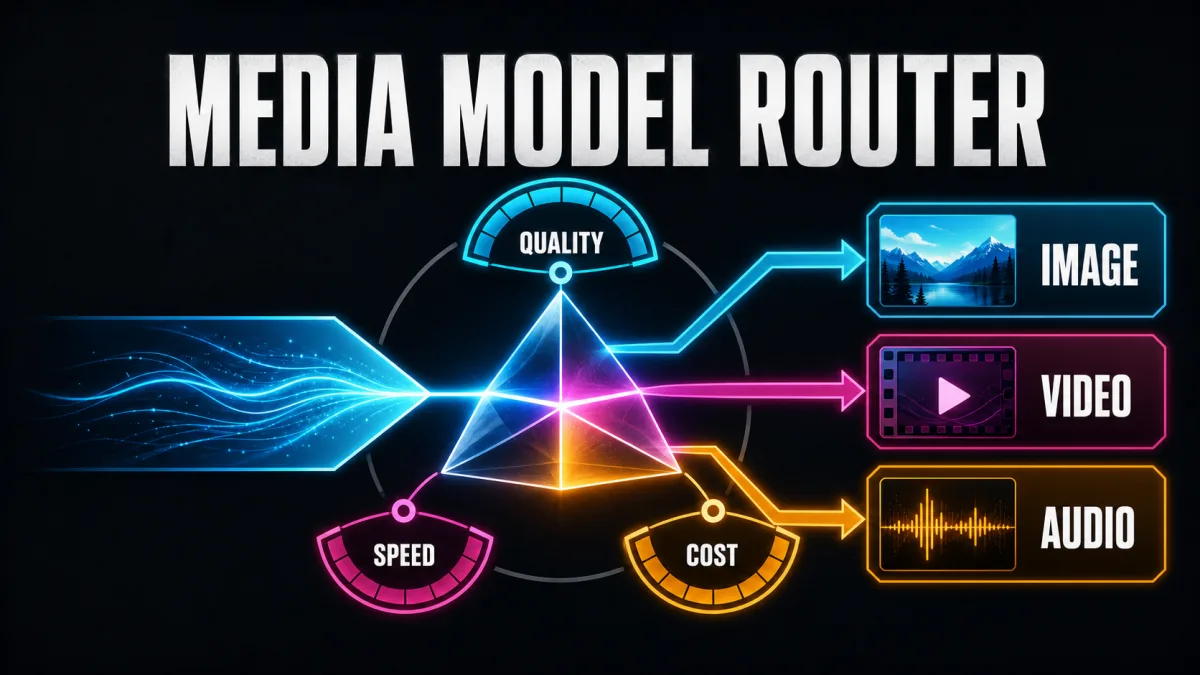
Runway is moving from being judged mainly as an AI video model company to selling the layer that helps developers choose among many generative media models. The company has launched Media Router through Runway Dev, its developer platform, as image, video and audio systems become more numerous and harder to compare.
Definition: Media Router is a model-selection tool for generative media requests.
Example: A developer can prioritize output quality, speed or cost instead of hard-coding one image, video or audio model for every request.
Key takeaway: Runway is packaging model evaluation and orchestration as infrastructure.
Business impact: If the router works, teams can experiment with new media models without rebuilding their product integration every time the leaderboard changes.
What Runway launched
According to TechCrunch’s report, Runway Media Router automatically chooses an image, video or audio generation model for a request. The selection is guided by the developer’s priorities, including quality, speed and cost.
The router is available through Runway Dev, the company’s API platform. Runway Dev gives developers access to Runway’s own models and a growing set of third-party models from the same integration layer. That means a company building a creative product can expose generation capabilities without asking its users to visit Runway’s consumer application.
Runway says Media Router is the first model router built specifically for generative media. Model routing is already familiar in language-model infrastructure, where a system can send simple requests to a cheaper model and reserve more capable models for harder work. Media generation adds a different problem: quality depends on the kind of output being created, not only on the complexity of the prompt. Background: Top 10: AI Platforms in Media. More on this: Cursor Releases Cursor Router: A Request-Level Classifier Delivering Frontier Coding Quality at 30–50% Lower Cost. Related reading: Ramp Router brings model routing to AI teams.
Why media routing is harder than choosing an LLM
For language models, a team can compare responses against a shared evaluation set, then tune a router around accuracy, latency, price and task type. Generative media needs a broader visual and production judgment.
A video model might be strong at motion but weak at consistency across shots. An image model might create attractive compositions but struggle with typography or precise edits. An audio model might produce convincing speech but fail at timing, pronunciation or lip synchronization. The best choice changes with the requested output and the acceptable trade-offs.
Runway’s product chief told TechCrunch that the company’s internal creative team has developed expertise in evaluating outputs across media types. The stated goal is to turn that expertise into a routing layer that can match a request to a model instead of making each developer maintain the same evaluation process independently.
The practical selection problem looks like this:
| Routing concern | Question a product team must answer |
|---|---|
| Quality | Which model produces an acceptable result for this exact type of image, video or audio? |
| Speed | How much latency can the user experience tolerate? |
| Cost | What generation price fits the product’s economics? |
| Consistency | Does the model preserve style, characters, motion or voice across a larger workflow? |
| Control | Which providers, regions or policies may the system use? |
These factors do not produce one universal winner. They produce a decision for a particular request.
Runway is selling an orchestration position
The launch is strategically important because Runway’s strongest position may no longer come from owning the single most capable video model at every moment. The generative-media market now includes models from large technology companies, specialist startups and providers based in different regions. A developer that commits to only one model risks rebuilding its stack whenever a better or cheaper option appears.
A router changes the relationship. Runway can remain useful even when the best model for a particular task comes from somewhere else, provided developers trust Runway to evaluate the options and select them intelligently. The company’s role shifts from model vendor to platform and inference-layer operator.
Runway’s broader platform strategy already points in that direction. TechCrunch reports that companies including Adobe, Cloudflare, ElevenLabs, Expedia, Shutterstock and Quora use Runway’s developer infrastructure to add media generation to their own products. The opportunity is not only to sell a creative application; it is to become the infrastructure behind other companies’ creative workflows.
That is a more durable ambition than a single leaderboard win, but it also creates a new dependency. The router’s value is only as strong as its evaluation data, provider coverage, request classification and failure handling.
Preferences become part of the product
The obvious routing controls are quality, speed and cost. The story also points to a wider set of constraints that enterprise developers may care about.
A company may prefer one provider because of price, another because of output quality and a third because of regional, contractual or policy requirements. Runway’s product chief told TechCrunch that customers are interested in routing by token pricing and quality, while the company also discussed provider preferences as generative media becomes more geopolitically and commercially fragmented.
This is familiar territory for enterprise software. “Best model” rarely means the highest score in isolation. It can mean the best model that fits a budget, passes an internal review, meets latency targets, is available in the required region and produces output that editors will actually approve.
The router therefore has to expose trade-offs rather than hide them. A black-box choice that quietly changes providers may be convenient, but it is difficult to audit when costs rise, output style shifts or a model changes its terms.
The risk of routing every problem away
Model routing is not automatically a quality improvement. It can create a new layer of complexity between a user’s request and the output they receive.
A weak router may send a prompt to the wrong model, optimize for price when the task needs consistency, or choose a visually impressive first frame that fails across a multi-scene campaign. A team may also lose the ability to explain why two similar requests produced different results if the routing decision is not recorded.
A production implementation should preserve at least four pieces of context:
- the request type and required output;
- the models considered and the reason for the selection;
- the cost, latency and policy constraints applied;
- the quality result and whether a human accepted or rejected it.
That turns routing into an evaluable system rather than a magic switch. It also gives teams evidence for improving their own model preferences over time.
For a broader view of why model selection should be connected to accepted outcomes instead of isolated leaderboard scores, see Yowox’s AI scorecard for useful work. The same principle applies to generative media: the relevant metric is not only which model produced an output, but whether the output was usable for the workflow at an acceptable total cost.
What Runway’s move means for developers
Media Router may reduce integration work for teams that want access to several media models without building a separate abstraction layer. It can also make experimentation faster: a developer can change the routing policy instead of rewriting every product path when a new model appears.
But teams should not treat the router as a substitute for their own evaluation. Before delegating selection, they should define what “good” means for each media task. That may be a short video with stable motion, a product image with accurate composition, a voice track with correct pronunciation or a sequence of assets that remains consistent across a campaign.
The better question is not whether Runway can pick a model in the abstract. It is whether Media Router can make the team’s chosen quality bar, cost limit, latency target and provider policy explicit—and then meet them repeatedly.
The bottom line
Runway’s Media Router is a bet that generative media will remain crowded and change too quickly for every developer to choose one permanent winner. By combining third-party model access with its own evaluation and orchestration layer, Runway is trying to become the system that decides which model should do the work.
That could make Runway more valuable even when its own model is not the best option for every request. It also raises the standard the company must meet: routing decisions need to be transparent enough to measure, flexible enough to respect business constraints and reliable enough to produce accepted creative work—not merely a plausible first generation.
Frequently asked questions
What is Runway Media Router?
Media Router is a Runway tool for developers that automatically selects an image, video or audio generation model for a request. The selection can account for priorities such as output quality, response speed and cost.
Is Runway Media Router limited to Runway models?
No. Runway says Media Router is available through Runway Dev alongside a growing roster of third-party image, video and audio models as well as Runway's own models.
Why is model routing becoming useful for generative media?
New image, video and audio models are arriving quickly, and their strengths differ by task. Routing can reduce the need for every developer to test and maintain each model separately, while keeping quality, latency, cost and policy preferences visible.
Does Media Router prove Runway has the best generative media models?
No. The product is a bet on orchestration rather than a claim that Runway's own model will lead every category. Its value depends on the quality of its model evaluations, routing decisions, available providers and the results a developer actually accepts.
Alex
Founder & Lead AI Writer
Alex is the founder of Yowox and lead AI writer since 2024, breaking down complex information into clear, actionable insights for thousands of readers every day. Alex has built AI automation systems for businesses since 2024, focusing on AI agents, workflow automation, and business process optimization.
Save hours. Save thousands.
Practical guides, real workflows, and the latest AI and automation news that matters — straight to your inbox.