 By Alex
 OpenAI gains ground against Anthropic on OpenRouter
The Information reports a shift in the OpenRouter model contest, while public usage data show why developer choice is becoming a routing and cost decision.
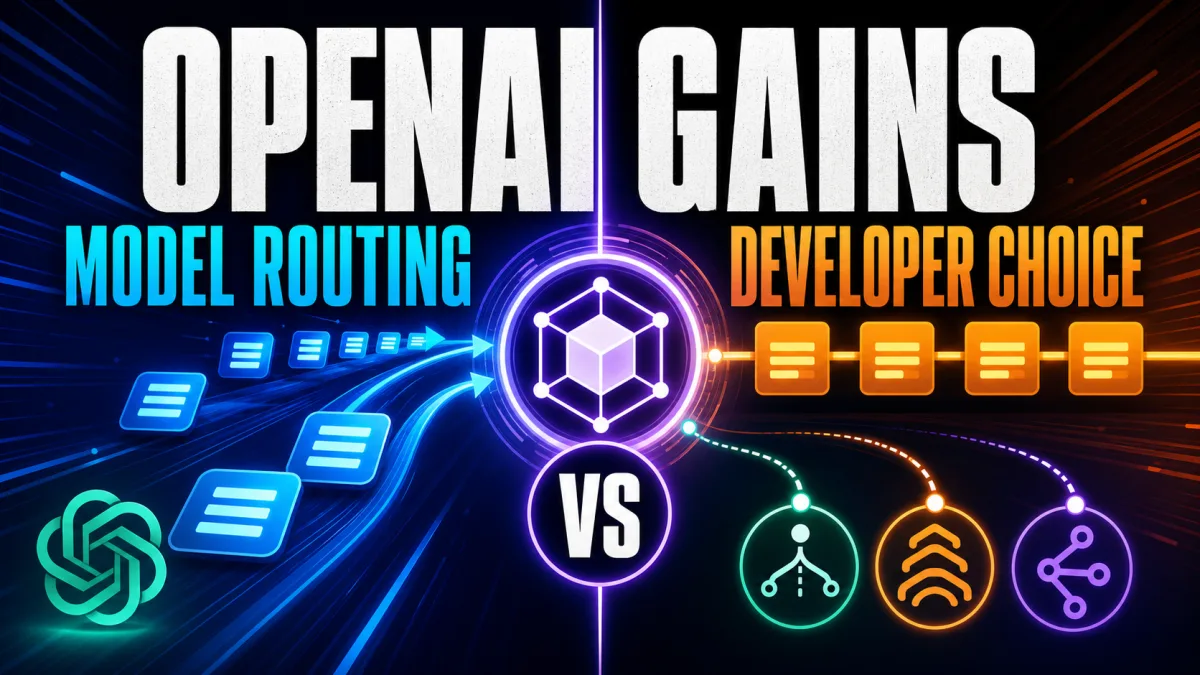
OpenAI is gaining ground against Anthropic on OpenRouter, according to The Information, making model selection a more competitive decision for developers who can switch providers through one gateway. The public version of the report does not reveal its full usage series, so the reliable takeaway is directional rather than a precise market-share claim: OpenAI is becoming harder for Anthropic to ignore in a channel built around comparing models. For businesses, that means keeping model choice flexible instead of tying an AI workflow to one vendor.
Definition: OpenRouter is a multi-model gateway where developers can access models from different providers through one service.
Example: A team can evaluate OpenAI and Anthropic models against the same application workflow without rebuilding the entire integration for every provider.
Key takeaway: OpenAI's reported gains on OpenRouter signal a change in developer selection, not a complete ranking of the AI market.
Business impact: Model competition gives operators more leverage to compare quality, latency and cost before committing a workflow to production.
What changed for OpenAI and Anthropic on OpenRouter?
The Information reports that OpenAI has gained ground against Anthropic among OpenRouter customers, placing the two providers in a more direct contest for developer wallets on a shared access layer. The accessible report summary identifies OpenRouter as a service used by AI application developers to reach models from different providers, but it does not publish the full underlying chart; operators should use the report as a directional signal and wait for exact figures before claiming a quantified market-share shift.
The practical change is not simply that one model is popular. OpenRouter lowers the switching cost between providers, so a developer can compare models within the same application environment. That makes OpenAI's reported progress relevant to AI agents and other production systems where routing, fallback behavior and cost controls matter as much as a model's headline capability.
Why is OpenRouter a useful market signal?
OpenRouter's public 2025 study analyzed more than 100 trillion tokens of real-world LLM interactions across a platform with more than 300 active models from over 70 providers. The study says its dataset covers anonymized request metadata rather than prompt or completion text, so it can show selection and token-volume patterns at scale while still leaving the platform's view narrower than the entire AI market. Businesses can use that evidence to watch adoption patterns, not to treat OpenRouter as a universal census.
The study also shows why a gateway view is valuable: proprietary models still held the largest share, while open-weight models reached roughly one-third of usage by late 2025. That mix means developers are not choosing on brand alone. Price, capability, latency, customization and availability all influence which model handles a real request, so a gain by OpenAI on one route can coexist with strong demand for Anthropic and open-weight alternatives elsewhere.
What can the public data prove about the shift?
The public data can prove that model choice on OpenRouter is fluid, but it cannot prove that OpenAI has overtaken Anthropic everywhere. OpenRouter describes its analysis as observational and says the results are shaped by pricing, model availability and user preferences; those conditions can change the measured share without a corresponding change in total industry demand. The right business interpretation is therefore narrower: OpenAI's reported OpenRouter gains are evidence that developers are reassessing provider fit. Background: Anthropic and OpenAI's Industry AI Push Raises Questions. See also Ramp data: OpenAI narrows Anthropic's business AI lead.
That distinction matters for procurement. A gateway percentage is not the same as revenue, active customers, production deployments or task success. Before switching a workflow, a business should reproduce the comparison on its own prompts, tool calls, latency budget and review process. The model that wins a general usage chart may still lose on a company's highest-risk task.
Why are developer wallets becoming routing decisions?
Developer model choice is becoming a routing decision because cost and capability are diverging across providers. CNBC reported that Chinese models accounted for more than 30% of tokens used by U.S. companies through OpenRouter in every week since February 8, 2026, reaching as high as 46%, while Justin Summerville of OpenRouter said Chinese open-source models can cost 60% to 90% less than leading Anthropic and OpenAI models. For operators, that evidence supports testing multiple routes and sending each task to the least expensive model that reliably clears its quality bar.
This does not make OpenAI or Anthropic interchangeable. A support agent, document extractor and coding workflow can need different levels of reasoning, context handling and tool reliability. The durable architecture is a model-agnostic workflow: keep prompts, tools, permissions, evaluation and escalation rules separate from the provider so a new usage signal can trigger a controlled test rather than an emergency rebuild.
How should businesses respond to OpenAI's OpenRouter gains?
Businesses should respond to OpenAI's reported gains by measuring completed-task economics, not by declaring a winner. The OpenRouter study's scale shows that usage data can reveal broad selection patterns, while its observational limits show why every production decision still needs local testing. A practical evaluation should compare the current model with at least one OpenAI route, one Anthropic route and one credible lower-cost alternative on the same test set before changing routing.
| Signal to watch | What it tells an operator | Decision to make |
|---|---|---|
| OpenRouter model share | Which models developers are selecting on one gateway | Shortlist candidates for testing |
| Cost per completed task | What the workflow actually costs after retries and review | Route routine work to the cheapest reliable option |
| Tool-call reliability | Whether an agent can execute actions safely and consistently | Keep human approval where failure is costly |
| Latency and availability | Whether a model fits the workflow's response budget | Define a fallback route before production |
OpenAI's progress against Anthropic on OpenRouter is therefore best read as a competitive signal, not a verdict. The gateway gives developers more choice; the business advantage comes from turning that choice into repeatable evaluation, routing and fallback controls.
Frequently asked questions
Does OpenAI now lead Anthropic across AI usage?
No. The reported gain concerns OpenRouter customers, a specific gateway rather than the whole AI market. The public report summary does not expose the complete series, and OpenRouter's own study says its data are observational and affected by pricing and availability. Treat the result as evidence of changing developer selection on that platform, not as proof that OpenAI leads Anthropic across every customer segment or workload.
Why can a multi-model gateway change provider competition?
A multi-model gateway reduces the integration work required to compare providers. When developers can access OpenAI, Anthropic and other models through one access layer, they can test quality, cost and latency without rebuilding every application connection. That makes provider choice more responsive to workflow results and pricing. It also means a usage shift on the gateway can reflect routing experiments, production adoption, model launches or changed economics rather than a single explanation.
Should a company switch from Anthropic to OpenAI now?
A company should not switch solely because OpenAI reportedly gained ground on OpenRouter. The correct test uses the company's own workload, including normal cases, edge cases, tool failures, structured-output checks, latency and human review. Keep the existing provider as a fallback until the candidate proves that it improves cost per completed task or reliability without increasing business risk. A gateway trend is a reason to evaluate, not a substitute for evaluation.
What is the main business lesson from the OpenRouter data?
The main business lesson is that model selection should remain an operating capability. OpenRouter's large-scale study shows meaningful real-world usage across many providers, while the reported OpenAI-Anthropic shift shows that developer preferences can move. A model-agnostic workflow lets a business respond to those changes with a measured routing update, rather than a disruptive rewrite of its tools, permissions and evaluation system.
What is an AI agent? explains why tool use and verification matter beyond chat. For the broader model-selection context, see What the latest AI models mean for your business.
Frequently asked questions
What changed between OpenAI and Anthropic on OpenRouter?
The Information reports that OpenAI has gained ground against Anthropic among OpenRouter customers, putting the two providers into a more direct contest for developer usage. The public version of the report does not expose the complete time series or exact share figures, so the defensible conclusion is directional: OpenAI is becoming more competitive in a multi-model gateway where developers can choose between providers.
Why does OpenRouter matter for AI model competition?
OpenRouter matters because it gives developers one access layer for models from many providers. OpenRouter's 2025 study analyzed more than 100 trillion tokens across real-world interactions and described usage across hundreds of models and more than 70 providers. That makes the platform a useful, though not universal, signal of what developers actually select when price, latency, capability and availability can be compared.
Does OpenAI gaining ground mean Anthropic is losing the market?
No. A gain in OpenRouter usage would show a change in selection on one gateway, not a complete measure of either company's total market share. OpenRouter's own methodology describes its data as observational and shaped by model availability, pricing and user preferences. Businesses should therefore treat the signal as evidence of changing developer choice, not as a final industry ranking.
What should businesses do with this model competition?
Businesses should keep model choice separate from workflow logic and test providers on their own tasks. Compare quality, tool-call reliability, latency, cost per completed task and escalation rates before changing production routing. A model-agnostic stack makes it easier to use OpenAI, Anthropic or a lower-cost alternative where each one clears the required quality and risk bar.
Alex
Founder & Lead AI Writer
Alex is the founder of Yowox and lead AI writer since 2024, breaking down complex information into clear, actionable insights for thousands of readers every day. Alex has built AI automation systems for businesses since 2024, focusing on AI agents, workflow automation, and business process optimization.
Save hours. Save thousands.
Practical guides, real workflows, and the latest AI and automation news that matters — straight to your inbox.