 By Alex
 Anthropic and OpenAI's Industry AI Push Raises Questions
Anthropic and OpenAI are moving beyond general model access toward industry-specific AI applications, raising a strategic question for the businesses that rely on their models.
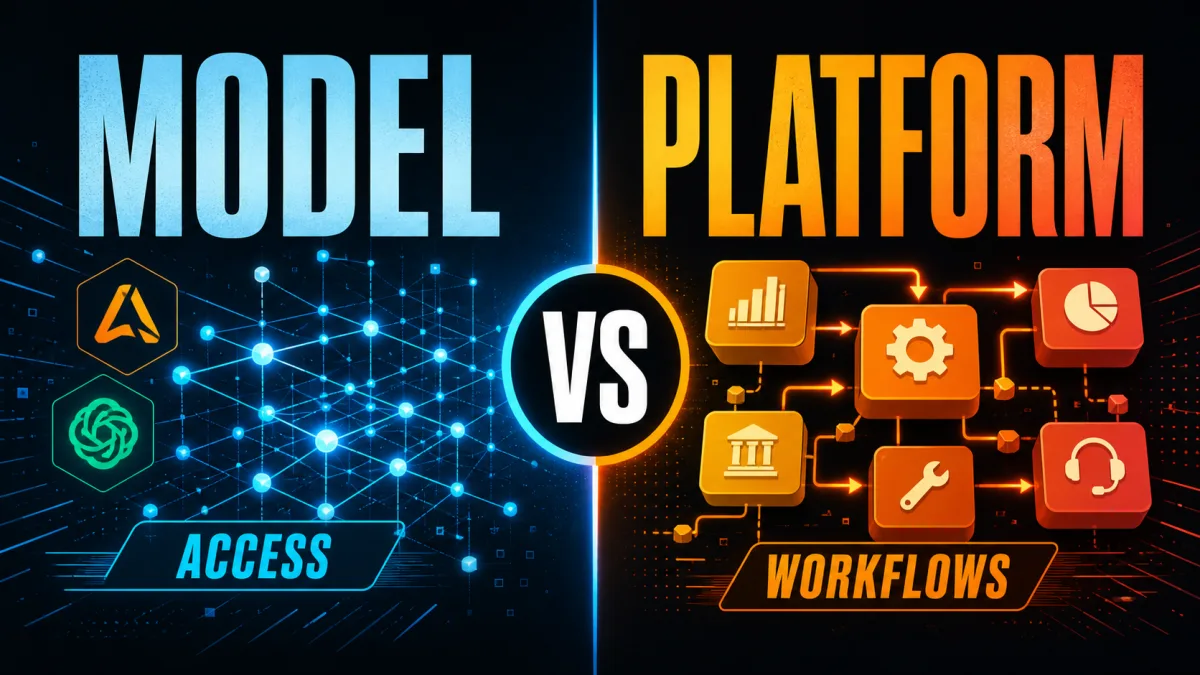
Anthropic and OpenAI are moving toward industry-specific AI applications and features, a shift that is worrying some of the businesses that rely on their models. The Information's AI Agenda report frames the central question: will frontier model companies keep selling their strongest capabilities to businesses if they also build the applications those businesses might otherwise create? The accessible report description supports the concern, but it does not establish that either company has announced an end to model sales.
Definition: Industry-specific AI is a model, application or workflow adapted to a particular field instead of offered only as a general-purpose capability.
Example: Anthropic's Cognizant partnership combines Claude with engineering platforms, industry blueprints and vertical solutions beginning with financial services.
Key takeaway: Businesses should evaluate both a provider's model access and its application roadmap before making a deep platform commitment.
Business impact: Separating models from data, tools and evaluations can reduce the disruption if a provider changes pricing, access or product priorities.
What is changing in the Anthropic and OpenAI business model?
Anthropic and OpenAI are being pulled toward two businesses at once: selling general-purpose intelligence and packaging that intelligence into products for specific work. The supplied Information report identifies the customer concern, while Anthropic's own enterprise announcement shows the pattern in concrete terms: Claude is being paired with implementation platforms, agent tooling and industry blueprints. Businesses should read the shift as a change in supplier strategy, not as proof that general model access is disappearing. More on this: Why an Anthropic robotics rumor spread despite a denial.
The practical boundary is between a model provider and an application competitor. A model provider sells a capability that a customer can build around; an application competitor sells a finished workflow that may overlap with the customer's own product or internal system. The boundary matters most when a business has invested in proprietary data, domain processes or customer-facing software, so procurement teams should document which layer they are actually buying and which layer they still control.
Why does Anthropic's enterprise strategy matter?
Anthropic's Cognizant announcement shows how a frontier model can move into vertical deployment without becoming a standalone industry application overnight. Anthropic says Cognizant will make Claude available to up to 350,000 employees, combine Claude with engineering platforms and industry expertise, and develop vertical solutions beginning with financial services. For a business buyer, the takeaway is to distinguish Anthropic's model capability from the partner's implementation layer and to ask who owns the workflow, controls the data and operates the resulting agents.
Anthropic's enterprise product also makes the model-provider relationship more operationally involved than a simple API call. Its enterprise documentation lists audit logs, data-retention controls, customer-managed encryption keys, workplace connectors and usage billed separately at API rates. Those controls can make enterprise adoption easier, but they also make the provider part of the operating architecture. A business should therefore review security, billing, portability and exit terms together rather than treating model quality as the only decision variable.
How is OpenAI deepening enterprise use?
OpenAI's own 2025 enterprise report describes a similar move toward embedded workflows. OpenAI says more than 1 million business customers use its tools, that ChatGPT workplace seats have passed 7 million, and that enterprise adoption is extending into Custom GPTs, Projects, APIs and products such as Codex. The report is based on OpenAI's de-identified, aggregated usage data and an enterprise survey, so its numbers are company-reported; they still show how OpenAI wants the market to understand its position: not only as a model vendor, but as infrastructure inside business processes.
OpenAI's report also says Custom GPTs and Projects are configurable interfaces with instructions, knowledge and custom actions, while companies use APIs to integrate models into their own products and systems. That combination creates two paths for customers: buy a more finished OpenAI experience, or build on the underlying model and retain more application control. Businesses making that choice can use a build-versus-buy decision instead of assuming that the most visible product is automatically the most durable architecture.
What does the shift mean for businesses buying AI?
Businesses should treat provider strategy as part of technical due diligence because Anthropic and OpenAI are both adding application, workflow and enterprise layers around their models. The evidence is visible in Anthropic's industry-partner deployment and OpenAI's description of Custom GPTs, Projects and API integrations. The concrete action is to map every dependency: model endpoint, prompt format, tool schema, retrieval layer, data store, evaluation set, permission boundary and user interface. More on this: OpenAI gains ground against Anthropic on OpenRouter. See also Ramp data: OpenAI narrows Anthropic's business AI lead.
A portable architecture does not mean refusing provider-native products. It means keeping the business-critical parts legible and testable while using provider features where they create real value. The same principle appears in the broader AI automation stack: models are one layer, while orchestration, integrations, data and governance determine whether an automation can survive a model or pricing change.
Are Anthropic and OpenAI becoming application competitors?
Anthropic and OpenAI are becoming closer to application competitors when they package models, tools and domain workflows for the same users that buy model access. The Information report raises that possibility through customer concern; Anthropic's Cognizant announcement supplies a public example of vertical deployment; OpenAI's report shows the company's push toward configurable workplace products and embedded APIs. Together, those sources support a strategic shift, not a verdict that every customer relationship is now conflicted.
The risk is not limited to direct competition. A provider can gain influence over the workflow through pricing, defaults, connectors, usage data, distribution or product bundling even when it never sells the exact same end product. Businesses should watch those interfaces during contract renewals and architecture reviews, then re-run workflow evaluations when a provider changes the model, application or billing layer.
What should operators watch next?
The unresolved question is not whether Anthropic and OpenAI will sell AI to businesses; both companies are clearly building enterprise channels. The question is how much of the value chain they will keep for themselves. Businesses should watch whether new industry features remain optional building blocks, become bundled applications, or start competing with customer-owned products. Until that becomes clearer, the sound position is neither panic nor blind dependence: use the strongest provider where it helps, but keep the workflow, evidence and exit path under control.
Frequently asked questions
Are Anthropic and OpenAI stopping sales of their AI models to businesses?
No public announcement in the supplied story says that Anthropic or OpenAI is ending model sales to businesses. The Information's report identifies a concern: both companies are developing applications and features tailored to particular industries, which can make customers question whether their model suppliers may also compete with them. The safer conclusion is that the companies' role is expanding from model provider toward application and workflow provider, not that API or enterprise access has been withdrawn.
Why are industry-specific AI applications worrying some customers?
Industry-specific applications can move an AI supplier closer to the workflows, data and customer relationships that businesses once expected to own themselves. That does not automatically create a conflict, but it changes the commercial boundary between buying model capability and buying a finished product. Businesses evaluating a provider should therefore ask which layer they are purchasing, what control they retain, how portable their workflow is, and whether the provider's roadmap overlaps with their own product or service.
What evidence shows Anthropic is moving into industry solutions?
Anthropic says its Cognizant partnership combines Claude, Claude Code, the Model Context Protocol and the Agent SDK with Cognizant's engineering platforms and industry blueprints. The announcement names vertical solutions beginning with financial services and describes domain-specific agents for regulated enterprise environments. That evidence shows a move toward packaged, industry-oriented deployment with a partner; it does not prove that Anthropic will stop offering general models or APIs.
What should businesses do if they depend on Anthropic or OpenAI?
Businesses should separate the model layer from the workflow and data layers wherever practical. Keep prompts, tool schemas, evaluations, permissions and business records under the company's control, then test providers against the actual workflow rather than assuming a supplier's newest application is the best fit. This does not require abandoning Anthropic or OpenAI. It reduces switching cost and makes it easier to respond if pricing, product boundaries, access terms or model quality change.
Alex
Founder & Lead AI Writer
Alex is the founder of Yowox and lead AI writer since 2024, breaking down complex information into clear, actionable insights for thousands of readers every day. Alex has built AI automation systems for businesses since 2024, focusing on AI agents, workflow automation, and business process optimization.
Save hours. Save thousands.
Practical guides, real workflows, and the latest AI and automation news that matters — straight to your inbox.