 By Alex
 Ramp data: OpenAI narrows Anthropic's business AI lead
Ramp's July data still puts Anthropic ahead of OpenAI among paying U.S. business users, but OpenAI is growing faster in the latest quarter-to-date view. The result points to a fluid market rather than a permanent winner.
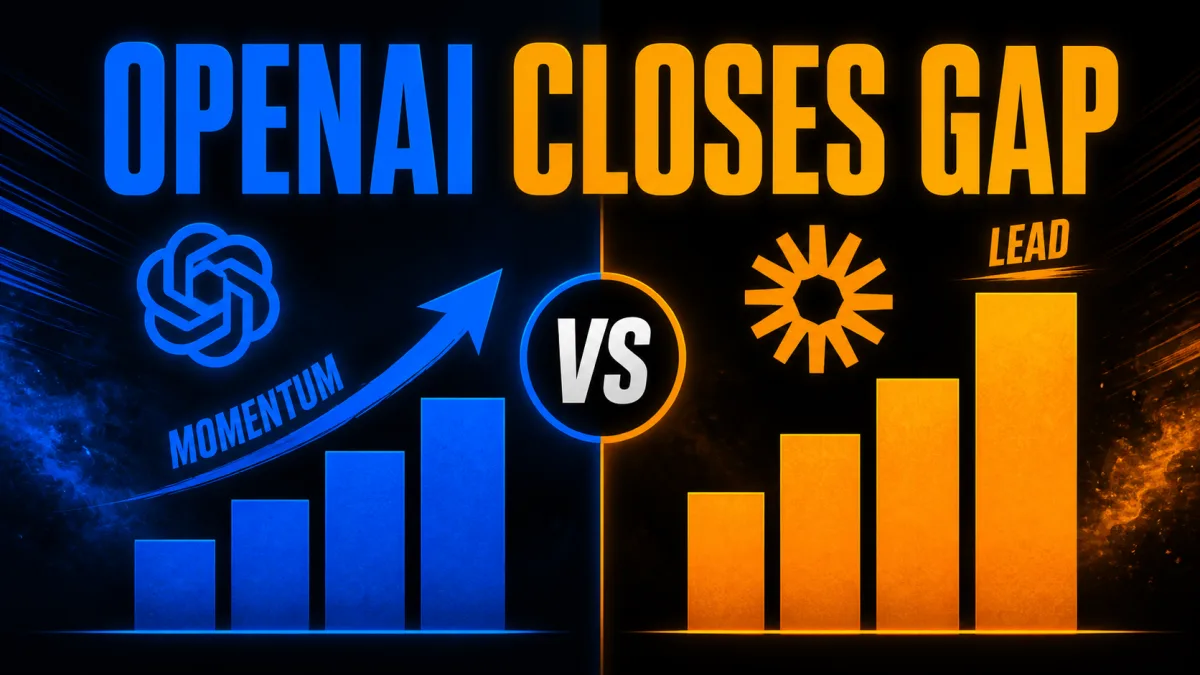
OpenAI is closing the business-user gap with Anthropic, but Anthropic still leads in Ramp's July snapshot. Ramp's published figures put Anthropic at nearly 44% of eligible U.S. businesses and OpenAI at nearly 40%, while the latest quarter-to-date trend has OpenAI growing faster. The evidence supports a narrower conclusion than “OpenAI is back on top”: business AI demand is expanding, and provider preference is still moving.
Definition: Ramp's AI Index is a business-spend signal that estimates which AI providers are being paid by eligible U.S. businesses.
Example: A business paying for Anthropic or OpenAI through a Ramp card or bill-pay flow can contribute to the provider adoption share.
Key takeaway: OpenAI is gaining momentum without yet overtaking Anthropic in the July snapshot.
Business impact: AI procurement teams should keep model evaluations and workflow integrations flexible while the ranking remains unsettled.
What did Ramp's July data actually show?
Ramp's July data shows Anthropic ahead of OpenAI among the businesses covered by its AI Index, with nearly 44% paying for Anthropic products or tokens and nearly 40% paying for OpenAI. The figures come from Ramp's AI Index, which uses business spend data rather than a survey of employee preferences. The immediate takeaway for a buyer is to separate current adoption share from growth rate: Anthropic leads the snapshot, while OpenAI has the stronger recent direction.
TechCrunch's August 20 report adds the time-series context: OpenAI lost the lead among Ramp's paying business users in May, when Anthropic reached 41% versus OpenAI's 39%, and Anthropic remained ahead in July at nearly 44% versus nearly 40%. The same report says OpenAI was growing faster in the quarter to date, with a month still left in the quarter. Businesses should therefore read the result as a live competitive movement, not a completed handover.
Why is OpenAI gaining faster without retaking the lead?
OpenAI can grow faster than Anthropic while remaining behind because the July starting points are different. With OpenAI at nearly 40% and Anthropic at nearly 44% in Ramp's chart, OpenAI begins about four percentage points back; faster growth narrows that gap before it changes the ranking. The business lesson is straightforward: a procurement team should track both level and velocity instead of treating one monthly leader as a durable moat.
The OpenAI-Anthropic movement also shows why model launches and product changes can affect business selection quickly. TechCrunch reports that Ramp economist Ara Kharazian attributed OpenAI's recent growth partly to stronger developer interest, while he linked weaker Anthropic uptake for its higher-end model tier to price and data-retention concerns. Those explanations are reported commentary, not a controlled causal study. Operators can use them as hypotheses to test against their own workloads, not as proof that one product decision caused the market shift.
What does the Ramp sample leave out?
Ramp's data is informative but not a census of business AI. TechCrunch says the dataset covers more than 70,000 American businesses spending through Ramp's corporate-card and bill-pay products, and that the customer base leans toward technology companies. The report also notes that large enterprises using other spend-management providers are excluded. The practical takeaway is to use Ramp for directional competitive monitoring, not to infer total revenue, total seats or universal enterprise market share.
Ramp's adoption metric is adoption by businesses with relevant spend, not the amount each company spends or the amount of work each model completes. A company can pay for two providers, buy a small subscription, or route only one workflow to a model. That means OpenAI's nearly 40% and Anthropic's nearly 44% do not say which provider handles more tokens, earns more dollars or delivers better results for a given task. A team evaluating an AI agent should keep those operational measures separate from market-share headlines.
Is enterprise AI spending becoming more stable?
Ramp's data points to a growing market and unstable provider ranking at the same time. TechCrunch reports that the share of Ramp customers paying for AI rose from above 50% in March to nearly 56% in July, while Anthropic and OpenAI competed for position within that expanding base. The signal matters for finance leaders because both conditions can coexist: total AI spending can rise even when companies change which lab receives a portion of the spend.
The Ramp pattern weakens the idea that one monthly lead proves long-term vendor loyalty. TechCrunch describes businesses moving back and forth as the labs release new models and says that volatility should make investors question how sticky enterprise AI spending really is. That does not prove customers will switch every month; it does show why a company should avoid embedding provider-specific assumptions into permissions, prompts and evaluation logic. For the broader model-choice angle, OpenAI's reported gains on OpenRouter show a related selection problem in a different usage channel.
What should business buyers do with the signal?
Businesses should use the Ramp result to schedule a controlled model comparison, not to declare a winner. The most useful test runs the same representative workload through OpenAI, Anthropic and any credible alternative, then measures cost per completed task, latency, tool-call reliability, escalation rate and failure recovery. Those measures answer the procurement question that a provider-adoption chart cannot: which model is dependable and economical for this company's work?
A model-flexible architecture makes that test cheaper to run. Keep workflow logic, tool permissions, evaluation sets and human-approval rules outside the provider-specific adapter; then a new Ramp reading can change the shortlist without forcing a full application rewrite. Teams can also connect the decision to AI automation ROI measurement by tracking completed outcomes and review costs rather than counting model calls alone.
The current evidence supports a balanced reading. Anthropic still holds the July lead among Ramp's eligible business users, OpenAI is gaining faster in the latest quarter-to-date view, and the overall pool of businesses paying for AI is growing. For operators, the winning move is not to predict which lab will own the market; it is to preserve enough portability to benefit when the market moves again.
Frequently asked questions
Does OpenAI now lead Anthropic among business users?
No. Ramp's July data still shows Anthropic ahead among the U.S. businesses in the sample that paid for Anthropic or OpenAI products: nearly 44% used Anthropic and nearly 40% used OpenAI. TechCrunch reports that OpenAI was growing faster in Ramp's quarter-to-date view, but that trend was not yet a lead reversal. The practical conclusion is that OpenAI is closing the gap, not that it has already retaken first place across business AI.
What does Ramp's AI data measure?
Ramp's AI Index uses business spend data from Ramp's corporate card and bill-pay products to estimate the share of eligible U.S. businesses paying for AI models, platforms and tools. The July chart is an adoption signal, not a complete measure of revenue, seats, usage intensity or total market share. Ramp's sample is useful for observing paid business selection, but companies outside Ramp and large buyers using other spend systems are not represented in the same way.
Why can OpenAI gain while Anthropic remains ahead?
OpenAI can grow faster than Anthropic from a smaller July base while Anthropic keeps the lead in the latest snapshot. Ramp reported nearly 44% of eligible businesses for Anthropic and nearly 40% for OpenAI, leaving OpenAI about four percentage points behind. A faster growth rate changes the gap before it changes the ranking, so buyers should distinguish momentum from current share.
What should businesses do with this AI market signal?
Businesses should treat the Ramp result as a reason to test model choice, not as a reason to switch vendors automatically. Compare OpenAI, Anthropic and relevant alternatives on the company's own tasks, including cost per completed task, latency, tool reliability, failure handling and human review. Keep prompts, permissions and evaluations separate from the model provider so a change in business adoption can trigger a controlled routing test instead of a costly rebuild.
Frequently asked questions
Does OpenAI now lead Anthropic among business users?
No. Ramp's July data still shows Anthropic ahead among the U.S. businesses in the sample that paid for Anthropic or OpenAI products: nearly 44% used Anthropic and nearly 40% used OpenAI. TechCrunch reports that OpenAI was growing faster in Ramp's quarter-to-date view, but that trend was not yet a lead reversal. The practical conclusion is that OpenAI is closing the gap, not that it has already retaken first place across business AI.
What does Ramp's AI data measure?
Ramp's AI Index uses business spend data from Ramp's corporate card and bill-pay products to estimate the share of eligible U.S. businesses paying for AI models, platforms and tools. The July chart is an adoption signal, not a complete measure of revenue, seats, usage intensity or total market share. Ramp's sample is useful for observing paid business selection, but companies outside Ramp and large buyers using other spend systems are not represented in the same way.
Why can OpenAI gain while Anthropic remains ahead?
OpenAI can grow faster than Anthropic from a smaller July base while Anthropic keeps the lead in the latest snapshot. Ramp reported nearly 44% of eligible businesses for Anthropic and nearly 40% for OpenAI, leaving OpenAI about four percentage points behind. A faster growth rate changes the gap before it changes the ranking, so buyers should distinguish momentum from current share.
What should businesses do with this AI market signal?
Businesses should treat the Ramp result as a reason to test model choice, not as a reason to switch vendors automatically. Compare OpenAI, Anthropic and relevant alternatives on the company's own tasks, including cost per completed task, latency, tool reliability, failure handling and human review. Keep prompts, permissions and evaluations separate from the model provider so a change in business adoption can trigger a controlled routing test instead of a costly rebuild.
Alex
Founder & Lead AI Writer
Alex is the founder of Yowox and lead AI writer since 2024, breaking down complex information into clear, actionable insights for thousands of readers every day. Alex has built AI automation systems for businesses since 2024, focusing on AI agents, workflow automation, and business process optimization.
Save hours. Save thousands.
Practical guides, real workflows, and the latest AI and automation news that matters — straight to your inbox.