 By Alex
 DeepSeek V4 Flash: the economics of 28-cent AI tokens
DeepSeek V4 Flash pairs a 284B-parameter mixture-of-experts design with sparse long-context attention and $0.28 output tokens, changing how teams should route coding, document and agent workloads.
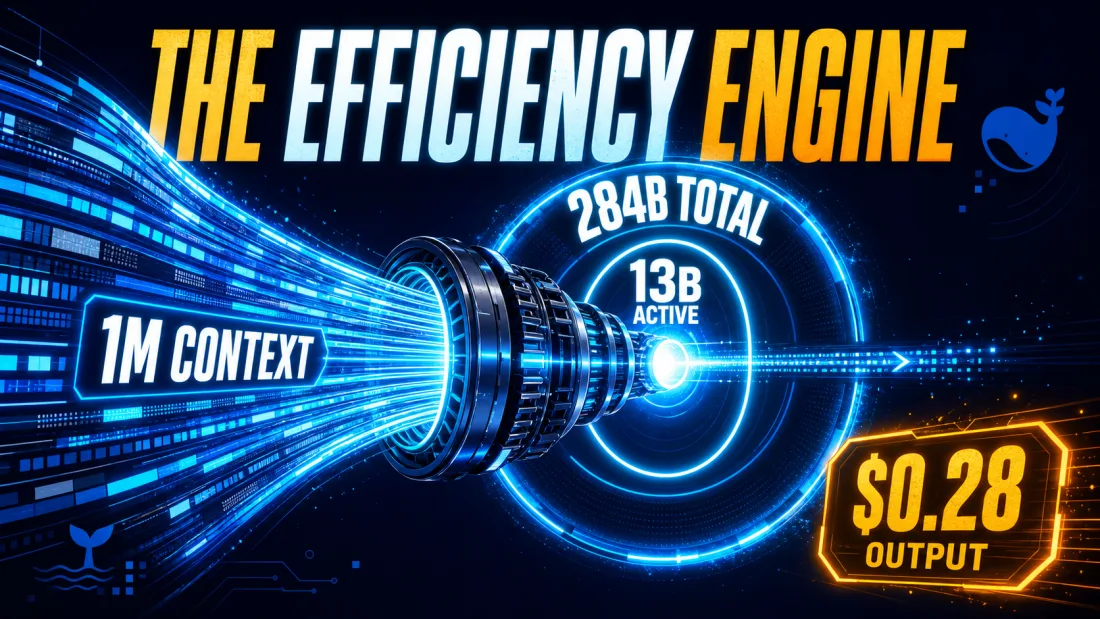
DeepSeek V4 Flash changes the model-buying question from “which frontier model wins?” to “which tasks need frontier pricing?” The model lists output tokens at $0.28 per million, supports a one-million-token context and is positioned for fast, economical inference. In the source analysis from Towards AI, the strongest case is not universal superiority; it is unusually low-cost performance on agentic and long-context workloads. That routing question also connects to Yowox’s earlier analysis of Chinese-model token share and enterprise routing.
Definition: DeepSeek V4 Flash is the efficiency-oriented model in DeepSeek’s V4 family, combining a sparse mixture-of-experts model with hybrid attention for long contexts.
Example: A team can evaluate DeepSeek V4 Flash for repetitive tool calls, code review and document processing while reserving a larger model for ambiguous reasoning.
Key takeaway: The $0.28 rate matters because it makes workload-specific routing economically practical, not because it makes every model interchangeable.
Business impact: AI budgets can be managed at the task level: cheap execution for high-volume work, escalation for cases where an error costs more than a token.
What makes DeepSeek V4 Flash different?
DeepSeek V4 Flash is a 284-billion-parameter mixture-of-experts model with about 13 billion active parameters per token, according to the DeepSeek V4 technical report. The model keeps a large pool of specialized parameters but routes each token through only a fraction of them, which reduces per-token computation; teams should therefore judge it by active-workload cost rather than total parameter count alone.
DeepSeek V4 Flash also uses hybrid Compressed Sparse Attention and Heavily Compressed Attention to reduce long-context overhead, rather than applying dense attention uniformly to every prior token. The technical report describes compression of key-value cache entries and selective attention over the resulting representations; for a million-token workload, the practical takeaway is lower memory pressure and less inference work than the preceding DeepSeek-V3.2 design.
The architectural result is unusually specific: DeepSeek V4 Flash reaches roughly 10% of DeepSeek-V3.2’s single-token inference FLOPs and 7% of its accumulated KV-cache size at a one-million-token context, according to DeepSeek’s technical report. Those figures describe the report’s comparison setting, not a guarantee for every deployment, so operators should measure latency, memory and throughput on their own context lengths before extrapolating savings.
Why does the price gap matter for AI agents?
DeepSeek’s current pricing page lists $0.14 per million uncached input tokens, $0.0028 per million cache-hit input tokens and $0.28 per million output tokens for the Flash model. That pricing applies before a team accounts for retries, tool results, hidden reasoning tokens, orchestration overhead and the cost of handling failures; a routing policy should compare cost per successful task, not the advertised token rate in isolation. See also DeepSeek V4 API prices are about to jump at peak hours. See also DeepSeek Vision Model Nears Opus 4.8, Wins 3 Tests.
DeepSeek V4 Flash is unusually relevant to agent workflows because one user request can trigger several planning turns, tool calls, retries and summaries. DeepSeek V4 Flash’s $0.28 output rate makes it a plausible first candidate for routine coding-agent steps, CI feedback, structured extraction and other high-volume paths where a small quality gap can be detected and contained.
DeepSeek V4 Flash’s low price can create a trap: cheap tokens can encourage excessive calls. If an agent using DeepSeek V4 Flash loops, emits long reasoning traces or retries weak tool arguments, the bill can still grow and the operational result can still be poor; teams should set per-task token budgets, log token counts and stop runaway loops before treating the low list price as automatic savings.
Which workloads fit DeepSeek V4 Flash best?
Tool-heavy coding and CI are the clearest evaluation target for DeepSeek V4 Flash because success can be checked against concrete outputs such as valid patches, passing tests and correct tool arguments. A team should replay real or sanitized task transcripts, compare completed-task cost and inspect whether the model calls the right tool in the right order; a benchmark score alone cannot reveal failures in a company’s own schema or sandbox.
Long-document processing is another natural fit for DeepSeek V4 Flash when the workflow genuinely benefits from a one-million-token context rather than merely accepting a large maximum. Contract review, codebase analysis and log investigations can be tested against known answers and retrieval baselines; the relevant question is whether fewer chunks and fewer orchestration turns offset any increase in latency or review effort.
High-volume conversational work can benefit from DeepSeek V4 Flash when the quality threshold is explicit. Classification, summarization, first-pass drafting and routine support replies are easier to evaluate than open-ended strategic advice, so operators can route those high-volume cases to DeepSeek V4 Flash and escalate uncertain cases. This is a routing opportunity, not a recommendation to remove human review from consequential conversations.
Where does DeepSeek V4 Flash fall short?
DeepSeek V4 Flash is not a universal replacement for larger or more mature frontier systems because its smaller parameter scale shows up most clearly on broad knowledge tasks. DeepSeek’s own report says Flash trails the Pro variant on knowledge evaluations while approaching it on some reasoning and simpler agent tasks; the defensible decision is therefore to segment workloads instead of repeating a blanket “matches the frontier” claim.
DeepSeek V4 Flash’s long-context efficiency also involves approximation. Sparse selection can miss a relevant detail if the task depends on information that the attention mechanism ranks below other context, while compression can trade detail for lower memory use; DeepSeek’s technical report identifies the hybrid attention design as the mechanism behind the model’s 1M-token efficiency. Teams using million-token prompts should include buried-fact retrieval, conflicting instructions and long tool traces in their evaluation set rather than testing only short prompts.
DeepSeek V4 Flash model updates are another production risk. The source analysis describes a July 31 refresh delivered under the same model identity and notes that the API supports a high concurrency ceiling. That convenience reduces migration work, but it also means teams need to log model identifiers, rerun regression tests after provider changes and keep a fallback path for critical workloads. See also Gemini 3.7 Flash pairs stronger agents with half-price input.
How should a team evaluate the model?
A five-step DeepSeek V4 Flash evaluation is safer than a provider-wide switch. First, export representative prompts, tool calls, long contexts and known failures after removing secrets and personal data. Second, define pass/fail rules for factual accuracy, structured output, tool-call correctness, latency and successful-task cost. Third, run the incumbent and DeepSeek V4 Flash on the same cases. Fourth, route only the workload slice that clears the threshold. Fifth, repeat the evaluation after pricing or model updates.
DeepSeek’s API compatibility lowers the mechanical barrier to a pilot: its documentation lists OpenAI-format and Anthropic-format endpoints, plus tool calls and both thinking and non-thinking modes. Compatibility does not make a migration safe by itself, however; a team still needs to review response schemas, tool-call parsing, token accounting, timeout behavior and the permissions exposed to model-generated actions.
Security controls for a DeepSeek V4 Flash deployment should be designed around the workflow, not the model brand. A coding agent that can run shell commands needs a sandbox, an allowlist and isolated credentials whether it uses DeepSeek, OpenAI or Anthropic. A document pipeline needs redaction, retention rules and a clear data-residency decision before production traffic moves to any external API.
What should operators do with the $0.28 headline?
The $0.28 figure is best understood as a routing signal. DeepSeek V4 Flash makes it rational to test a cheaper model on large volumes of narrow, verifiable work, while the price gap creates room to reserve expensive models for tasks where failure is costly or correctness is hard to measure. The winning architecture may use several models rather than one default.
For teams already building agents, the next step for DeepSeek V4 Flash is not a dramatic replacement announcement. It is a small replay set drawn from real transcripts, a cost-per-success metric, an escalation rule and a regression test that runs whenever the provider changes behavior. DeepSeek V4 Flash may reduce the cost of the right workload; only that workload-level evidence can show whether it reduces the cost of yours. Teams new to this architecture can first review how an AI agent uses models, tools and verification.
Frequently asked questions
What does DeepSeek V4 Flash cost?
DeepSeek's pricing page lists DeepSeek V4 Flash at $0.14 per million input tokens when the cache misses, $0.0028 per million input tokens on a cache hit, and $0.28 per million output tokens. The same page lists a 1M-token context, a maximum output of 384K tokens and a concurrency limit of 2,500. Prices can change, and DeepSeek says its API may introduce peak and off-peak pricing, so teams should check the live pricing page before budgeting or comparing vendors.
Why can DeepSeek V4 Flash be priced so low?
DeepSeek V4 Flash is designed to reduce the work required for long contexts. Its technical report describes a 284B-parameter mixture-of-experts model with about 13B parameters activated per token, plus hybrid Compressed Sparse Attention and Heavily Compressed Attention. At one million tokens, DeepSeek reports that Flash uses about 10% of the single-token inference FLOPs and 7% of the accumulated KV-cache size of DeepSeek-V3.2. Those architectural savings explain the economics, but they do not guarantee the same quality on every task.
Is DeepSeek V4 Flash as capable as the most expensive models?
No universal parity claim is supported by the available evidence. DeepSeek's own report says the Flash variant is weaker on knowledge evaluations because it has a smaller parameter scale, while it can approach the Pro model on some reasoning and simpler agent tasks. The practical conclusion is workload specialization: test Flash on tool-heavy coding, long-context processing or high-volume chat, and keep a stronger fallback for broad factual recall or expensive-to-fail decisions.
Should a company switch its production model to DeepSeek V4 Flash?
A company should not switch solely because the list price is low. The safer path is to replay representative prompts, tool calls and long-context cases; measure successful-task cost, latency and error recovery; and review data residency, retention and vendor-jurisdiction requirements. DeepSeek V4 Flash supports OpenAI-format and Anthropic-format APIs, which can simplify a pilot, but a low-friction migration still needs sandboxed tools, rate-limit handling, fallback routing and regression tests after model updates.
Alex
Founder & Lead AI Writer
Alex is the founder of Yowox and lead AI writer since 2024, breaking down complex information into clear, actionable insights for thousands of readers every day. Alex has built AI automation systems for businesses since 2024, focusing on AI agents, workflow automation, and business process optimization.
Save hours. Save thousands.
Practical guides, real workflows, and the latest AI and automation news that matters — straight to your inbox.