 By Alex
 DeepSeek Vision Model Nears Opus 4.8, Wins 3 Tests
DeepSeek's experimental V4-Flash-Vision-Exp adds image understanding to its low-cost Flash model, comes close to Opus 4.8 on multimodal agent benchmarks, and wins three of eleven reported comparisons.
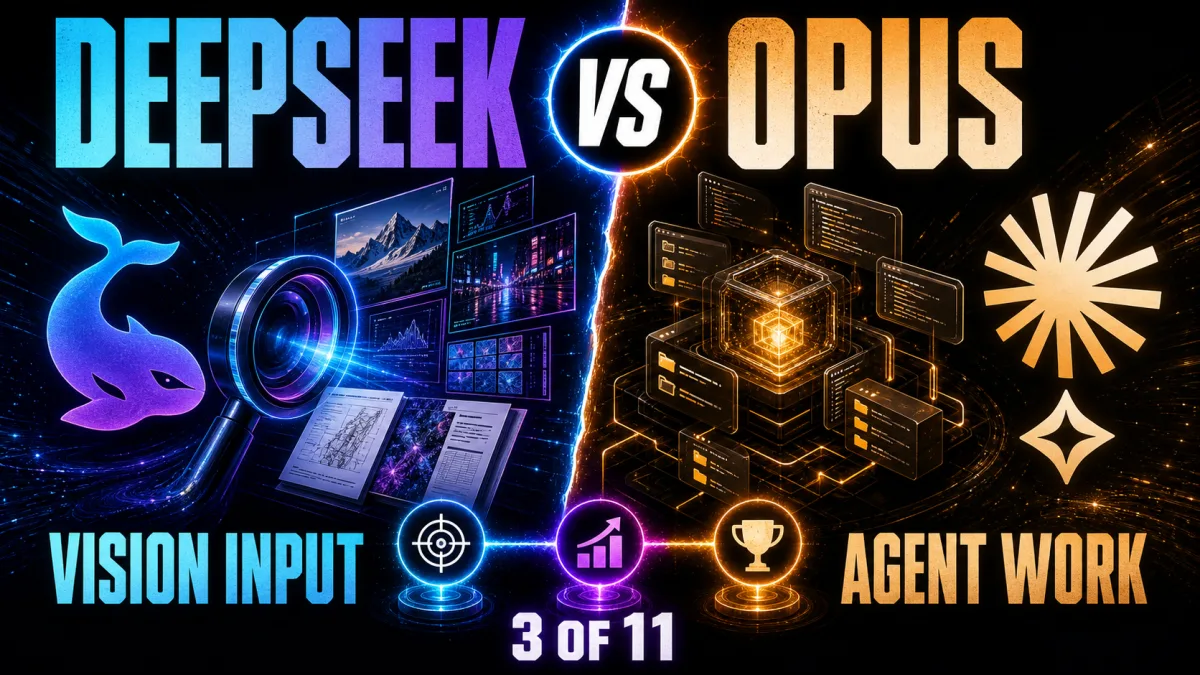
DeepSeek V4-Flash-Vision-Exp is an experimental multimodal model that adds image understanding to DeepSeek's low-cost V4 Flash, and DeepSeek says its multimodal agent performance comes close to Anthropic's Opus 4.8. Bloomberg reported the release as a new test model from the Hangzhou-based company. The release is now live on DeepSeek's API platform, where developers can send text and images to the same agent-oriented model. The practical question is not whether DeepSeek has created a universal Opus replacement; it is whether visual input makes a cheap model useful for more production workflows.
Definition: DeepSeek V4-Flash-Vision-Exp is an experimental vision model built on DeepSeek V4 Flash, with support for image and screenshot understanding.
Example: An agent can inspect a screenshot or document image, decide which tool to call, and continue a workflow instead of asking a separate vision model for interpretation.
Key takeaway: DeepSeek's claim is “close to Opus 4.8” on multimodal agent tests, not a clean win across all capabilities.
Business impact: Teams can evaluate visual, tool-using workloads against a low-cost API before paying frontier-model prices for every request.
What did DeepSeek release?
DeepSeek released V4-Flash-Vision-Exp on August 21, 2026 as an experimental extension of its text-only V4 Flash model. DeepSeek says the new model matches V4 Flash on text capabilities, including agents, reasoning and world knowledge, while adding visual understanding; the official release note is the source for the model name, API availability and supported interfaces. For teams already evaluating AI agents that use tools and complete multi-step tasks, the change matters because the agent can now treat images and screenshots as part of its working context.
DeepSeek's release supports mixed text-and-image input through base64 data, external URLs or the Files API. It also supports Chat Completions, Messages, Responses and tool calls, so the model is aimed at existing agent infrastructure rather than a separate visual demo. The immediate takeaway is an easier pilot: a team can add visual cases to an established text-agent evaluation instead of rebuilding the orchestration layer around a new product.
How close is DeepSeek to Opus 4.8?
DeepSeek V4-Flash-Vision-Exp is close to Opus 4.8 on several reported multimodal agent tests, but the available comparison does not show a general DeepSeek victory. The Next Web's review of DeepSeek's published table reports three wins for the new model out of eleven comparisons, with Opus 4.8 ahead on the other eight; operators should therefore read the result as a task-specific comparison rather than a replacement announcement.
| Benchmark | V4-Flash-Vision-Exp | Opus 4.8 | What the gap shows |
|---|---|---|---|
| DeepSWE | 84.5 | 83.2 | DeepSeek leads by 1.3 |
| Agents' Last Exam | 77.9 | 76.3 | DeepSeek leads by 1.6 |
| ZeroBench | 46.2 | 45.2 | DeepSeek leads by 1.0 |
| Toolathlon-Verified | 75.9 | 76.2 | Nearly tied |
| Chartography | 64.3 | 65.0 | Nearly tied |
| NL2Repo | 57.7 | 69.7 | Opus leads by 12.0 |
| DSBench-Hard | 63.6 | 71.7 | Opus leads by 8.1 |
The table makes the commercial signal more nuanced. DeepSeek V4-Flash-Vision-Exp is within a few points of Opus 4.8 on several tasks and wins three reported tests, but the model trails materially on repository-scale and difficult benchmark cases. A buyer should use the close scores to justify a workflow pilot, not to skip a workload-level evaluation where coding quality, recovery and review time determine the real cost.
How large is the multimodal improvement?
DeepSeek V4-Flash-Vision-Exp makes the biggest visible improvement when the benchmark contains images that the text-only model cannot read. DeepSeek reports ApexBench at 36.5 for the vision model versus 26.2 for V4 Flash, and Agents' Last Exam at 27.3 versus 25.2; the comparison shows why visual access can change an agent's result more than another small text-reasoning upgrade.
The benchmark footnote also supplies an important limitation: DeepSeek says V4 Flash ignored multimodal elements in those evaluations. That means part of the improvement measures the difference between a model that can see the test inputs and one that cannot. The new model's scores remain useful for visual-agent planning, but the fair business test is a matched evaluation in which every candidate receives the same images, tools, time limits and success criteria.
DeepSeek says the vision variant matches V4 Flash on text performance, but the published figures summarized by The Next Web show a mixed result rather than a perfect tie. The vision model improves on six of seven listed text benchmarks and falls behind on Cybergym, scoring 75.3 versus 76.7; teams should therefore test whether the added visual capability helps their workload without creating regressions in security-sensitive or text-only tasks.
What does the API support?
DeepSeek V4-Flash-Vision-Exp supports images, screenshots and ordinary text in one request, with tool calls and the Responses API available alongside Chat Completions and Messages. DeepSeek also launched a Files API that lets a developer upload an image once, reuse its file_id, and avoid sending the same bytes repeatedly; that is useful for workflows that inspect the same document across several agent steps.
Images are converted into tokens for billing, and DeepSeek says the model can tokenize up to 384 tokens per image at V4 Flash pricing. The current DeepSeek pricing table lists V4-Flash-Vision-Exp at $0.22 per million uncached input tokens and $0.66 per million output tokens off-peak, rising to $0.44 and $1.32 during peak hours. A visual workflow can still cost more than a text-only workflow because image tokens are added to the request, so cost per completed task is the metric that matters. See also DeepSeek V4 API prices are about to jump at peak hours.
Developers should also treat the model's “experimental” label as an operational constraint. A production pilot needs a pinned model identifier, logs for image and tool inputs, retry limits, a fallback route and a regression set that includes screenshots and document scans. The low token price reduces the cost of testing; it does not remove the need to control data access or verify outputs before an agent acts.
Why does this matter for AI budgets?
DeepSeek V4-Flash-Vision-Exp makes visual agent steps cheaper to experiment with because its pricing is tied to the V4 Flash tier rather than an Opus-class rate. That matters for high-volume processes such as screenshot triage, document classification, visual quality checks and browser-agent state recognition, where a workflow may make several model calls per task. The earlier analysis of DeepSeek V4 Flash's token economics explains why low-cost inference changes routing decisions even when a model does not lead every benchmark.
DeepSeek V4-Flash-Vision-Exp should be compared by cost per successful outcome, not by token price alone. A model that costs less per token can lose its advantage if it misreads a screenshot, chooses the wrong tool, retries repeatedly or requires a human to repair the result. Conversely, DeepSeek V4-Flash-Vision-Exp can still be the better default when it completes a narrow visual task reliably at a lower total cost. This is the same workload-splitting logic behind the shift toward multi-model routing in enterprise AI: use the expensive model where failure is costly, and route repeatable work to a cheaper model that clears the required bar.
What should teams test next?
Teams evaluating DeepSeek V4-Flash-Vision-Exp should begin with a small, representative set of visual tasks rather than a broad migration. Include screenshots with ambiguous states, scanned documents, charts, tool-call decisions, refusals, long conversations and cases where the correct action is to ask a human. Measure visual accuracy, structured-output validity, tool selection, latency, retries, cost per completed task and the percentage of cases escalated for review.
The strongest evidence available on launch day supports a narrow conclusion: DeepSeek has added a practical vision layer to V4 Flash and placed it within a few points of Opus 4.8 on much of its published agent benchmark set. The model wins three of eleven reported comparisons, but it trails by 12 points on NL2Repo and has not been shown here against Anthropic's newest Opus model. Businesses should treat the release as a credible low-cost candidate for visual agent routing, not as proof that benchmark leadership has changed hands.
FAQ
Is DeepSeek V4-Flash-Vision-Exp a general-purpose replacement for Opus 4.8?
No. DeepSeek V4-Flash-Vision-Exp is an experimental multimodal model, and DeepSeek's claim is that it comes close to Opus 4.8 on multimodal agent benchmarks. The published comparison summarized by The Next Web shows three wins out of eleven tests, with Opus 4.8 ahead on the rest. The new model is better understood as a candidate for visual, tool-using workloads where lower inference cost matters. A company should compare both models on its own screenshots, documents, tools, latency target and review process before changing a production route.
What is the largest reported gap between the two models?
The largest gap in the summarized benchmark table is NL2Repo, where DeepSeek V4-Flash-Vision-Exp scores 57.7 and Opus 4.8 scores 69.7, a 12-point advantage for Opus. DSBench-Hard also shows a substantial Opus lead of 8.1 points. Those results matter because repository-scale and difficult agent tasks can expose weaknesses that a close average comparison hides. Teams evaluating coding agents should therefore include real repositories and test execution, not only image understanding or short tool calls.
Does the vision model cost more than DeepSeek V4 Flash?
DeepSeek's release says V4-Flash-Vision-Exp uses V4 Flash pricing, while images are converted into input tokens and billed with the request. The current pricing table lists $0.22 per million uncached input tokens and $0.66 per million output tokens off-peak, with peak rates of $0.44 and $1.32. The final bill depends on image dimensions, text length, output length, retries and tool calls. Measure the cost of completing a real task rather than multiplying a text-only token estimate.
What is the safest first use case?
DeepSeek V4-Flash-Vision-Exp's safest first use case is a bounded visual task with clear inputs, a reversible action and a human review path. Examples include classifying screenshots, extracting fields from documents, checking whether a visual state meets a rule, or selecting the next tool in a supervised workflow. Avoid giving DeepSeek V4-Flash-Vision-Exp unrestricted authority over irreversible payments, account changes or sensitive data until the experimental model has passed a task-level evaluation with logging, access controls, fallback routing and explicit escalation conditions.
Frequently asked questions
What is DeepSeek V4-Flash-Vision-Exp?
DeepSeek V4-Flash-Vision-Exp is an experimental multimodal model that adds image and screenshot understanding to DeepSeek V4 Flash. DeepSeek says it keeps the text capabilities of V4 Flash, including agents, reasoning and world knowledge, while adding the ability to work with visual inputs. The model is available through DeepSeek's API using the deepseek-v4-flash-vision-exp identifier, with support for mixed text and image input, tool calls and the Responses API.
Does DeepSeek V4-Flash-Vision-Exp beat Claude Opus 4.8?
Not across the reported benchmark set. DeepSeek says the experimental model comes close to Opus 4.8 on multimodal agent benchmarks. A review of DeepSeek's published table found the model ahead on three of eleven listed comparisons, while Opus 4.8 led on the other eight. The largest reported gap was on NL2Repo, where DeepSeek scored 57.7 against Opus 4.8 at 69.7. The evidence supports a close comparison on several tasks, not universal superiority.
How much does DeepSeek V4-Flash-Vision-Exp cost?
DeepSeek lists V4-Flash-Vision-Exp at the same token rates as V4 Flash on its pricing page: $0.22 per million uncached input tokens and $0.66 per million output tokens off-peak, with peak rates of $0.44 and $1.32. Images are converted into input tokens and billed with the request. DeepSeek's release also says images can use up to 384 tokens each, so teams should measure image-heavy workloads rather than assume that text-only cost estimates will hold.
Should businesses switch an AI agent to the new DeepSeek model?
Businesses should test the model on representative visual and tool-using tasks before changing production routing. The model is most relevant where an agent must interpret screenshots, documents or other images and then call tools. Compare successful-task cost, visual accuracy, tool-call correctness, latency, retries and data-governance requirements against the current model. DeepSeek's vendor benchmarks are useful for forming a test plan, but they do not replace an evaluation on the company's own workflow.
Alex
Founder & Lead AI Writer
Alex is the founder of Yowox and lead AI writer since 2024, breaking down complex information into clear, actionable insights for thousands of readers every day. Alex has built AI automation systems for businesses since 2024, focusing on AI agents, workflow automation, and business process optimization.
Save hours. Save thousands.
Practical guides, real workflows, and the latest AI and automation news that matters — straight to your inbox.