 By Alex
 DeepSeek V4 API prices are about to jump at peak hours
DeepSeek will replace flat V4 API rates with peak and off-peak pricing on August 16, raising V4-Pro output from $0.87 to $3.96 per million tokens during peak hours.
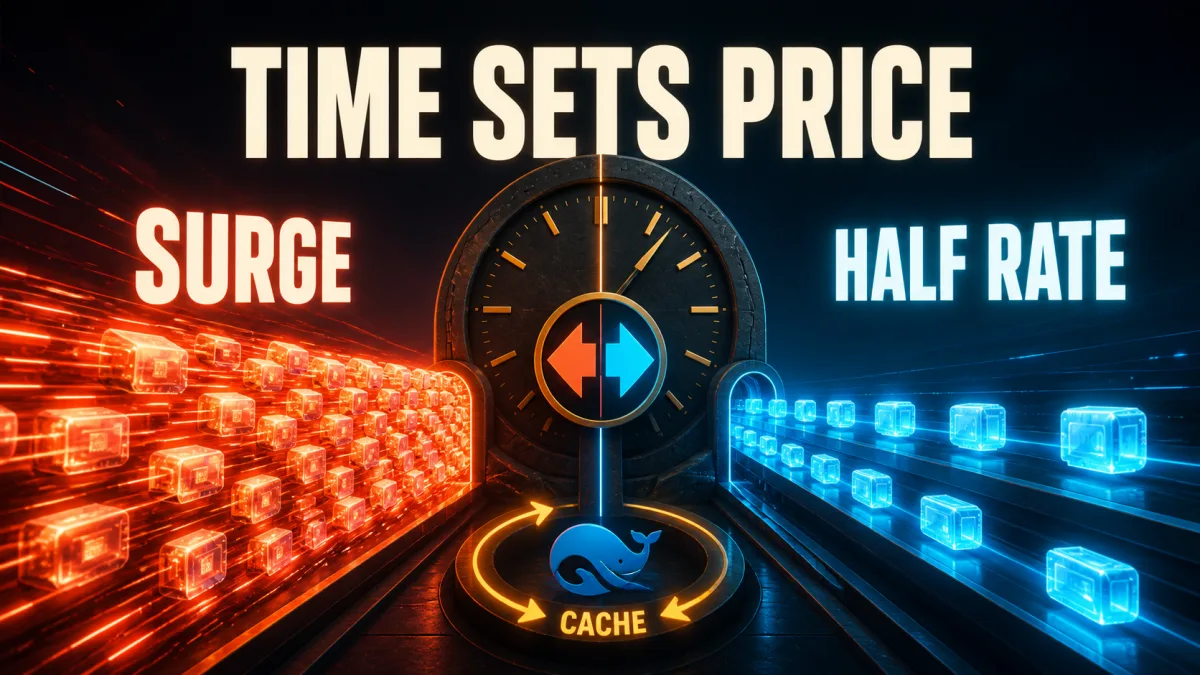
Definition: DeepSeek is moving its V4 API from one published rate card to peak and off-peak billing, with new prices taking effect at 16:00 UTC on August 16, 2026.
Example: V4-Pro output will cost $3.96 per million tokens during peak hours and $1.98 off-peak, compared with $0.87 under the current rate.
Key takeaway: DeepSeek's V4 models remain price-competitive on the published figures, but the cheapest route will now depend on workload timing as well as model choice.
Business impact: Teams running agents, coding pipelines or high-volume generation need to add time-of-day and cache behavior to their model-cost forecasts.
DeepSeek is changing the economics of its V4 API one day after releasing V4-Pro broadly. The Information reports that DeepSeek will raise model prices and that V4-Pro has received mixed user reviews; the practical question for operators is how the new schedule changes the cost of real workloads.
What changes in DeepSeek's V4 pricing?
DeepSeek's official V4-Pro general-availability announcement says the V4 lineup is moving to peak and off-peak rates, with the new schedule starting at 16:00 UTC on August 16, 2026. DeepSeek says off-peak rates are 50% lower than peak rates, so teams with flexible workloads can reduce spend by changing execution windows rather than changing model IDs.
DeepSeek's published rate card separates cache-hit input, cache-miss input and output tokens, and the announced V4 schedule applies a different price to each lane. DeepSeek's pricing page supplies the current and announced values per one million tokens, so operators should budget all three lanes rather than multiply one headline output rate across every request:
| Model | Current cache hit | Current cache miss | Current output | New off-peak: hit / miss / output | New peak: hit / miss / output |
|---|---|---|---|---|---|
| V4-Flash | $0.0028 | $0.14 | $0.28 | $0.007 / $0.22 / $0.66 | $0.014 / $0.44 / $1.32 |
| V4-Pro | $0.003625 | $0.435 | $0.87 | $0.022 / $0.66 / $1.98 | $0.044 / $1.32 / $3.96 |
The DeepSeek pricing documentation defines peak hours as 01:00–04:00 UTC and 06:00–10:00 UTC; all other hours are off-peak. The same page lists a one-million-token context window for both V4 models and says the model names remain deepseek-v4-flash and deepseek-v4-pro, so the immediate migration problem is financial rather than an API integration rewrite.
Why does timing now matter for AI agents?
DeepSeek's time-based pricing makes scheduling a direct cost-control lever for agent workloads because DeepSeek defines two peak windows and prices every V4 billing lane at twice the off-peak level. A background coding run, batch extraction job or overnight document pipeline can target off-peak hours, while an interactive support or production task may have to accept peak rates; operators should therefore tag workloads by urgency before estimating savings.
The change matters most when a single user request creates many model calls. DeepSeek's V4 rate card charges output separately from cache-hit and cache-miss input, while an AI agent can spend tokens on planning, tool arguments, retrieved context, retries and final output; teams should therefore track cost per completed task and stop runaway loops rather than budgeting from one nominal request.
Cache behavior adds another variable to DeepSeek's new rate card. DeepSeek lists much lower cache-hit prices than cache-miss prices for both V4 models, which means repeated prompt prefixes can materially change effective spend; developers should measure their actual hit rate instead of assuming that a long system prompt will always qualify for the lower lane.
This is consistent with Yowox's earlier analysis of production model routing: model selection is not only a quality decision, because caching, latency, execution paths and retries can reverse the ranking suggested by a static price table. The useful comparison is the whole successful trajectory, not the first token estimate.
What should operators measure before August 16?
The first step is to build a workload-level baseline for DeepSeek V4 before August 16. DeepSeek's published schedule has two peak windows and three billing lanes, so teams should export recent usage by model, UTC hour, cache-hit share, input tokens, output tokens, retries and completed tasks; that data shows whether a team is exposed mainly to peak-hour output pricing or to cache-miss input pricing.
The second step is to split interactive and delay-tolerant work because DeepSeek's announced off-peak rates are half of peak rates. Interactive calls may need a peak-hour budget, while batch summarization, evaluation runs and scheduled agent maintenance can move to off-peak windows; the new schedule makes that distinction measurable instead of treating every token as equally timed.
The third step is to test alternatives against the same acceptance criteria because DeepSeek lists V4-Flash at $0.28 per million output tokens and V4-Pro at $0.87 before the new schedule. V4 Flash may fit high-volume extraction or routine tool steps, while V4-Pro may be reserved for harder reasoning, but the choice should follow task accuracy, tool-call correctness, latency and cost per successful result; a cheaper model that needs more retries can erase its list-price advantage.
DeepSeek's new schedule also gives procurement teams a reason to review routing policies. The existing DeepSeek V4 Flash economics analysis already showed why a low token rate can make workload-specific routing practical; the price change means that routing policy now needs a clock, a cache metric and a fallback path.
What remains uncertain about DeepSeek's price hike?
The new rate card establishes the prices and effective time, but it does not establish whether every workload will cost more in practice. DeepSeek lists V4-Pro output at $0.87 today, $1.98 off-peak and $3.96 at peak, so a team with high cache-hit rates and mostly off-peak execution may see a smaller increase than a peak-heavy agent workload, while a team with long generated outputs may feel the output multiplier first.
The Information's report also notes mixed user reviews for V4-Pro, which leaves the value side of the decision open. Because the report pairs the price change with an unresolved user-reception question, higher prices can be justified for a workflow only if the model's quality, reliability or operating fit clears that workflow's threshold; operators should not treat a launch announcement or a rate card as a substitute for their own evaluation.
DeepSeek's official GA announcement frames the change as resource allocation and more flexible scheduling, not a promise that every customer will save money. The defensible conclusion is narrower: DeepSeek is testing a more capacity-aware pricing model for V4, and developers should respond by managing time, caching and model quality together rather than assuming that the new off-peak lane removes the need for evaluation.
FAQ
Does the price increase change the DeepSeek API model names?
No. DeepSeek's official release and pricing documentation say the V4 model names remain deepseek-v4-flash and deepseek-v4-pro. The change is to billing: DeepSeek is adding peak and off-peak rates rather than requiring a new API integration. See also DeepSeek Vision Model Nears Opus 4.8, Wins 3 Tests.
What are DeepSeek's peak hours?
DeepSeek defines peak hours as 01:00–04:00 UTC and 06:00–10:00 UTC. All other hours are off-peak under the announced V4 schedule. The new prices begin at 16:00 UTC on August 16, 2026, so teams should convert those windows into their own operating timezone before changing job schedules.
Is DeepSeek V4-Pro still a low-cost model?
That depends on the comparison and the workload. The announced peak output rate is $3.96 per million tokens, while the off-peak output rate is $1.98. Those prices remain meaningful for teams comparing premium APIs, but the correct decision metric is cost per successful task after cache hits, retries, latency and human review are included.
Should a company move all DeepSeek traffic to off-peak hours?
Not automatically. Off-peak scheduling can reduce cost for batch and delay-tolerant work, but interactive requests, service-level objectives and data freshness may make peak execution necessary. A sensible policy separates workloads by urgency, measures the resulting latency and success rate, and keeps a fallback route for tasks that cannot wait.
DeepSeek's V4 price increase is more than a higher number on a pricing page. It turns model economics into a scheduling problem: the right route now depends on which V4 model is used, how much context is cached, how much output an agent generates and when the work runs.
Frequently asked questions
When do DeepSeek's new V4 API prices take effect?
DeepSeek's new peak and off-peak V4 API prices take effect at 16:00 UTC on August 16, 2026. DeepSeek's published schedule defines peak windows as 01:00–04:00 UTC and 06:00–10:00 UTC; all other hours are off-peak.
How much will DeepSeek V4-Pro cost after the increase?
At peak hours, DeepSeek V4-Pro will cost $0.044 per million cache-hit input tokens, $1.32 per million cache-miss input tokens and $3.96 per million output tokens. Off-peak rates are half those prices: $0.022, $0.66 and $1.98.
Will DeepSeek V4 still be cheaper after the price increase?
The new rates preserve a lower-cost position than many premium AI APIs on the published figures, but the size of the gap depends on the competing model, cache behavior, output volume and time of day. Teams should compare cost per successful task rather than token price alone.
What should developers do before the price change?
Developers should measure traffic by model, input cache hits, output tokens, peak-hour share, retries and completed-task cost. They can then move delay-tolerant jobs to off-peak windows, cap runaway agent loops and test alternative routes without assuming that a lower list price will produce a lower production bill.
Alex
Founder & Lead AI Writer
Alex is the founder of Yowox and lead AI writer since 2024, breaking down complex information into clear, actionable insights for thousands of readers every day. Alex has built AI automation systems for businesses since 2024, focusing on AI agents, workflow automation, and business process optimization.
Save hours. Save thousands.
Practical guides, real workflows, and the latest AI and automation news that matters — straight to your inbox.