 By Alex
 Gemini 3.7 Flash pairs stronger agents with half-price input
Google’s Gemini 3.7 Flash targets coding, web development and enterprise agents with higher benchmark scores, a 1M-token context window and an introductory input price of $0.75 per million tokens.
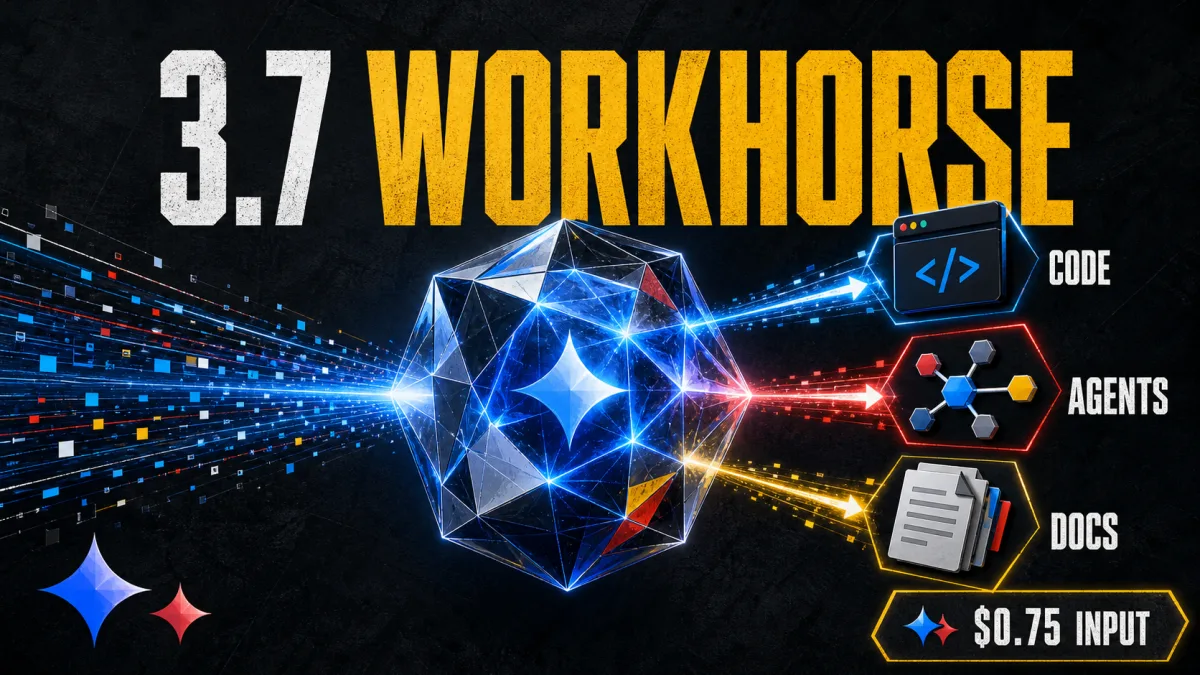
Gemini 3.7 Flash is Google’s new workhorse model for coding and AI agents, with stronger reported results than Gemini 3.6 Flash and an introductory input price of $0.75 per 1 million tokens. Google announced the model on August 13, 2026, positioning it for software engineering, web development, knowledge work and enterprise automation. For teams comparing model releases, the practical question is not whether 3.7 Flash is “smarter” in the abstract; it is whether the model completes a real workflow with fewer retries and lower cost. Read our broader guide to how AI agents differ from chatbots before evaluating the model as an operator.
Definition: Gemini 3.7 Flash is Google’s Flash-family model for coding, agentic workflows, web development and knowledge work, based on Gemini 3.6 Flash.
Example: A development agent can use Gemini 3.7 Flash to debug an issue, call tools across several steps and produce more production-ready code.
Key takeaway: The release is about capability per completed task, not only a larger model number.
Business impact: The introductory price can make stronger reasoning and tool use easier to test in production agents, but the price rises after 2026 and does not remove the need for workflow evaluation.
What changed in Gemini 3.7 Flash?
Gemini 3.7 Flash adds algorithmic improvements to the Gemini 3 reasoning foundation while keeping the Flash family’s workhorse positioning. Google says the model adapts better to roadblocks, asks for clarification when intent is unclear, follows instructions more faithfully and spends more effort on multi-step planning and tool calls. For an engineering or operations team, the immediate test is whether those changes reduce manual intervention and retries in a complete workflow, rather than whether a single response sounds more polished. Google’s launch announcement is the primary source for the release scope and introductory pricing.
Gemini 3.7 Flash also keeps a broad input surface: text, images, audio and video, with a context window of up to 1 million tokens and a maximum output of 64K tokens, according to the Gemini 3.7 Flash model card. That combination makes the model relevant to long codebases, large documents and multimodal product workflows, but teams should still measure context quality on their own material because a large window does not guarantee accurate retrieval or reasoning.
How much better is Gemini 3.7 Flash at coding?
Gemini 3.7 Flash reports higher coding scores than Gemini 3.6 Flash on both production-code quality and long-horizon software engineering. The model card lists 43.6% versus 34.4% on FrontierCode 1.1 Main, while Google’s launch comparison reports 65.3% versus 49.0% on DeepSWE v1.1. Those results support testing Gemini 3.7 Flash for debugging, issue resolution and code generation, while the actionable next step is to compare accepted pull requests, test failures and review time on a representative repository.
Gemini 3.7 Flash is also positioned as a stronger web-development model, not only a backend coding model. Google reports a WebDev Arena Elo score of 1588 for 3.7 Flash versus 1538 for 3.6 Flash, and says the model creates more functional layouts and feature-complete apps in fewer prompts. Teams generating interfaces should therefore test reference-image adherence, accessibility, functional behavior and the number of correction prompts, not treat the leaderboard score as a guarantee of production quality. The WebDev Arena leaderboard provides the external evaluation context.
Can Gemini 3.7 Flash run enterprise workflows?
Gemini 3.7 Flash reports a large improvement on enterprise workflow automation: 30.4% versus 17.0% for Gemini 3.6 Flash on AutomationBench. That result matters for agents that must interpret business context, choose among tools and complete a multi-step process, because the failure mode is often an incorrect action rather than a poor paragraph. A team evaluating Gemini 3.7 Flash should replay normal cases, missing-data cases, tool failures and escalation cases before granting the model write access to business systems. AutomationBench documents the benchmark’s workflow focus.
Gemini 3.7 Flash also improves on the GDP.pdf document-comprehension benchmark, scoring 34.0% versus 22.0% for Gemini 3.6 Flash in Google’s published comparison. That makes the model a candidate for finance, legal and bioscience document workflows, but not an automatic replacement for review. Operators should validate extracted fields, preserve document citations and send ambiguous or high-consequence cases to a person before expanding the agent’s permissions.
What does Gemini 3.7 Flash cost?
Gemini 3.7 Flash costs $0.75 per 1 million input tokens and $3.75 per 1 million output tokens through December 31, 2026, under Google’s introductory pricing. The model card says those prices increase to $1.50 and $7.50 respectively from January 1, 2027. The useful comparison is therefore time-bounded: teams can run a discounted evaluation now, but a production business case should use the post-introduction price or show that the workflow will remain viable after the change.
Gemini 3.7 Flash’s token price is only one part of an agent’s operating cost: the introductory $0.75 input and $3.75 output rates can still become expensive when a workflow sends oversized context, retries failed tool calls or requires extensive human correction. A reliable Gemini 3.7 Flash evaluation should record cost per completed task, latency, tool-call success, retry count and review time. That is the same model-selection discipline described in our practical guide to evaluating new AI models, applied to this specific release.
How does Gemini 3.7 Flash fit into Gemini Spark?
Gemini Spark will use Gemini 3.7 Flash starting August 13, 2026, according to Google, with the stated goal of improving knowledge work and Google Workspace tool use. Spark is available to Google AI Pro and Ultra subscribers in more than 160 countries, although regional and product availability rules still apply. The update is significant because it connects the model upgrade to a consumer-facing agent that can consolidate files, draft emails and update status documents under a user’s direction.
For individuals, the model change should be judged by whether Spark completes those multi-skill tasks more accurately and with fewer corrections. For enterprises, Spark is a reminder that model capability and permission design are inseparable: an agent that can read files or draft messages may still need confirmation before changing shared documents or sending consequential communications.
Where can developers access Gemini 3.7 Flash?
Developers can try Gemini 3.7 Flash in Google AI Studio, the Gemini API, Google Antigravity and Android Studio, while enterprises can access it through Gemini Enterprise Agent Platform and Gemini Enterprise. Google’s launch announcement also points individuals to Gemini Spark. Builders should verify the current model ID, quotas, rate limits and regional availability in the relevant Gemini API documentation before changing application routing. Background: Gemini API Managed Agents: 3.6 Flash, hooks, and more.
Gemini 3.7 Flash access does not mean that every surface exposes the same controls: Google lists AI Studio, the Gemini API, Antigravity, Android Studio and enterprise products as separate access channels. A developer API may offer thinking configuration and structured tool calls, while a consumer agent may abstract those settings behind a product experience. Teams should test the Gemini 3.7 Flash interface they will actually operate, keep a fallback model during migration and log model version, prompt context, tool arguments and final task outcome.
What safety limits should operators watch?
Gemini 3.7 Flash ships with updated safeguards for misuse involving chemical, biological, radiological and nuclear risks and cyber offense, according to Google’s announcement. The model card also notes possible hallucinations, occasional timeouts, uneven knowledge coverage and ongoing work on jailbreak resistance. Those limits mean an agent should not receive broad permissions simply because its benchmark scores improved: access scopes, validation rules, audit logs and escalation paths remain part of the system.
Gemini 3.7 Flash has a March 2026 knowledge cutoff, with some domains potentially limited to January 2025, according to its model card. A workflow that depends on current law, prices, security advisories or live operational data should retrieve that information from an approved source instead of assuming Gemini 3.7 Flash knows it. Teams can then use Gemini 3.7 Flash for reasoning over verified context while keeping freshness and authority outside the model.
What should teams do with Gemini 3.7 Flash?
Gemini 3.7 Flash is worth testing when a team needs stronger coding, web development, document reasoning or tool-using agents and can measure the result against Gemini 3.6 Flash. Start with one reversible workflow, create a fixed evaluation set and compare completed-task cost, quality, latency, retries and human review. Do not migrate every task because a public benchmark moved upward; route only the workflows where the improvement survives real inputs.
The release’s durable signal is the combination of capability and price discipline. Gemini 3.7 Flash gives developers a cheaper introductory path to a more capable Flash model, but the offer is temporary and the model still has ordinary foundation-model limits such as hallucinations and timeouts. The right Gemini 3.7 Flash production decision is to test the model now, price the workflow for January 2027 and keep a human boundary wherever an incorrect action costs more than another model call.
Frequently asked questions
What is Gemini 3.7 Flash?
Gemini 3.7 Flash is Google’s latest Flash-family model for coding, agentic workflows, web development and knowledge work. Google describes it as an upgrade over Gemini 3.6 Flash, with stronger benchmark results, improved planning and tool use, multimodal inputs, a context window of up to 1 million tokens and a 64K-token output limit. It is available through Google AI Studio, the Gemini API, Google Antigravity, Gemini Enterprise Agent Platform and Gemini Spark, subject to each product’s access rules.
How much does Gemini 3.7 Flash cost?
Gemini 3.7 Flash has an introductory price of $0.75 per 1 million input tokens and $3.75 per 1 million output tokens through December 31, 2026, according to Google’s model card. From January 1, 2027, the listed price becomes $1.50 per 1 million input tokens and $7.50 per 1 million output tokens. Teams should still compare cost per completed task, because retries, tool calls, context size and human review can matter more than token price.
Is Gemini 3.7 Flash good for AI agents?
Gemini 3.7 Flash is designed for AI-agent workloads that require planning, tool calls, coding and multi-step execution. Google reports improvements on agentic terminal coding, enterprise workflow automation, long-context tasks and computer-use evaluations compared with Gemini 3.6 Flash. The model card also describes customizable thinking configurations that let developers trade quality against cost and latency. Production teams should test those settings on representative tasks before routing important work to the model.
Where can developers use Gemini 3.7 Flash?
Developers can access Gemini 3.7 Flash through Google AI Studio, the Gemini API, Google Antigravity and Android Studio, according to Google’s launch announcement and model documentation. Enterprises can access it through Gemini Enterprise Agent Platform and the Gemini Enterprise app. The Gemini API developer guide and each product’s documentation determine the current model ID, quotas and availability for a particular account.
What are Gemini 3.7 Flash’s main limitations?
Gemini 3.7 Flash retains general foundation-model limitations, including possible hallucinations, occasional slowness or timeouts and uneven knowledge coverage. Google’s model card gives March 2026 as the knowledge cutoff for the model, while some domains may have information limited to January 2025. Google also says it continues to strengthen jailbreak resistance and Frontier Safety mitigations. Teams should use validation, permissions and human escalation for workflows where an incorrect action is costly.
Alex
Founder & Lead AI Writer
Alex is the founder of Yowox and lead AI writer since 2024, breaking down complex information into clear, actionable insights for thousands of readers every day. Alex has built AI automation systems for businesses since 2024, focusing on AI agents, workflow automation, and business process optimization.
Save hours. Save thousands.
Practical guides, real workflows, and the latest AI and automation news that matters — straight to your inbox.