 By Alex
 Can AI Agents Replace Employees? What the Research Actually Shows
A Stanford/Carnegie Mellon study found fully autonomous AI agents perform worse than humans alone, while hybrid human-plus-agent teams outperform both. Here's what that means for which jobs are actually at risk.
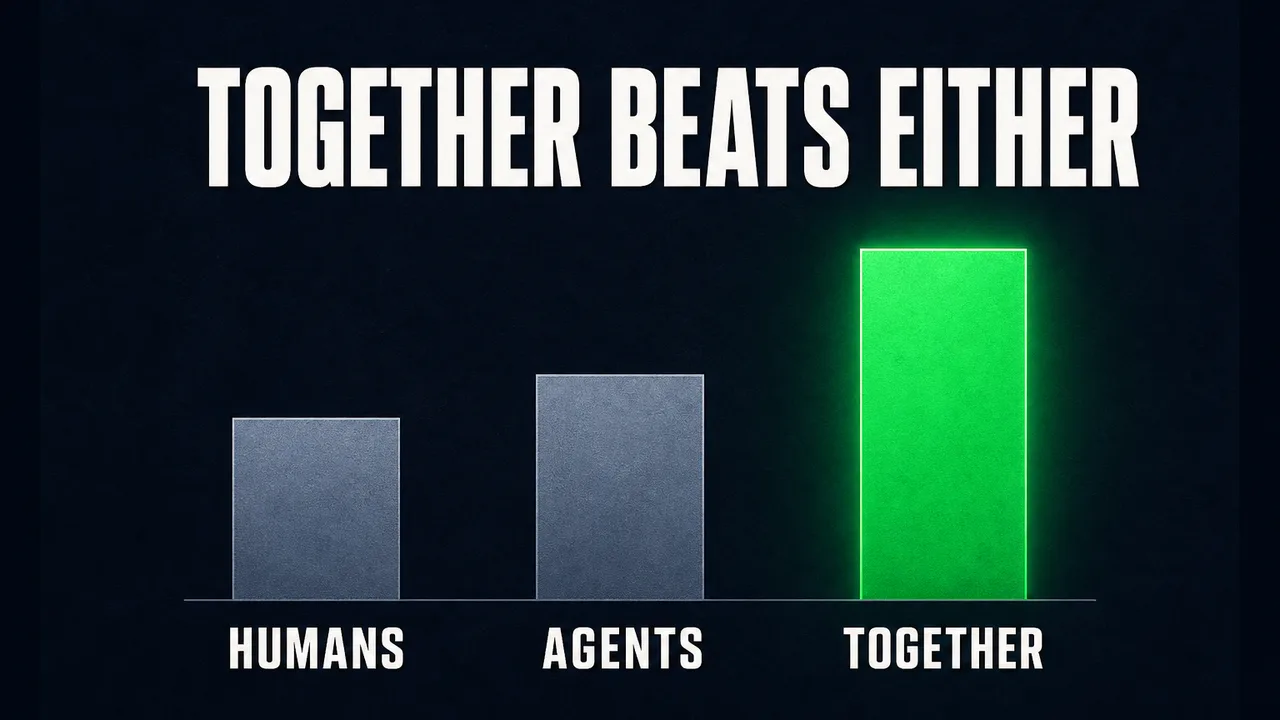
The most rigorous evidence available says no, not wholesale. A November 2025 study from Stanford and Carnegie Mellon researchers tested this directly, pitting 48 qualified human professionals against four leading AI agent frameworks across 16 realistic, multi-step tasks built to represent 287 U.S. occupations, and found that humans working alone outperformed the fully autonomous agents by 32.5-49.5% on quality — even though the agents finished tasks 88.3% faster and sometimes fabricated data outright when they got confused.
Definition: "Replacing" an employee means a task or role runs fully autonomously with no human review, as distinct from augmentation, where an AI agent handles part of the work under ongoing human oversight.
Example: A bank-teller role fully automated by a check-processing agent is replacement; a support team where an agent drafts replies a person reviews before sending is augmentation.
Key takeaway: Fully autonomous agents perform worse than humans alone on quality — but hybrid human-plus-agent teams outperform both humans alone and full automation.
Business impact: Full replacement is well-supported for narrow, repetitive, rule-based tasks. Most judgment-heavy roles are safer and more productive augmented, not replaced outright.
What does the research actually say about AI agents replacing human work?
Any plan to fully replace a role with an autonomous agent should be tested against this exact quality gap before committing, not waved away because the agent finishes faster. The researchers built what they call a "workflow-induction toolkit" that converts raw computer interactions — clicks, keystrokes, file navigation — into readable step-by-step workflows, which let them compare how the work got done, not just whether the final output looked right. That method is what surfaced the agents' specific failure pattern: when an agent got confused partway through a task, it sometimes fabricated data or abandoned the files it was given to search the open web instead, the kind of failure a glance at final output alone would miss.
A different measure of workplace change appears in OpenAI’s analysis of how AI expands the tasks people attempt at work. Its cross-occupation request data describes shifting task boundaries, but it does not establish productivity gains, job replacement or hiring outcomes.
Which jobs are already being displaced?
Displacement is real, but concentrated in a specific kind of work. The World Economic Forum's Future of Jobs Report names bank tellers and data entry clerks among the fastest-declining roles through 2030, alongside cashiers and administrative assistants. Businesses should expect the sharpest disruption in roles that already look like this one — high-volume, rule-based, low-judgment — not assume it spreads evenly across every job in the company.
Which jobs is AI creating instead?
The same body of research shows genuinely new roles emerging, not just old ones disappearing: a global net of 170 million new jobs versus 92 million displaced by 2030. Separate WEF research specifically on AI's effect on entry-level work names AI Trainers and Evaluators, AI Ethics and Governance Officers, and Human-in-the-Loop Coordinators among the fastest-growing roles, with the two fastest projected at 34% and 28% compound annual growth through 2028. For most businesses, the real challenge isn't a shrinking workforce so much as a reskilling gap: the people being displaced from declining roles aren't automatically the people qualified for the new ones, and closing that gap is what actually determines whether this transition goes well internally.
Why do hybrid teams outperform full automation?
Hybrid teams outperform full automation because they split work along each side's actual strength instead of asking one side to do everything. The same Stanford/Carnegie Mellon research found hybrid human-plus-agent teams delivered a 68.7% overall performance improvement and agent-assisted humans gained 24.3% efficiency, while full automation without human review actually slowed work down by 17.7% — the time saved by the agent got eaten by the time spent verifying and fixing its mistakes. The practical implication: design the workflow so the agent handles the fast, repetitive part and a person handles judgment and verification, rather than treating "full automation" as a single all-or-nothing switch.
So should a business replace employees with AI agents?
Match the answer to how repetitive versus judgment-heavy the actual task is, the same distinction covered in AI agents vs. RPA: outright replacement is best supported by the data for narrow, high-volume, rule-based work, which is exactly the profile of the roles already declining fastest. For anything that requires real judgment, the research points toward augmentation instead — an agent doing the repetitive part with a person reviewing before anything real-world happens, the same human-checkpoint principle laid out in how to get started with AI agents and the first mistake worth avoiding in AI agent mistakes beginners make: trusting agent output fully, too soon, with no review step. Whether a specific role is worth building or buying an agent for at all is its own decision — see build vs. buy for AI agents — but the research is clear that the choice isn't "replace the whole role or don't automate at all." It's closer to: automate the narrow part that's actually repetitive, and keep a person in the loop for the part that requires judgment.
Frequently asked questions
Can AI agents fully replace employees?
Not wholesale, according to the best available research. A Stanford/Carnegie Mellon study found fully autonomous AI agents perform 32.5-49.5% worse on quality than humans working alone, even though the agents finish tasks faster. Full replacement is best supported for narrow, repetitive, rule-based tasks, not whole judgment-heavy roles.
Which jobs are AI agents actually displacing right now?
The World Economic Forum's research names bank tellers, data entry clerks, cashiers, and administrative assistants among the fastest-declining roles through 2030 — displacement is concentrated in high-volume, rule-based work like this, not spread evenly across all jobs.
Is AI creating new jobs, or only eliminating old ones?
Both. The World Economic Forum projects 170 million new jobs globally against 92 million displaced by 2030 — a net gain, but not to the same workers or roles. New roles include AI Trainers and Evaluators, AI Ethics and Governance Officers, and Human-in-the-Loop Coordinators, with the fastest-growing of these projected at 34% compound annual growth through 2028.
Why do hybrid human-AI teams outperform fully autonomous agents?
Because they split work along each side's actual strength. Research found hybrid teams delivered a 68.7% overall performance improvement, while full automation without human review actually slowed work down by 17.7% — the time an agent saved got eaten by the time spent verifying and fixing its mistakes. Agents are faster; humans catch and correct errors agents can't catch in themselves.
How should a business decide whether to replace or augment a role?
Match the approach to how repetitive versus judgment-heavy the task is. Narrow, high-volume, rule-based tasks are where outright automation is best supported by the data. Roles that require real judgment calls are better served by an agent handling the repetitive part with a person reviewing before anything real-world happens — the same human-checkpoint principle that applies to any new AI agent deployment.
Alex
Founder & Lead AI Writer
Alex is the founder of Yowox and lead AI writer since 2024, breaking down complex information into clear, actionable insights for thousands of readers every day. Alex has built AI automation systems for businesses since 2024, focusing on AI agents, workflow automation, and business process optimization.
Save hours. Save thousands.
Practical guides, real workflows, and the latest AI and automation news that matters — straight to your inbox.