 By Alex
 AI Is Expanding Work Beyond Job Descriptions
OpenAI's analysis of more than 800,000 work-related ChatGPT messages shows how AI is moving tasks across occupational boundaries — and why that signal is not the same as productivity or job replacement.
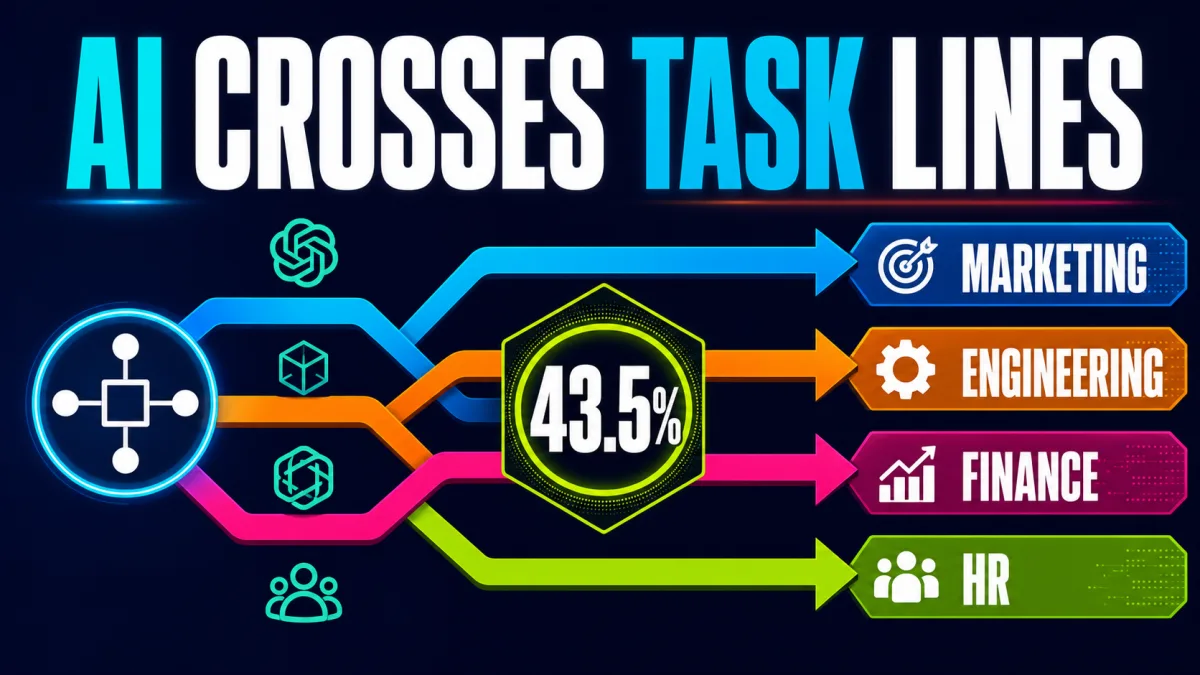
AI is expanding the range of work people can attempt before companies have decided who officially owns it. OpenAI's analysis of more than 800,000 work-related ChatGPT messages found that many users ask for help with tasks historically associated with another occupation. That is evidence of a changing division of labor, not evidence that occupations are disappearing.
Definition: Task crossover is work historically associated with one occupation appearing in the AI use of a person in another occupation.
Example: A salesperson can explore a customer dataset, a marketer can troubleshoot a website, and a small-business owner can prepare a first-pass financial analysis without waiting for a separate specialist.
Key takeaway: AI lowers the cost of attempting work outside a formal job description, but attempting a task is not the same as owning its outcome.
Business impact: Leaders should treat cross-occupation AI use as a signal to redesign handoffs, training, and review — not as a shortcut to cutting an entire role.
What did OpenAI actually measure?
OpenAI measured the task composition of work-related AI use, not the performance of workers. The researchers took a random sample of messages from U.S. ChatGPT users whose self-reported roles could be linked to customer experience, design, engineering, finance, human resources, legal, marketing, or sales; they then mapped each message to the closest O*NET detailed work activity. The published Work at the Frontier analysis therefore describes messages, not people, hours, completed projects, or business outcomes. Related reading: ChatGPT adoption: From answers to action worldwide.
The headline numbers become meaningful only when their denominators stay visible. Across the sample, 16.8% of work-related messages were classified as cross-occupation. Once broadly shared activities such as writing, summarizing, and scheduling were excluded, 43.5% of occupation-specific messages concerned work historically associated with another occupation. The 43.5% figure is therefore not the share of employees doing another job, and neither percentage is a productivity rate.
Which occupations stretch beyond their usual boundaries?
AI-assisted work crosses occupational boundaries most often in customer experience, design, human resources, legal work, and marketing. In OpenAI's non-generic sample, cross-occupation tasks made up 77% of customer-experience messages, 75% of design messages, 69% of human-resources messages, 56% of legal messages, and 53% of marketing messages. These shares describe the mix of messages after generic work was removed, so they identify where task mixing is visible rather than ranking workers or professions.
The full Work at the Frontier report shows that crossover has two directions: workers can borrow tasks from other fields, while a profession's own tasks can spread into other jobs. Design is the clearest example of the first pattern: about 35.2% of designers' messages involved work associated with another occupation, while design tasks accounted for only 1.7% of messages from workers in other fields. Engineering is closer to the reverse, with 18.5% of engineering messages involving outside tasks while engineering tasks represented 7.4% of messages in other occupations. Marketing does both: marketers used AI for outside tasks in 24.3% of their messages, while marketing tasks represented 8.9% of messages from other fields.
That distinction changes the business question. A department that frequently borrows work may be becoming more generalist, while a department whose tasks travel widely may be turning into an internal capability layer. Neither pattern says that the originating specialists are unnecessary; it says that AI is making some of their work easier for other employees to start.
Which tasks travel furthest?
The most portable cross-occupation tasks are practical, bounded activities rather than entire professions. OpenAI found that financial calculation and troubleshooting computer applications or systems each appeared among the three most common related tasks in all seven other occupation groups; recurring examples also included creating marketing materials, discussing customer or product information, and communicating with government agencies. The pattern suggests that AI is opening access to specialist-adjacent work where the first step can be expressed in language and checked against a source or rule.
For a team, the useful response is to inventory repeated handoffs rather than label a whole role “automatable.” A sales team can ask whether a customer-data request needs a full analyst handoff or only a reviewed first-pass exploration; a marketing team can distinguish a small website fix from production engineering; and a finance team can separate a draft calculation from an approved financial decision. This is the same boundary that matters when comparing an AI agent with a chatbot: generating or preparing work is different from giving a system permission to act. More on this: How sales teams use ChatGPT Work.
Why is crossover stronger in smaller workspaces?
Smaller workspaces show more cross-occupation AI use among typical-volume users, which is consistent with AI serving as a generalist layer where fewer specialists are immediately available. OpenAI reported a cross-occupation share of 18.9% for users in 2–5-seat workspaces versus 16.3% in workspaces with 101 or more seats, while noting that the pattern was not monotonic among the heaviest users and that workspace seats are not the same as total company headcount.
The result is descriptive rather than causal: it does not prove that company size created the difference. It does offer a credible workflow hypothesis for small businesses — the person closest to a problem may use AI to prepare work that would otherwise wait for a specialist. That can widen individual responsibility, but it also makes explicit review ownership more important when the draft affects money, customers, compliance, or production systems.
Is AI expanding high-value work or just making tasks faster?
AI appears to be expanding access to analysis and problem-solving, but the strongest evidence still comes from usage and self-report rather than controlled output measures. Microsoft's 2026 Work Trend Index combined anonymized Microsoft 365 Copilot usage with a survey of 20,000 AI-using workers across 10 countries; its Copilot analysis found 49% of conversations supported cognitive work such as analyzing information, solving problems, evaluating, or thinking creatively, while 66% of surveyed AI users said AI let them spend more time on high-value work and 58% said it helped them produce work they could not have produced a year earlier.
Microsoft's findings also point to the new constraint: judgment does not disappear when execution gets cheaper. In the survey, 86% of AI users said they treat AI output as a starting point rather than a final answer, while quality control and critical thinking ranked as the most important human skills as AI takes on more work. For employees, the practical shift is from producing every first draft alone to setting intent, checking evidence, refining the result, and owning the consequence.
Why are organizations changing more slowly than individual workers?
Individual AI use can expand before the surrounding workflow, incentives, and controls catch up. Gallup's survey of 23,717 U.S. employees found that half used AI in their role at least a few times a year and 65% of employees in AI-adopting organizations said AI improved their productivity or efficiency, yet only about one in ten strongly agreed that AI had transformed how work gets done across their organization.
That gap matters because a faster first draft does not automatically create a better operating model. If a worker can prepare analysis outside their role but nobody has defined the source of truth, approval threshold, or accountable owner, the organization has expanded activity without necessarily improving the outcome. The first step toward value is to turn informal crossover into a bounded workflow with a named reviewer and a measurable result; a workflow ROI estimate is more useful than a vague claim that AI “saves time.”
What should leaders do with the signal?
Leaders should map AI-assisted handoffs before rewriting job descriptions. OpenAI's message-level evidence shows where employees are already attempting neighboring tasks, while Gallup's organization-level evidence shows that individual efficiency can coexist with limited workflow transformation. Together, those findings support a practical sequence: identify repeated cross-functional requests, define which parts AI may prepare, assign a domain owner for review, and measure cycle time, correction rate, quality, and escalation volume before expanding access.
Leaders should also separate permission from capability. An employee may be capable of producing a plausible legal, financial, technical, or customer-facing draft with AI while still lacking authority to approve it. A safe design gives AI room to prepare low-risk work, keeps consequential decisions with the accountable specialist, and records the evidence used for approval. That approach captures the benefit of broader task access without pretending that a fluent output has replaced professional judgment.
Does expanding work mean jobs are being replaced?
The current evidence does not support a simple replacement story. OpenAI's research observes what users ask AI to help with and explicitly does not measure whether an output was used, whether it was correct, whether it saved time, or whether employment changed. A separate Boston Consulting Group analysis estimates that 50%–55% of U.S. jobs could be reshaped by AI over the next two to three years, while estimating that 10%–15% could be vulnerable to elimination over four to five years; BCG states that its model is not an unemployment forecast and depends on adoption, demand, and other unknowns.
The more defensible near-term picture is redistribution inside jobs. Routine execution may shrink, while verification, exception handling, systems thinking, customer judgment, and work design grow. That does not make the transition painless: if entry-level execution is automated faster than organizations create new learning paths, workers can lose the easiest route into higher-responsibility work. The question is therefore not only which tasks AI can perform, but who gets practice, authority, and credit for the new bundle of human-and-machine work.
The bottom line
AI is expanding what people do at work by lowering the cost of crossing from one occupational task set into another. OpenAI's 43.5% figure is a strong signal of that boundary crossing inside occupation-specific AI use, but it is not a jobs forecast and not proof of productivity. Microsoft and Gallup point to the same unresolved issue from different angles: people report broader and more valuable AI-assisted work, while organizations are still redesigning the systems around it. Background: Why generative AI invites endless micro-iterations.
The companies that benefit will not be the ones that merely give everyone a chatbot. They will be the ones that notice which handoffs are changing, turn safe crossover into measured workflows, preserve specialist accountability where risk is high, and give workers a way to build judgment instead of outsourcing it. AI is expanding the task bundle; management still decides whether that bundle produces better work.
Frequently asked questions
What does task crossover mean in the OpenAI workplace study?
Task crossover means that a work activity historically associated with one occupation appears in the AI use of a person in another occupation. OpenAI mapped work-related ChatGPT messages to O*NET activities and compared those activities with the user's self-reported occupation. The measure shows what people ask AI to help with; it does not prove that they completed the task independently, performed it correctly, or changed jobs.
How much workplace AI use crosses occupational boundaries?
OpenAI found that 16.8% of all work-related messages in its sample were about tasks associated with another occupation. After generic activities such as writing, summarizing, and scheduling were removed, 43.5% of occupation-specific messages crossed into another occupation's historical task boundary. The denominator matters: neither figure is the share of workers doing a second job or a measure of productivity.
Which tasks are spreading across occupations?
OpenAI found recurring cross-occupation requests involving financial calculations, computer troubleshooting, customer and product information, marketing materials, and communication with government agencies. Financial calculation and computer troubleshooting each appeared among the three most common related tasks in all seven other occupation groups studied. These are signs of easier access to specialist-adjacent work, not proof of expert-level performance without review.
Does AI expanding people's work mean jobs are disappearing?
No. The OpenAI analysis measures AI-assisted messages, not employment, wages, output, quality, or hiring. Other research expects many roles to change substantially while warning that task automation is not the same as job loss. The defensible conclusion is that AI can change the division of work before companies change job titles, staffing plans, or reporting lines.
Alex
Founder & Lead AI Writer
Alex is the founder of Yowox and lead AI writer since 2024, breaking down complex information into clear, actionable insights for thousands of readers every day. Alex has built AI automation systems for businesses since 2024, focusing on AI agents, workflow automation, and business process optimization.
Save hours. Save thousands.
Practical guides, real workflows, and the latest AI and automation news that matters — straight to your inbox.