 By Alex
 How sales teams use ChatGPT Work
OpenAI's sales workflows show how ChatGPT Work can turn CRM context, customer conversations and deal signals into usable briefs, meeting packs, forecast reviews and account plans.
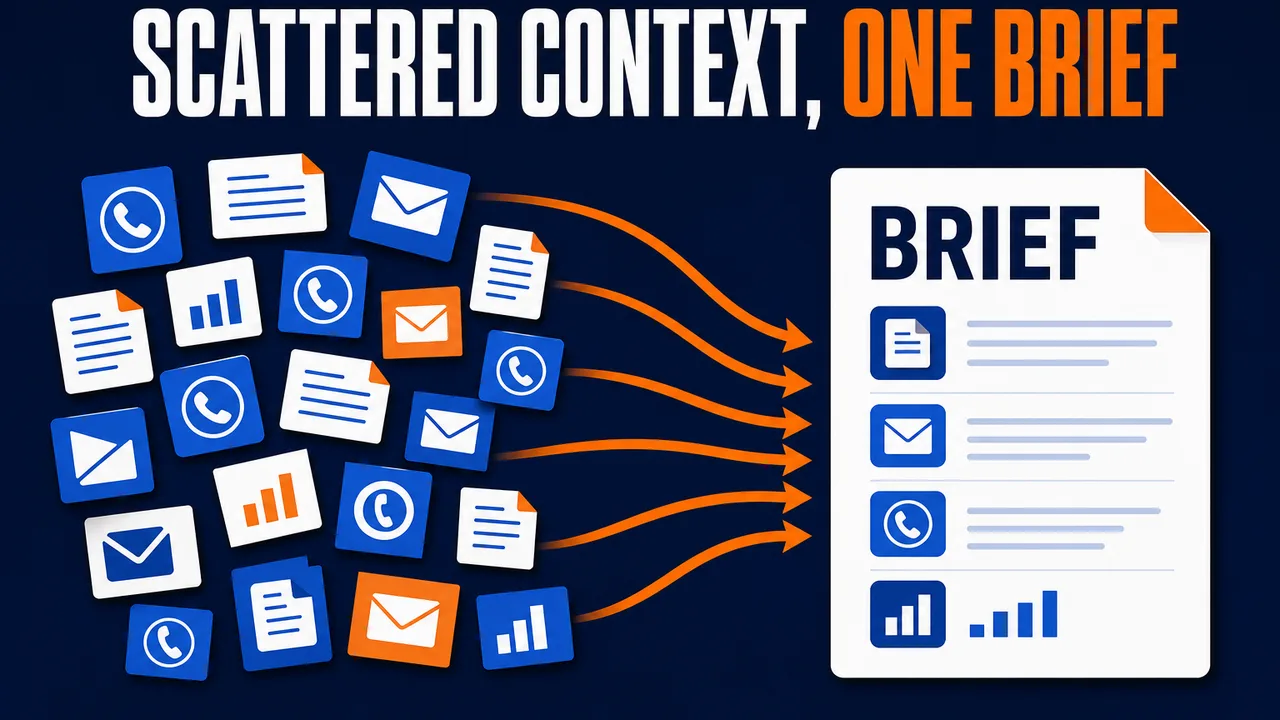
OpenAI’s sales playbook for ChatGPT Work is less about writing generic emails and more about turning scattered account context into the next useful sales artifact. The proposed workflow combines CRM fields, call notes, email threads, Slack discussions, decks, customer documents and account signals so sellers and managers can begin with a coherent draft instead of a blank page.
Definition: ChatGPT Work is positioned as a context-assembly layer for sales work, turning fragmented account information into briefs, meeting packs, reviews and plans.
Example: Before a customer meeting, a seller can ask for a preparation pack that brings together the account history, recent conversations, open risks and relevant follow-up questions.
Key takeaway: The value is not autonomous deal ownership; it is reducing the time between “the information exists somewhere” and “the team has a usable working document.”
Business impact: Sales teams can spend less time assembling context and more time deciding what to do with it—but the relationship strategy and final judgment remain human responsibilities.
Why sales teams need a context layer
Sales information rarely lives in one system. A CRM may hold opportunity stages and contact fields, while call notes describe objections, email threads contain commitments, Slack contains internal context and customer documents explain the account’s priorities. A manager reviewing a deal may need all of those sources before deciding whether the forecast is credible.
That fragmentation creates a predictable cost: every new meeting, forecast call or account review begins with manual context assembly. People search, copy, paste, reconcile and format before they can do the actual reasoning.
OpenAI’s description of ChatGPT Work for sales teams focuses on this assembly problem. The assistant produces a first usable version of the artifact, while the seller or manager decides what is accurate, important and appropriate to share.
This is a familiar pattern in AI agent workflows: the system handles bounded information work and tool use, but the human owns decisions that carry relationship, commercial or reputational consequences.
Five sales artifacts ChatGPT Work can accelerate
1. Prioritized account briefs
An account brief turns a large amount of customer context into a compact view of what matters now. OpenAI describes using account context and signals to identify high-priority accounts and surface the information a seller needs to act.
A useful brief should answer practical questions:
- Why is this account a priority now?
- What changed since the last meaningful interaction?
- Which stakeholders are engaged, silent or at risk?
- What evidence supports the current opportunity stage?
- What is the next action and who owns it?
The important distinction is between summarizing everything and prioritizing what changes the next decision. A long transcript dump may be complete but still fail as a sales brief.
2. Meeting preparation packs
Meeting preparation is a natural context-assembly task. A seller can bring together account history, recent conversations, open opportunities, customer documents and internal notes before the call.
The output is most useful when it separates facts from preparation prompts. A strong pack might include:
| Section | What it should contain |
|---|---|
| Account context | Current relationship, opportunity and relevant history |
| New signals | Recent events, changes, risks or commitments |
| Meeting objective | The outcome the seller needs from this conversation |
| Questions | Gaps that need confirmation from the customer |
| Follow-up plan | Owners, next steps and unresolved decisions |
The generated pack is a starting point, not a script. The seller still needs to remove stale assumptions, adapt the language to the relationship and decide which questions are appropriate for the customer.
3. Follow-ups and customer-record updates
After a meeting, the work often shifts from conversation to administration: capture the commitments, draft the follow-up, identify owners and update the customer record.
OpenAI’s sales-plugin description includes completing follow-ups and updating customer records among the intended workflows. That can reduce the gap between what was agreed verbally and what the rest of the team can see in the systems they use.
The control point is verification. A model can confuse a suggestion with a commitment or assign an action to the wrong person. Any workflow that writes to a CRM should make proposed changes visible for review before they become durable records.
4. Forecast risk reviews
Forecast reviews are not just arithmetic. A manager needs to evaluate whether the opportunity evidence supports the stage, whether recent customer behavior changes the outlook and whether the next step is concrete enough to justify confidence.
ChatGPT Work can help assemble the evidence for a review by connecting opportunity data with conversations, notes and account signals. It can also organize the reasons a deal may be at risk so the manager can challenge assumptions consistently across a pipeline.
That does not make the forecast objective by default. If the underlying CRM fields are stale, the conversations are incomplete or the signals are interpreted without context, a polished review can still be wrong. The assistant improves the review process when it makes evidence easier to inspect—not when it turns uncertainty into a confident sentence.
5. Account plans and stalled-deal diagnosis
Account planning requires a longer view: customer priorities, stakeholders, expansion possibilities, blockers and a sequence of actions. A stalled-deal diagnosis is narrower but related: what changed, where momentum stopped and which missing piece is preventing movement?
OpenAI lists building close plans, creating account strategies and reviewing deals at risk among the sales-plugin use cases. These outputs are useful when they distinguish observed evidence from proposed tactics.
For example, an account plan can label each item as:
- Observed: a statement or event supported by the available record;
- Inferred: a plausible interpretation that needs confirmation;
- Proposed: a next action the team may choose to test.
That separation helps prevent an AI-generated hypothesis from becoming an accidental “fact” in the account strategy.
The sales plugin connects the work to sales systems
OpenAI says the ChatGPT Work sales plugin can bring customer context into workflows involving Salesforce, HubSpot, Slack, Outreach, Clay, Rox and Actively. The practical implication is that the assistant is not limited to a chat window where someone manually pastes every note.
Connections also introduce the most important implementation questions:
- Scope: Which accounts, channels, records and documents can the assistant access?
- Freshness: How quickly do updates in the source systems become visible?
- Write permissions: Can the assistant only propose changes, or can it execute them?
- Auditability: Can a team see which sources supported a generated brief or update?
- Access boundaries: Are customer-sensitive records separated correctly by team, region and role?
The plugin makes context gathering more convenient, but convenience is not the same as governance. The more systems a workspace can read or update, the more important it becomes to use least-privilege access, review gates and an audit trail.
What sales leaders should measure
A sales team should not evaluate this kind of workflow only by asking whether the generated prose sounds good. Better measures focus on the distance between information and action:
- time spent preparing a meeting or forecast review;
- percentage of follow-ups captured within an agreed window;
- number of records requiring correction after an AI-assisted update;
- time for a manager to find the evidence behind a risk decision;
- rate at which proposed next steps are accepted, edited or rejected;
- seller and manager adoption across the intended workflow.
These measures reveal whether the system removes repetitive assembly work or simply creates another draft that someone must clean up. They also preserve a useful distinction between speed and quality: a faster wrong account brief is not a sales productivity win.
The boundary OpenAI keeps visible
The most important line in OpenAI’s description is that sellers and managers still own relationship strategy and judgment. That boundary is easy to lose when an assistant can read more context and produce polished artifacts quickly.
A practical operating model is:
- let the assistant gather and organize context;
- require a human to verify important facts and interpretations;
- keep proposed CRM or outreach changes reviewable;
- record the source context behind consequential recommendations;
- let the account owner decide what happens next.
In that model, ChatGPT Work is not a replacement sales manager. It is a context and drafting layer that helps a sales team reach the decision point with less manual assembly.
FAQ
Is this primarily an email-writing tool?
No. Email and follow-up drafting are part of the picture, but OpenAI’s sales workflows emphasize a broader set of artifacts: account briefs, meeting preparation, forecast risk reviews, account strategies, close plans and stalled-deal analysis.
Will every sales team get the same results?
No. Results depend on the quality, freshness and accessibility of the underlying CRM, conversation and account data, as well as the team’s review and permission design.
What should a team start with?
Choose one bounded, high-frequency artifact—such as meeting preparation or post-call follow-up—define the required fields and approval step, then measure time saved and correction rate before expanding access or write permissions.
Frequently asked questions
What is ChatGPT Work for sales teams?
ChatGPT Work is presented as a workspace where sales teams can combine account context, customer conversations and deal signals to produce working sales artifacts such as account briefs, meeting preparation, forecast reviews and account plans.
Can ChatGPT Work replace a sales rep or manager?
No. OpenAI frames it as a way to produce the first usable version of an artifact faster while sellers and managers retain responsibility for relationship strategy, prioritization and judgment.
Which tools can the sales plugin connect?
OpenAI lists Salesforce, HubSpot, Slack, Outreach, Clay, Rox and Actively among the tools the sales plugin can work with; availability and permissions still depend on the team's setup.
Alex
Founder & Lead AI Writer
Alex is the founder of Yowox and lead AI writer since 2024, breaking down complex information into clear, actionable insights for thousands of readers every day. Alex has built AI automation systems for businesses since 2024, focusing on AI agents, workflow automation, and business process optimization.
Save hours. Save thousands.
Practical guides, real workflows, and the latest AI and automation news that matters — straight to your inbox.