 By Alex
 ChatGPT adoption: From answers to action worldwide
OpenAI's latest Signals data shows ChatGPT moving from information-seeking toward task completion at work, while adoption spreads across regions, age groups and multimedia use.
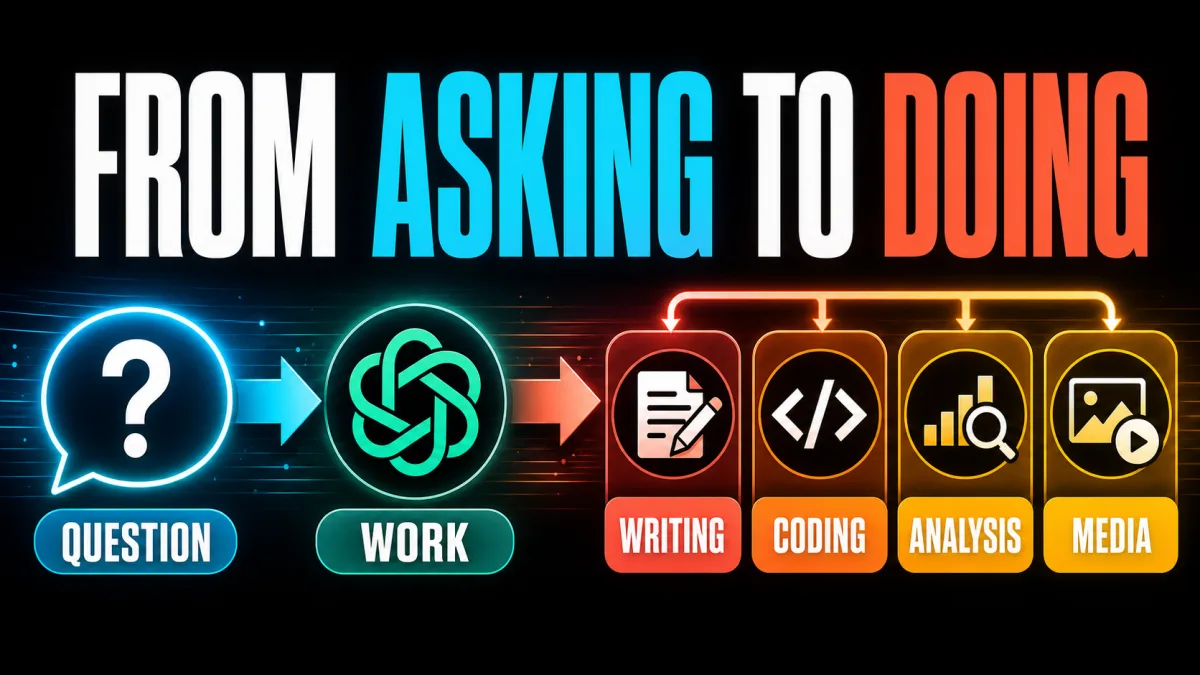
ChatGPT is moving from an answer engine toward a work tool. OpenAI's latest country-by-country Signals release says people use ChatGPT for producing outputs and completing tasks more than for information-seeking in work settings, while adoption is spreading across regions, age groups and multimedia use. The practical signal for operators is to watch where ChatGPT is entering a workflow, not only how many people can ask it a question.
Definition: OpenAI's “doing” category covers messages where a person uses ChatGPT to produce an output or perform a task; “asking” covers information-seeking and clarification.
Example: Editing, coding and analysis are examples of work-oriented ChatGPT use, while information-seeking remains more prominent outside work.
Key takeaway: ChatGPT adoption is broadening along two dimensions at once: more people are using it, and more users are embedding it in practical work.
Business impact: Teams should identify repeatable tasks where ChatGPT already helps produce a checked output, then define who reviews the result before treating usage as operational value.
What does “doing” mean in ChatGPT use?
ChatGPT “doing” is the production side of consumer use, not proof of autonomous execution. In OpenAI's classification, “doing” means using ChatGPT to produce an output or perform a task, with editing, coding and analysis named as examples; “asking” means seeking information or clarification. The distinction gives operators a useful first cut: measure which messages lead to a usable artifact or completed step, rather than counting every conversation as business automation.
Work makes the shift from asking to doing especially visible. Across the individual ChatGPT data described by OpenAI, people are more than twice as likely to use ChatGPT for doing at work than outside work, where asking remains the largest category. The comparison covers messages in work and non-work settings, so it is a signal about task orientation rather than a direct productivity measure. A team evaluating adoption should therefore pair message patterns with completion, correction and review data.
The work signal is meaningful but narrower than an enterprise-adoption claim. The Signals dataset covers messages from ChatGPT Free, Go, Plus and Pro accounts, which OpenAI describes as generally managed by individuals rather than organizations; the accompanying individual data page says the dataset excludes enterprise and Codex usage and may underrepresent business and technical work. The safe takeaway is that personal-account behavior is becoming more task-oriented at work, not that the dataset measures every corporate deployment.
Where is ChatGPT adoption spreading?
ChatGPT adoption is growing fastest in regions that started with lower per-capita usage. OpenAI reports that countries across Latin America, Africa and Oceania are catching up to established early adopters, narrowing the global adoption gap. In its Q2 2026 ranking update, Peru, Uruguay and Costa Rica rose the most among countries in the global leaderboard. Because the measure is change in messages-per-capita rank, operators should read it as geographic diffusion, not as a ranking of total users or market revenue.
The Southern Hemisphere is becoming more important to the adoption story. OpenAI says adoption continues to rise in North America and Europe while parts of Latin America, Oceania and Africa are catching up in per-capita rates. The evidence comes from country-level movement in the second quarter of 2026 rather than a claim that every country has reached the same absolute usage level. Businesses planning international AI programs should treat local language, access and workflow context as open questions instead of assuming that early-adopter markets define the whole opportunity.
Why does multimedia matter now?
Multimedia is the fastest-growing ChatGPT use case in OpenAI's latest release. Multimedia generation, analysis and retrieval reached 7.8% of messages globally, still behind practical guidance, writing and information-seeking but rising consistently during 2026. OpenAI connects the increase with the April release of ChatGPT Images 2.0. The operational takeaway is to look beyond text-only assistance when mapping candidate workflows: visual creation and analysis are now a measurable part of how people use ChatGPT.
Latin America shows especially strong multimedia use in the country data. More than one in ten messages in Brazil and Colombia fell into OpenAI's multimedia category, compared with the 7.8% global share cited in the release. The figure is based on classified individual ChatGPT messages in Q2 2026, so it does not establish why the difference exists or whether the messages produced useful business outcomes. Product teams can use the pattern as a research prompt—ask which local media tasks are recurring—without turning it into a causal conclusion.
Who is joining the ChatGPT user base?
ChatGPT usage is expanding among people over 35. OpenAI reports that users aged 35 and older represented a 5% higher share of messages than 12 months earlier, with growth in nearly every country. The analysis covers only users who self-reported their age on the platform, so the result describes the age mix of classified messages rather than the percentage of all adults using ChatGPT. For organizations, the immediate implication is practical: onboarding and workflow design should not assume that AI adoption is concentrated only among younger employees.
France and Czechia show some of the sharpest increases among older ChatGPT users. In both countries, the share of messages from users aged 35 and above rose by more than 10 percentage points over the past year, according to OpenAI's country-level analysis. The comparison is against each country's Q2 2025 average and uses self-reported age data, which limits what can be inferred about the wider population. Leaders introducing ChatGPT workflows should measure participation and assistance needs by role and experience, not use age as a proxy for readiness.
What should business operators do with the signal?
The most useful response is to measure completed work around ChatGPT, not to chase a headline adoption number. OpenAI's data shows more task-oriented work use, broader geographic adoption, faster-growing multimedia use and increasing participation from older users, but it does not report whether every message produced a correct or valuable result. Operators should choose one recurring workflow, define what “done” means, record review and correction effort, and then compare those outcomes with the baseline. This turns a usage trend into an evidence-based deployment decision.
ChatGPT adoption should be treated as a workflow-design signal rather than a replacement forecast. The source describes how people use individual ChatGPT accounts; it does not measure jobs, productivity, revenue or the success rate of generated outputs. That boundary matters alongside research on how AI is expanding work beyond job descriptions: broader task access can change handoffs without proving that a role or specialist is no longer needed. The responsible next step is to expand low-risk assistance while keeping ownership, review and escalation explicit.
The bottom line
OpenAI's new Signals release shows ChatGPT becoming more global, more task-oriented at work and more varied in how people use it. The strongest facts are specific: doing is more than twice as common at work than outside it, multimedia accounts for 7.8% of messages, countries in Latin America, Africa and Oceania are catching up, and the over-35 share of messages is up 5% year over year. Those figures describe adoption and use, not guaranteed business value. Companies should use them to find workflows worth testing, then judge the result by completed work, quality and accountable review.
Frequently asked questions
What is the main change in how people use ChatGPT?
OpenAI's latest Signals release describes a shift from asking ChatGPT for information toward doing: producing an output or completing a task. The difference is clearest at work, where people are more than twice as likely to use ChatGPT for doing than outside work. OpenAI gives editing, coding and analysis as examples. The data does not prove that every output was correct or used, so the practical conclusion is narrower: ChatGPT is increasingly being used inside task workflows rather than only as a source of answers.
Which regions are catching up in ChatGPT adoption?
OpenAI says countries across Latin America, Africa and Oceania are narrowing the adoption gap with earlier adopters. In the second quarter of 2026, Peru, Uruguay and Costa Rica rose the most among countries in the global per-capita ranking. The ranking measures messages per person and relative movement, not total users or absolute economic impact. Businesses should therefore read the result as evidence that ChatGPT use is spreading geographically, not as a league table of market size.
How important is multimedia use in ChatGPT?
Multimedia was the fastest-growing ChatGPT use case in OpenAI's latest global release and represented 7.8% of messages. In Brazil and Colombia, more than one in ten messages fell into the multimedia category. OpenAI links the increase to multimedia generation, analysis and retrieval after the release of ChatGPT Images 2.0 in April 2026. The figure describes the share of classified messages in individual accounts, so it should not be treated as a measure of revenue, output quality or enterprise adoption.
Are older users adopting ChatGPT?
Yes, within OpenAI's self-reported age data. Users aged 35 and older accounted for a 5% higher share of messages than they did 12 months earlier, and their share increased in nearly every country. In France and Czechia, the share rose by more than 10 percentage points over the year. Because the analysis includes only people who reported their age on the platform, it describes the composition of classified messages rather than the adoption rate of every adult in those countries.
Alex
Founder & Lead AI Writer
Alex is the founder of Yowox and lead AI writer since 2024, breaking down complex information into clear, actionable insights for thousands of readers every day. Alex has built AI automation systems for businesses since 2024, focusing on AI agents, workflow automation, and business process optimization.
Save hours. Save thousands.
Practical guides, real workflows, and the latest AI and automation news that matters — straight to your inbox.