 By Alex
 Anthropic AI Cost Advantage Depends on the Workload
A study covered by The Information challenges the simple China-is-cheaper story: Anthropic models can win on total cost in some workloads, while cheaper Chinese models still dominate many price-sensitive tasks.
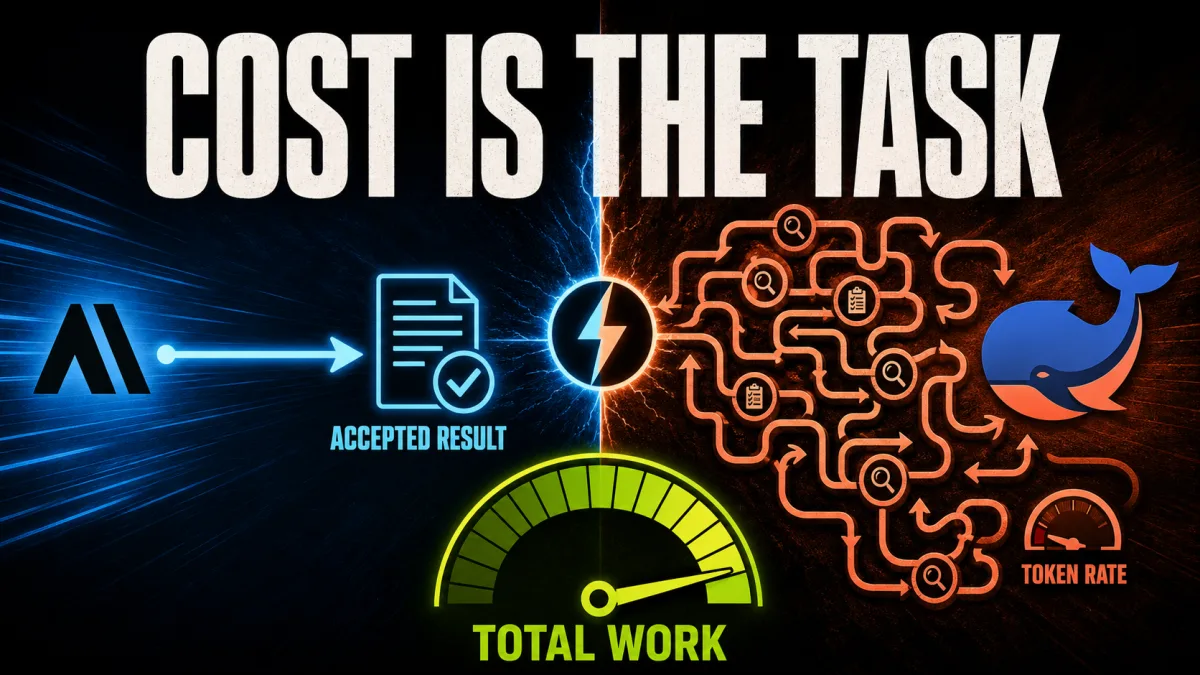
Definition: The Information reports a study finding that some Anthropic models can be cheaper to use than Chinese alternatives under particular workloads, even though Chinese models often advertise lower token prices.
Example: A model that finishes a long agent task with fewer turns and less rework can beat a cheaper model on total cost per successful result.
Key takeaway: AI cost is a property of the completed workload, not just the price per million tokens.
Business impact: Companies should evaluate model routing with task success, retries, review time, and governance—not nationality or a rate card alone.
The simple version of this market story says that Chinese AI models are cheaper and American frontier models are better. The report behind The Information’s study story complicates that split: some Anthropic models can be cheaper to use when the comparison includes the work required to reach a usable result.
The study does not overturn the large price advantage visible in many Chinese model APIs. It changes the unit of comparison. A provider’s input and output rates describe a call, while a business pays for a workflow: prompts, context, reasoning steps, tool calls, retries, failed attempts, latency, and review. The earlier Chinese-model routing analysis found a 46% weekly peak in Chinese-origin token volume on OpenRouter but cautioned that token share is not broad enterprise replacement; the takeaway is to measure the whole workload.
When can Anthropic models cost less than Chinese models?
Anthropic models can have a higher list price and still produce a lower total bill when they complete a defined task with fewer expensive consequences. Anthropic’s own cost-optimization guidance says teams should measure cost per task because a higher sticker price can be cheaper when a model finishes in fewer turns; the condition is workload-specific, so The Information’s study is evidence against a universal pricing rule, not proof that Anthropic wins every benchmark. See also Claude Opus 5: long-horizon coding at unchanged pricing.
The distinction is the same one exposed by Artificial Analysis’ AA-Briefcase benchmark. AA-Briefcase evaluates models on multi-week knowledge-work projects with thousands of source files and deliverables such as spreadsheets, presentations, and memos. Its cost-per-task metric includes the tokens used to complete the evaluation, rather than treating a model’s published token price as the final answer.
The AA-Briefcase benchmark shows why a rate-card comparison is incomplete. At launch, Artificial Analysis reported that Claude Fable 5 cost more than $31 per AA-Briefcase task on average, while DeepSeek V4 Flash cost about $0.04. The same release said GLM-5.2 offered a stronger price-performance tradeoff than the cheapest models, with a score roughly 90 Elo below Claude Opus 4.8 for less than a quarter of the cost. The result is not “cheap always wins” or “frontier always wins.” It is a curve with different operating points.
What does the Anthropic-versus-Chinese model study change?
The study’s practical contribution is to separate price per token from cost per completed outcome. CNBC’s OpenRouter data shows Chinese-origin models reaching a 46% weekly token-volume peak, while Artificial Analysis’s task-cost work shows why volume and completion are different measures; Chinese models remain competitive for repetitive work, while Anthropic becomes more defensible when failed attempts create expensive review.
Evidence from the wider market shows both sides of that picture. CNBC reported that Chinese-origin models accounted for more than 30% of U.S.-organization token volume routed through OpenRouter in each week it examined, with a peak of 46%, compared with an average of 11% over the previous 12 months. The same report quoted OpenRouter’s Justin Summerville saying open-source Chinese models were 60% to 90% cheaper than leading Anthropic and OpenAI offerings. That is strong evidence of price-driven adoption, but it measures routed token volume—not the success rate or economic value of every task. More on this: OpenAI gains ground against Anthropic on OpenRouter.
NPR’s reporting provides a different kind of evidence. Lindy founder Flo Crivello said Anthropic had become the company’s largest expense, exceeding payroll, and that moving all of the startup’s traffic to DeepSeek V4 saved millions of dollars. That is a real operating decision, but it does not establish that DeepSeek is the cheaper choice for every company or every workflow. A startup processing large volumes of assistant tasks has a different cost function from a bank automating a small number of high-consequence decisions.
The Information’s workload-specific finding should be read as a correction to the loudest version of the cost narrative: “Chinese models are cheaper, therefore they are always the economic choice.” The defensible conclusion is narrower: NPR documented Lindy’s move from Anthropic to DeepSeek for reported savings, while the study reports the opposite outcome for some workloads, so model choice must follow the measured cost of finishing a particular task.
Which Anthropic and Chinese model tasks expose the difference?
Anthropic’s cost case is strongest when the cost of failure is material and the task requires sustained reasoning. Artificial Analysis’s AA-Briefcase uses multi-week projects, thousands of source files, and deliverables such as spreadsheets and presentations; that structure makes coherent completion and review burden economically relevant. The practical test is whether Anthropic reduces total work around the model, not whether it has the lowest token rate.
Chinese models are strongest economically when the workflow has high volume, predictable acceptance criteria, and cheap verification. CNBC reported that GLM-5.2 reached adoption quickly and that Chinese open-source models were 60% to 90% cheaper than leading Anthropic and OpenAI offerings; classification, extraction, first-pass drafting, and routine coding are sensible starting points when validators catch mistakes. Open weights can also move spend from recurring API fees to infrastructure and operations.
A practical comparison looks like this:
| Workload condition | Model choice that may win | Metric that decides it |
|---|---|---|
| High-volume, repetitive tasks | Lower-cost Chinese or open-weight model | Cost per accepted item |
| Long, ambiguous agent workflows | Anthropic or another frontier model | Cost per successful completion |
| Code with automated tests | Cheaper model plus validation | Passing change per dollar |
| High-consequence decisions | Model with stronger reliability and review fit | Error cost plus human review |
| Sensitive or regulated data | Approved model and deployment boundary | Total cost inside governance limits |
The table is a decision frame, not a leaderboard. A company still needs its own representative test set, because the ranking can change with context length, tool availability, cache hits, output verbosity, provider latency, and the definition of “done.”
What do coding results show about Anthropic and Chinese models?
The same mixed picture appears outside the study. In July, Databricks reported that GLM-5.2 was statistically comparable with Anthropic’s Opus 4.8 on an internal benchmark built from its own codebase. The report covered by The Decoder said GLM-5.2 reached the top performance cluster at $1.28 per task versus $1.94 for Opus, leading Databricks to plan it as a daily coding model.
The Databricks GLM-5.2 result supports the case for cheaper alternatives on a defined workload, but it also shows why broad claims are risky. Databricks used its own repository, tasks, tests, and harness. The result says something useful about that engineering environment; it does not settle the economics of long-horizon research, customer support, compliance review, or every other agent workload.
The most durable enterprise pattern for Anthropic and Chinese models is therefore model routing. IBM Research’s 417-task AppWorld comparison, summarized in Model routing in production, found Claude Sonnet 4.6 costing $79 versus GPT-4.1 at $155 in that run despite GPT-4.1’s lower token prices; teams can use a cheaper model for predictable work and escalate difficult cases after measuring the full trajectory.
How should companies test Anthropic versus Chinese model cost?
A company evaluating the study’s claim should not begin by comparing provider pricing pages. Artificial Analysis’s AA-Briefcase reports cost per task for 91 rubric-graded tasks, which is a useful reminder to define one workflow and measure the complete path to an accepted result.
Define the successful task
Write the acceptance condition before choosing the models. AA-Briefcase grades concrete deliverables against task rubrics rather than treating fluent text as success; “extract the required fields, cite the source record, pass schema validation, and escalate ambiguous cases” gives a company the same measurable finish line.
Capture the full trajectory
Record input tokens, output tokens, reasoning tokens where available, cache hits, cache misses, tool calls, retries, latency, and failures. Artificial Analysis separates input, cache-hit, cache-write, reasoning, and answer tokens in its task-cost calculation; a low-priced model can lose its advantage if it needs several attempts or emits much more context.
Price human work honestly
Include review and rework. The Information’s finding is specifically about cases where the apparent price ranking changes after the work around the model is counted; if one model costs less at the API layer but causes an engineer or analyst to check every result, the price comparison is incomplete.
Add governance as a hard constraint
A model that cannot be used for a particular data class, region, or contract is not a cheaper option for that workload. NPR described U.S. companies using American inference providers to keep data in the United States even when the underlying model was Chinese; hosting location, provider retention, access controls, open-weight deployment, and procurement requirements belong in the evaluation before the route is selected.
Compare cost per successful task
OpenAI’s useful-intelligence-per-dollar proposal makes a similar measurement point: useful work, dependability, cost, and scale matter more than output volume alone. The same logic applies across vendors. A company should compare the dollars required to clear its quality bar, not the dollars required to generate a token. Yowox’s AI value scorecard explainer applies the same lens to completed work and review burden.
Is Anthropic-versus-Chinese model procurement becoming workload-level?
The study does not show that Anthropic has discovered a universal cost advantage over Chinese AI. It shows that “Chinese is cheap” and “Anthropic is expensive” are incomplete labels once a model must finish a real task.
Chinese models still have a powerful advantage in many price-sensitive workloads. OpenRouter traffic, startup migrations, and benchmark pricing all show why teams are experimenting with them. Anthropic models still have a credible economic case where correctness, coherence, fewer retries, or lower review burden matter more than the first-call rate.
The strategic change is that companies no longer need one model to win every category. They can assign models to workloads, measure cost per successful result, and keep a stronger model as an escalation path. That turns AI procurement into an operating-system decision: the winning stack is the one that routes each task to a model whose total economics fit the work. Background: AI hiring bias outpaces human stereotypes. Related reading: Four startup bets on what comes after transformer LLMs.
FAQ
Are Anthropic models cheaper than Chinese AI models?
Sometimes, but not as a universal rule. The study covered by The Information points to workload-specific cases where an Anthropic model’s stronger output, shorter trajectory, or lower review burden can reduce total cost. Other evaluations still show Chinese models such as DeepSeek and GLM-5.2 delivering much lower measured task costs, especially for repetitive work with cheap automated verification. The right comparison is cost per accepted result on the same task.
Why can a more expensive AI model cost less overall?
Token price is only one input to total cost. A model that needs fewer turns, produces less rework, uses context more efficiently, or reaches a correct result more often can be cheaper per completed task even when its published token rates are higher. The calculation should include retries, tool calls, latency, human review, and the cost of failures that do not clear the acceptance bar. Background: Writer targets 50% lower AI costs with Palmyra X6.
What should a company measure before switching models?
Measure cost per successful task on representative production-shaped work. Include input and output tokens, cache behavior, retries, tool calls, latency, human review, failure recovery, and governance constraints. Compare models on the same acceptance criteria rather than comparing list prices alone. Record enough trajectory detail to explain why a model won or lost, instead of relying on a single average token rate.
Does this study prove Anthropic is better than Chinese models?
No. It shows that model economics depend on the workload and the measurement method. Anthropic may justify a premium on complex or high-stakes work, while Chinese models may be the better fit for repetitive, high-volume, or lower-risk tasks. A routing policy can use both rather than choosing one provider for everything, with escalation and governance rules deciding when the stronger model is worth its premium. Background: AI usage data still misses personal use.
The headline finding is best understood as a warning against one-number procurement. Measure the whole task, keep the quality bar visible, and let the workload—not the model’s country of origin—decide where the budget goes.
Frequently asked questions
Are Anthropic models cheaper than Chinese AI models?
Sometimes, but not as a universal rule. The study covered by The Information points to workload-specific cases where an Anthropic model's stronger output, shorter trajectory, or lower review burden can reduce total cost. Other evaluations still show Chinese models such as DeepSeek and GLM-5.2 delivering much lower measured task costs, especially for repetitive work with cheap automated verification. The right comparison is cost per accepted result on the same task.
Why can a more expensive AI model cost less overall?
Token price is only one input to total cost. A model that needs fewer turns, produces less rework, uses context more efficiently, or reaches a correct result more often can be cheaper per completed task even when its published token rates are higher. The calculation should include retries, tool calls, latency, human review, and the cost of failures that do not clear the acceptance bar.
What should a company measure before switching models?
Measure cost per successful task on representative production-shaped work. Include input and output tokens, cache behavior, retries, tool calls, latency, human review, failure recovery, and governance constraints. Compare models on the same acceptance criteria rather than comparing list prices alone. Record enough trajectory detail to explain why a model won or lost, instead of relying on a single average token rate.
Does this study prove Anthropic is better than Chinese models?
No. It shows that model economics depend on the workload and the measurement method. Anthropic may justify a premium on complex or high-stakes work, while Chinese models may be the better fit for repetitive, high-volume, or lower-risk tasks. A routing policy can use both rather than choosing one provider for everything, with escalation and governance rules deciding when the stronger model is worth its premium.
Alex
Founder & Lead AI Writer
Alex is the founder of Yowox and lead AI writer since 2024, breaking down complex information into clear, actionable insights for thousands of readers every day. Alex has built AI automation systems for businesses since 2024, focusing on AI agents, workflow automation, and business process optimization.
Save hours. Save thousands.
Practical guides, real workflows, and the latest AI and automation news that matters — straight to your inbox.