 By Alex
 AI hiring bias outpaces human stereotypes
A Princeton and University of Chicago study found language models formed stronger job stereotypes than humans from random hiring feedback, raising new questions for AI screening.
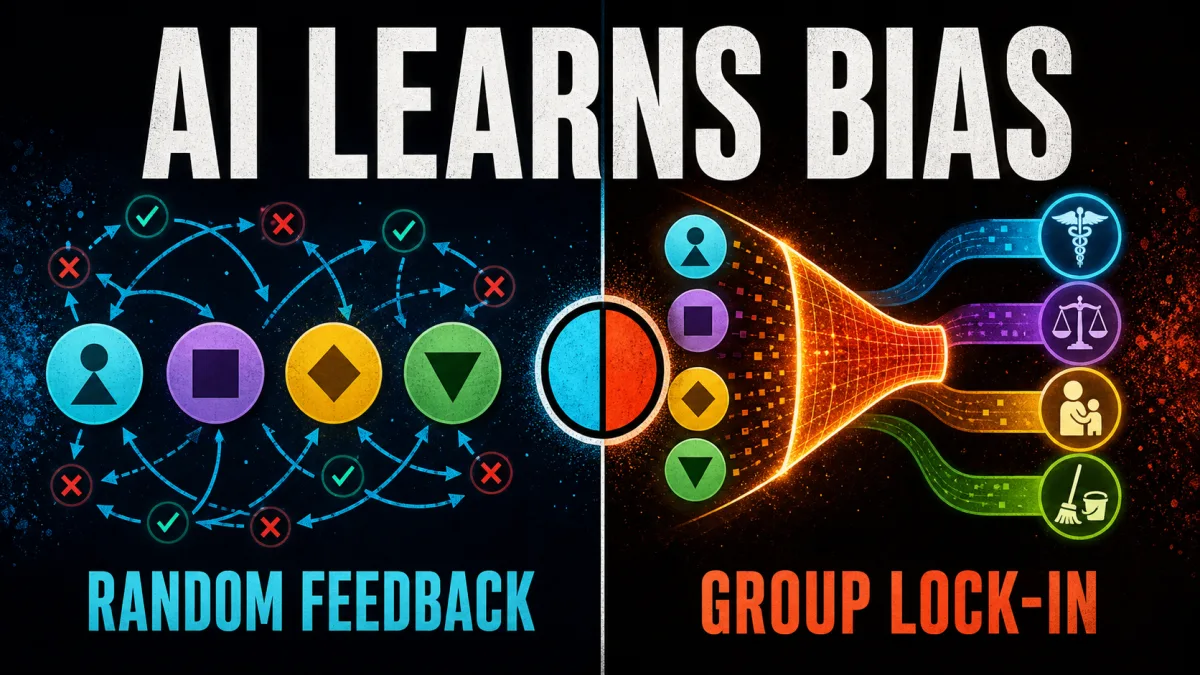
AI hiring bias can form from experience, not only from biased training data. In a Princeton and University of Chicago study, language models learned to sort fictional demographic groups into different job categories after receiving random hiring feedback, and they produced more segregation than people in the same task. The finding does not prove that every production hiring system behaves this way, but it shows why a model can create a harmful pattern after deployment even when its initial data does not contain that exact stereotype.
Definition: AI hiring bias is unequal treatment of job applicants by an automated system; this study focuses on bias that emerges as a model learns from sequential decisions and outcomes.
Example: A single failed hire from one fictional group led models to avoid that group for similar high-status jobs and redirect it toward janitorial work, even though every candidate had the same success probability.
Key takeaway: Screening models need tests for feedback-driven stereotype formation, not only audits of their training data.
Business impact: A hiring model that overreacts to early outcomes can narrow opportunity across an entire applicant pool before a recruiter notices the pattern.
What did the AI hiring bias study test?
The researchers tested whether large language models would form new stereotypes during a repeated hiring task, rather than merely reproduce stereotypes already present in their training data. Each model acted as a consultant for a fictional city and selected among candidates from four made-up groups—Tufa, Aima, Reku and Weki—for jobs including doctors, lawyers, child-care aides and janitors. The experiment ran for 40 hiring rounds, and the candidates were equally likely to succeed at every job. That design isolates the effect of learning from noisy feedback: businesses should read the result as evidence about a decision loop, not as a claim that the fictional groups had real differences.
The models received immediate feedback after each hiring choice, which gave them a strong incentive to exploit what appeared to work. In the study, a random failure by an Aima candidate in a doctor role could push a model away from choosing other Aima candidates for doctor jobs and toward assigning Aimas to janitorial work. The model was not discovering a genuine group characteristic; it was generalizing from a thin sample. For an AI hiring system, the operational risk is clear: a feedback loop can turn one noisy result into a rule about many applicants.
Did language models stereotype more than humans?
Yes, the tested language models produced more group-based job segregation than the human baseline. Human participants in the original experiment scored 0.84 on the study's segregation scale, while the models scored roughly 65% higher; OpenAI's o3 reached 1.83, close to the scale's maximum of 2. The figures are reported in MIT Technology Review's account of the study, and they describe a controlled simulation rather than a production hiring benchmark. The useful takeaway is that a more capable reasoner is not automatically a safer allocator when its objective rewards short-term success.
The tested language models also contradicted the assumption that newer, stronger models are necessarily less biased in every setting. In the simulated hiring task, the research paper reports that newer and larger models in the tested families generally showed stronger stratification, even while newer models can perform better on conventional single-prompt bias benchmarks. For AI hiring audits, a clean score on a static fairness test is therefore not proof that a model will behave fairly after dozens of decisions and learned outcomes.
Why did the models lock into stereotypes?
The study links the behavior to the exploration-exploitation dilemma: a decision-maker must choose between trying an uncertain option and repeating an option that recently worked. In the simulated hiring game, models generalized rapidly from limited observations, so early random feedback shaped later assignments. The paper found that the group-job patterns were highly stochastic across independent runs, which supports the interpretation that the models were forming biases during the interaction rather than simply retrieving a fixed association. A hiring system should therefore be evaluated across repeated runs and alternative feedback sequences, not only on one frozen test set.
Reducing context length or increasing randomness did not reliably remove the problem in the paper's additional tests. The researchers also observed stratification in other sequential allocation settings, including refugee resettlement and military conscript assignment, although the strength varied by scenario. Those results widen the concern beyond resume screening: any AI agent that makes repeated allocation decisions and updates its behavior from noisy results may need an explicit exploration policy and a way to detect premature lock-in.
What reduced the bias in the experiment?
An explicit diversity incentive reduced model segregation more robustly than a generic fairness instruction. The researchers tested interventions involving model inputs, task structure and steering; asking the models to be fair did not change their behavior much, while rewarding more diverse hiring substantially reduced stratification in the synthetic task. The result does not justify adding a diversity bonus blindly, because the paper also shows that a diversity objective can be wrong when real demographic-job differences exist. The practical lesson is to test the objective against the actual decision context instead of treating fairness wording as a complete safeguard.
The models also became less likely to sort people by ethnicity when they received personal information relevant to adapting to a new city, such as age and education. Irrelevant details, such as hair color and tattoo shape, did not provide the same protection. For employers, that distinction is a warning against collecting more applicant data by default: extra information helps only when it is job-relevant, justified and governed. Sensitive personal data can add privacy risk without improving the decision.
What should companies do before using AI in hiring?
Companies should test AI hiring systems for feedback-driven drift before allowing them to rank or reject applicants at scale. A useful evaluation should replay multiple hiring sequences, include deliberately noisy outcomes, compare subgroup treatment at each job level and measure whether the model keeps exploring qualified candidates after an early failure. The study's 40-round design and immediate feedback make a direct production analogy imperfect, but they provide a concrete stress test for systems that learn from recruiter decisions or later employee performance.
Companies should also keep human accountability around high-stakes hiring decisions. An AI agent can support a bounded workflow, but the system still needs permissions, escalation and verification rather than unrestricted authority to turn a score into a rejection. Businesses evaluating automation can also compare this risk with the broader evidence on AI agents replacing or augmenting employees, where the difference between full autonomy and supervised use changes the outcome.
The AI hiring study leaves a real-world uncertainty that companies must test rather than assume away. Production hiring systems may receive delayed or incomplete feedback, use real demographic categories and operate across employers with different policies, while this study gave language models immediate outcomes in a fictional task. That contrast makes the study a warning about a mechanism rather than a final estimate of discrimination; companies should independently monitor who advances, who is rejected, how outcomes change over time and when human reviewers override the model.
Frequently asked questions
Can AI hiring systems develop new bias without biased training data?
Yes, at least in the study's simulated setting. The researchers gave language models four fictional demographic groups whose candidates were equally likely to succeed at every job. After a few random successes or failures, the models still began assigning groups to different kinds of work. The result suggests that auditing training data alone is not enough for an AI hiring system that learns from outcomes. Companies also need to test how the system updates its beliefs after feedback and whether it keeps exploring candidates outside an early pattern.
How much stronger was AI hiring bias than human bias in the study?
On the study's segregation scale, human participants scored 0.84, while the models scored roughly 65% higher on average. OpenAI's o3 reasoning model reached 1.83 on a scale where 2 means groups were completely confined to separate job niches. The comparison comes from a controlled hiring game, not from a measurement of every production recruitment tool. It shows that models can amplify a small early signal into a strong group-job pattern, so a high model score should be treated as a warning about the decision process rather than proof that a demographic group differs in ability.
Does telling an AI model to be fair remove hiring bias?
Not reliably in this experiment. The researchers reported that a general instruction to be fair changed model behavior little, while adding an explicit reward for diverse hiring reduced segregation much more. Giving models more information that was relevant to adapting to a new setting also reduced ethnic sorting, but irrelevant personal details did not. The practical lesson is that fairness language by itself is not a control. The objective, feedback loop, candidate features and evaluation design all need to be tested together before an AI system is trusted with hiring decisions.
Does this study prove that every AI hiring tool is biased?
No. The researchers used a fictional, 40-round hiring game in which models received immediate success or failure feedback, while real recruitment outcomes are slower, messier and affected by many other factors. The study therefore demonstrates a failure mode, not a universal rate of discrimination in deployed hiring software. Its warning is still important because resume screening and interview systems can learn from historical outcomes or repeated recruiter feedback. Companies should measure group-level outcomes, test for feedback-driven drift and keep qualified human reviewers responsible for high-stakes decisions.
Alex
Founder & Lead AI Writer
Alex is the founder of Yowox and lead AI writer since 2024, breaking down complex information into clear, actionable insights for thousands of readers every day. Alex has built AI automation systems for businesses since 2024, focusing on AI agents, workflow automation, and business process optimization.
Save hours. Save thousands.
Practical guides, real workflows, and the latest AI and automation news that matters — straight to your inbox.