 By Alex
 10 model monitoring tools for production AI
AI Magazine's 2026 ranking puts ten model monitoring platforms in focus, from open-source observability to enterprise AI operations.
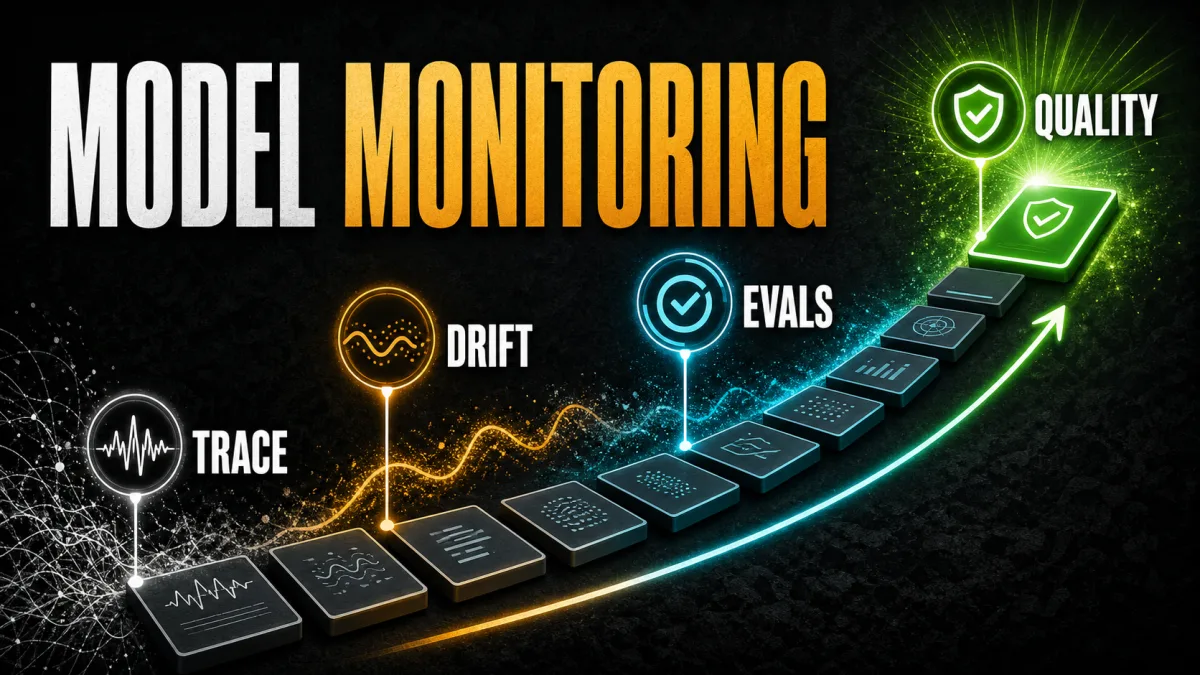
A model monitoring tool helps a team track, evaluate and debug an AI or machine learning system after deployment. In AI Magazine's 2026 ranking of ten model monitoring tools, the list spans open-source observability platforms, managed machine learning services and enterprise application-monitoring suites. The ranking considers usefulness, adoption, innovation and market share, so it should be read as an editorial shortlist rather than a controlled product benchmark.
Definition: Model monitoring is the ongoing tracking and evaluation of AI and machine learning performance, quality and operational behaviour after deployment.
Example: A team might watch latency and error rates for an LLM application, data drift for a predictive model, or trace-level failures inside an agent workflow.
Key takeaway: The ten tools cover different monitoring layers, so the right choice depends on the system and failure modes a business needs to see.
Business impact: Continuous monitoring gives model owners evidence for corrective action when quality, data or operational behaviour changes.
Which ten model monitoring tools made the list?
AI Magazine ranks the platforms from 10 to 1, with Langfuse at number 10 and Datadog at number 1. The table below preserves that published order while grouping each tool by the monitoring emphasis described in the source.
| Rank | Tool | Monitoring emphasis described by AI Magazine |
|---|---|---|
| 10 | Langfuse | LLM tracing, evaluations, prompts, cost and operational metrics |
| 9 | Evidently AI | AI testing, observability, evaluations and more than 100 metrics |
| 8 | NannyML | Performance estimation, data drift and root-cause analysis |
| 7 | Arthur AI | AI monitoring, evaluation, governance and anomaly detection |
| 6 | Fiddler AI | ML and LLM observability, drift, safety, bias and explainability |
| 5 | Arize AI | Monitoring, debugging, evaluations and continuous improvement |
| 4 | AWS SageMaker Model Monitor | Managed ML quality, drift and bias monitoring on SageMaker |
| 3 | Weights & Biases | Experiment visibility, live metrics, reproducibility and debugging |
| 2 | LangChain's LangSmith | Agent traces, evaluations, issue clustering and proposed fixes |
| 1 | Datadog AI Observability | LLM traces connected to application and infrastructure monitoring |
The ranking is useful because it shows that “model monitoring” is not one product category. Traditional ML quality checks, LLM observability, agent debugging and broad application performance can overlap, but they are not identical operating problems.
Langfuse for model monitoring
Langfuse is ranked number 10 as an open-source, model- and framework-agnostic AI engineering platform for LLM observability. AI Magazine says Langfuse combines tracing, evaluation, prompt management, cost tracking, dashboards and metrics, including latency, throughput and error rates; teams considering it should check whether those capabilities match their data and operational requirements.
Evidently AI for model monitoring
Evidently AI is ranked number 9 as an open-source platform for testing and observing AI-powered products. The source describes storage for application data and evaluation runs, test-dataset management, dashboards and a Python library with more than 100 metrics; teams evaluating it should decide which evaluations need to run before deployment and which need to continue in production.
NannyML for model monitoring
NannyML is ranked number 8 for post-deployment machine learning monitoring focused on performance estimation, data drift and root-cause analysis. AI Magazine describes both a Python library and a cloud platform, with support for tabular classification and regression use cases; teams with those workloads should compare NannyML's monitoring workflow with their existing data-science and model-operations process.
Arthur AI for model monitoring
Arthur AI is ranked number 7 as a platform for monitoring, evaluating and governing AI systems at scale. The source says Arthur ingests inference data, computes performance and data-quality metrics, surfaces anomalies, and lets users inspect models and agentic systems from workspace-level views; teams with many AI applications should assess whether that inventory and drill-down model fits their governance needs.
Fiddler AI for model monitoring
Fiddler AI is ranked number 6 for enterprise observability and control across traditional ML and LLM applications. AI Magazine highlights model drift, pre-deployment validation, safety guardrails, production bias tracking, root-cause debugging and explainable AI; organisations comparing Fiddler should separate the controls they need for model quality from the controls they need for operational governance.
Arize AI for model monitoring
Arize AI is ranked number 5 for monitoring and debugging chatbots, autonomous agents and multimodal experiences. The source says teams use Arize to inspect agent behaviour, detect hallucinations, evaluate quality, track production performance and improve prompts, models and workflows; teams with varied AI experiences should test whether the platform exposes the failure evidence their product and engineering teams need.
AWS SageMaker Model Monitor for deployed ML
AWS SageMaker Model Monitor is ranked number 4 as a managed service for continuously checking the quality of machine learning models hosted on Amazon SageMaker. AI Magazine describes alerts for inaccurate production predictions and automated detection of data, concept, bias and feature-attribution drift; organisations already operating models on SageMaker should first map those checks to their model-owner alerting and remediation process.
Weights & Biases for model monitoring
Weights & Biases is ranked number 3 for visibility across AI workflows, with live metrics, interactive graphs and tables, reproducibility and model-performance debugging. The source notes that the company was acquired by CoreWeave in 2025 and says its tools are used by teams including OpenAI, NVIDIA and Cohere; buyers should treat those statements as source-reported context and validate current ownership, product scope and fit for their own workflows.
LangSmith for agent monitoring
LangSmith is ranked number 2 for observing, evaluating and deploying AI agents in production. AI Magazine describes full conversation and agent-run traces, plus LangSmith Engine's 2026 focus on clustering failures, diagnosing root causes against code, and proposing fixes and evaluation coverage; teams building agentic workflows should examine whether those trace-to-improvement features reduce the time between a production failure and a tested change. For the broader distinction between an agent and a chatbot, see What Is an AI Agent?.
Datadog AI Observability for model monitoring
Datadog AI Observability is ranked number 1 for connecting LLM monitoring with broader application performance and infrastructure visibility. The source describes trace-level investigation of hallucinations and low-quality outputs, debugging for RAG embeddings, retrieval and context injection, correlations with microservices and APIs, and token tracking; teams already using Datadog should check whether one operational view is more valuable than adding a specialist monitoring platform.
What should operators compare before choosing?
The ten tools point to four practical comparison questions. First, does the platform monitor traditional model quality, LLM output quality, agent execution, or all three? Second, does it expose the evidence needed to diagnose a failure—such as drift, a bad retrieval step, an anomalous inference or a broken tool call? Third, does it fit the deployment environment, data controls and existing observability stack? Fourth, can the team turn monitoring findings into evaluations, fixes and ownership rather than collecting dashboards that nobody acts on? Background: LLM Observability Platforms in 2026: Which Fits Your Stack?.
That last question connects monitoring to the wider AI automation stack: observability is the layer that helps a business prove whether an automated workflow completed, whether its output was accepted, and where it failed. The shortlist is therefore a starting point. A production decision still needs a test against the actual model, workflow, data and operating team.
What remains uncertain?
AI Magazine's ranking does not publish a common scoring table, pricing comparison or controlled benchmark for the ten platforms. The article also describes fast-moving ownership and product developments, including ClickHouse's acquisition of Langfuse and CoreWeave's acquisition of Weights & Biases. Those details make the list timely, but they also mean buyers should verify current product capabilities, ownership, pricing and licensing before procurement.
Frequently asked questions
What are model monitoring tools used for?
Model monitoring tools track and evaluate the performance of AI and machine learning systems after deployment. In the ranking covered here, that includes signals such as latency, throughput, error rates, drift, data quality, trace behaviour, evaluations, cost and model output quality. The right scope depends on whether a team is monitoring a traditional ML model, an LLM application, an AI agent, or the wider application stack.
Which model monitoring tool is ranked first?
AI Magazine ranks Datadog AI Observability first in its list of ten model monitoring tools. The article describes Datadog as connecting LLM traces with application performance, infrastructure, APIs and user-experience data, while also helping teams investigate hallucinations, retrieval errors and token usage. The ranking is AI Magazine's editorial assessment, not an independent benchmark of every platform.
Which tools in the list are open source?
The source describes Langfuse, Evidently AI and NannyML as open-source offerings. It also describes NannyML as both a Python library and cloud platform, Evidently AI as an open-source collaborative observability platform, and Langfuse as an open-source AI engineering platform. Open-source status, hosted features and licensing can change, so teams should verify current terms before selecting a production dependency.
How should a business choose a monitoring platform?
Start with the system that needs to be observed and the failure signals that matter. A traditional ML deployment may need drift, bias, feature-attribution and prediction-quality checks; an LLM or agent may need trace visibility, evaluation, hallucination analysis, prompt or workflow debugging, and cost tracking. Then compare the shortlist against the existing cloud and observability stack, deployment requirements, data controls and the team's ability to operate the platform.
Alex
Founder & Lead AI Writer
Alex is the founder of Yowox and lead AI writer since 2024, breaking down complex information into clear, actionable insights for thousands of readers every day. Alex has built AI automation systems for businesses since 2024, focusing on AI agents, workflow automation, and business process optimization.
Save hours. Save thousands.
Practical guides, real workflows, and the latest AI and automation news that matters — straight to your inbox.