 By Alex
 LLM Observability Platforms in 2026: Which Fits Your Stack?
LLM observability platforms now combine traces, evaluations and production monitoring. Here is how Langfuse, LangSmith, Braintrust, Arize and the wider field differ by stack, deployment model and operating need.
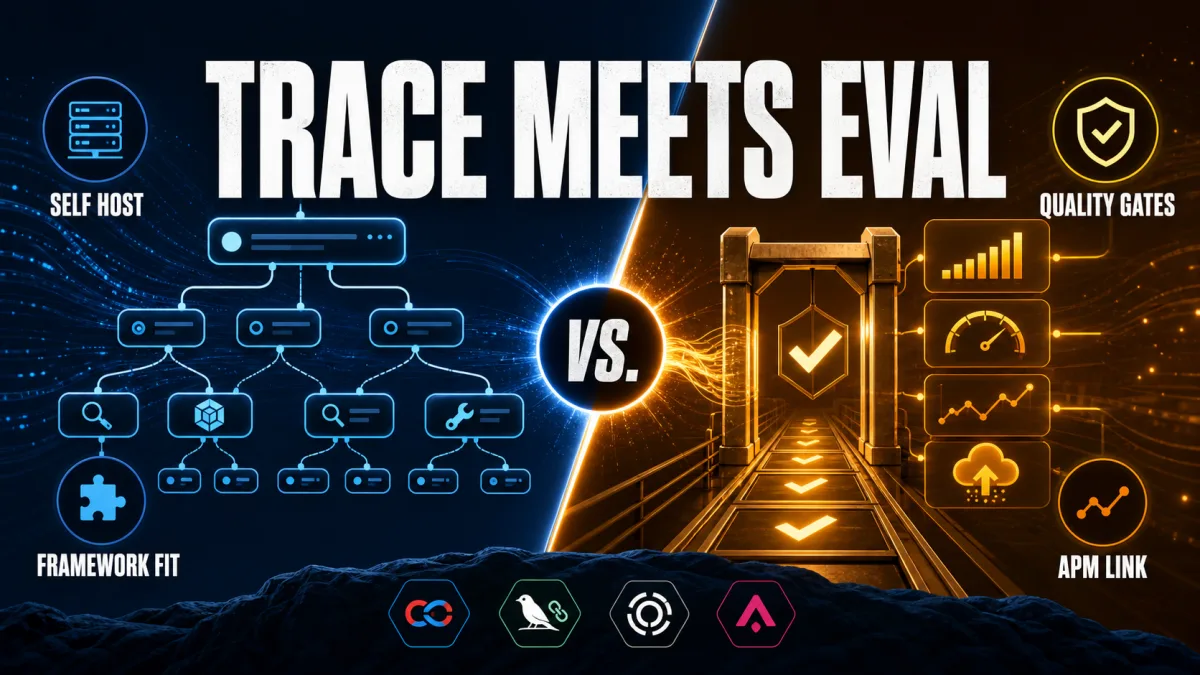
LLM observability platforms have become production infrastructure, not optional debugging tools. The 2026 comparison from MarkTechPost puts Langfuse, LangSmith, Braintrust and Arize at the center of a wider market that also includes MLflow, W&B Weave, Helicone and Datadog LLM Observability.
Definition: LLM observability records prompts, model calls, retrieval, tool use, latency, tokens and cost across an AI application.
Example: A trace can show that an agent retrieved the wrong document, made fourteen tool calls and still returned a confident answer.
Key takeaway: Tracing explains what happened; evaluation checks whether the result was good enough.
Business impact: Teams choosing a platform should start with deployment control and stack fit, not a generic “best tool” ranking.
Why LLM observability is different from ordinary APM
LLM observability is needed because an AI application can complete an HTTP request while producing a semantically wrong result. In an agent run, the model may retrieve irrelevant context, call the wrong tool or loop through several actions while the outer service still returns status 200. That failure mode is why a normal uptime dashboard cannot establish that an AI workflow succeeded.
LLM observability platforms address that gap by preserving the causal path inside the application. A useful trace contains the user request, nested retrieval and embedding spans, model inputs and outputs, tool executions, token counts, latency and cost, which lets an operator reconstruct a failed run instead of guessing from flat logs. For an AI agent, that evidence complements the broader agent architecture and tool loop and helps expose silent agent failures that ordinary success signals miss.
Evaluation answers a different question from tracing: whether the output was actually good. Offline evaluations score curated datasets before deployment, while online evaluations score selected production traces for properties such as relevance, faithfulness, toxicity or task completion. A team should therefore treat tracing and evaluation as two linked controls: one preserves evidence, and the other judges the result.
How the 2026 market is organized
The LLM observability market now has four practical camps, each optimized for a different operating model. AI-native platforms such as Langfuse, LangSmith, Braintrust and Arize treat the LLM trace as the primary object; evaluation platforms and libraries such as Phoenix, DeepEval, MLflow and RAGAS emphasize scoring; gateways such as Helicone and Portkey add request-level logging, cost tracking and routing; APM extensions such as Datadog, New Relic and Dynatrace connect AI signals to existing infrastructure telemetry.
OpenTelemetry GenAI semantic conventions are becoming the portability layer across these camps. The source comparison describes gen_ai.* attributes for model calls, token usage, agent steps and tool executions, with adoption across major cloud and observability ecosystems. For a buyer, OTel support reduces the cost of changing backends later, so it belongs in the technical requirements rather than the “nice to have” column.
Which platforms lead on tracing, evaluation and monitoring?
Langfuse is the strongest fit when self-hosting and framework flexibility are the deciding constraints. The comparison describes nested traces for LLM calls, retrieval, embeddings and agent actions, with integrations for OpenTelemetry, LangChain, the OpenAI SDK and LiteLLM; its evaluation layer adds LLM-as-a-judge scoring, human annotation, custom scores and dataset regression tests. Langfuse’s MIT-licensed core and Docker Compose deployment make it the practical choice for teams that need data-residency control without giving up a full observability workflow.
LangSmith is the strongest fit for teams building around LangChain or LangGraph. LangSmith captures full conversation and agent-run traces, including intermediate state and tool calls, while its evaluation workflow supports LLM judges, code-based checks, multi-turn evaluators and human annotation. The platform also adds production trace clustering and a unified cost view across model calls, retrieval, tools and external APIs, so LangChain-centric teams get the least integration friction by staying in that ecosystem.
Braintrust is the strongest fit when evaluation is the center of the development loop. Braintrust combines framework-agnostic tracing with versioned datasets, automated and human scoring, prompt and model experiments, and CI regression testing. Its distinguishing workflow runs proposed prompt changes against production data before release, then feeds production observations back into quality work; that makes Braintrust a natural choice for product teams that want evaluation gates to block regressions before deployment.
Arize AX and Arize Phoenix are the strongest fit for evaluation rigor and mixed ML/LLM environments. Phoenix supplies an OpenTelemetry-native, self-hostable layer, while Arize AX extends the workflow for enterprise use; the comparison highlights RAG-specific quality plots, drift detection, embedding analysis and audio evaluation for voice applications. That combination suits regulated or accuracy-critical workloads where monitoring degradation over time matters as much as inspecting a single agent trace.
MLflow is the strongest fit when trace-data ownership and an existing ML platform matter most. The comparison describes native agent tracing, OpenTelemetry GenAI export, built-in judges, multi-turn evaluation, human-feedback alignment and integrations with several evaluation libraries. MLflow also includes an AI Gateway for routing, rate limits, fallbacks and usage tracking, but teams without an existing MLflow footprint may prefer a lighter first deployment.
Comparison at a glance
The main trade-off is not a single score; it is where each platform puts depth and control. The following summary restates the supplied comparison’s editorial assessments rather than presenting a measured benchmark.
| Platform | Primary strength | Trace depth | Evaluation profile | Deployment signal |
|---|---|---|---|---|
| Langfuse | Self-hosting and flexibility | Deep, OTel-native | Judges, datasets and CI | MIT core; self-host or cloud |
| LangSmith | LangChain/LangGraph integration | Deepest in its ecosystem | Calibrated judges and live traces | Managed, hybrid and enterprise self-hosted options |
| Braintrust | Eval-first development | Deep via Brainstore | CI gates, experiments and human scoring | Commercial with hybrid options |
| Arize AX / Phoenix | ML-grade evaluation | Deep, OTel-native | Drift, RAG and audio evaluation | Phoenix self-hostable; AX enterprise |
| MLflow | Ownership and open-source platform | Deep with OTel export | Judges, multi-turn and prompt optimization | Open-source and self-hosted |
| W&B Weave | Lineage with ML experiments | Good multi-agent trees | Scorers and judges | Commercial cloud around an open SDK |
| Helicone | Fast gateway visibility | Request-level | Light compared with AI-native platforms | Open-source gateway and cloud |
| Datadog LLM Observability | Correlation with infrastructure | Good and infrastructure-linked | Moderate, with growing AI coverage | SaaS APM extension |
How to choose a platform without overbuying
A LangChain or LangGraph team should start with LangSmith because first-party framework context reduces instrumentation work. The comparison specifically positions LangSmith as the default backend for those ecosystems and highlights traces that expose each tool call and intermediate state. The takeaway is practical: if the framework is already a durable architectural decision, prioritize depth of integration over broad vendor neutrality.
A team with strict data-residency requirements should start with Langfuse, Phoenix or MLflow and verify the operating burden. Self-hosting is not just a licensing choice; it means owning retention, upgrades, storage and access controls. Langfuse emphasizes a full-featured self-hosted path, Phoenix emphasizes OTel-native evaluation, and MLflow emphasizes trace-data ownership, so the final decision should follow the organization’s existing platform skills.
A team practicing evaluation-driven development should compare Braintrust with LangSmith and Arize by workflow, not by feature count. Braintrust centers versioned datasets and CI quality gates, LangSmith combines dataset and live-trace evaluators with its LangChain ecosystem, and Arize brings deeper drift and ML-style evaluation primitives. The right test is whether a prompt or model change can move from failed production trace to reproducible regression test with minimal manual work.
A team that mainly needs cost, latency and routing visibility should consider a gateway before buying a full tracing platform. Helicone’s one-line proxy model makes it useful when the immediate requirement is request-level visibility across providers, caching and usage tracking. Its documented boundary is equally important: deep agent graphs, span-level reasoning steps and rich production evaluation loops are not its core story, so a gateway may need to sit beside a dedicated tracing or evaluation system.
A company already standardized on Datadog should treat Datadog LLM Observability as the infrastructure-correlated option, not automatically as a replacement for AI-native evaluation. Datadog connects token usage, model latency, cost and security signals with existing APM, logs and infrastructure metrics. That is valuable during incidents, while teams that need CI-gated prompt regression tests may still layer a specialist evaluation platform on top.
What operators should watch next
The durable buying requirement in 2026 is a layered observability stack that preserves portability. AI-native tracing and evaluation explain whether an agent behaved correctly, while APM explains whether the surrounding services and infrastructure stayed healthy; neither layer fully replaces the other. OpenTelemetry GenAI conventions provide a route to connect those layers and reduce backend lock-in.
The safest selection process is to choose one primary platform for the team’s dominant constraint, then test it against real failure traces. Use a failed retrieval, a tool error, a long agent loop and a cost-heavy request as acceptance cases; verify that the platform preserves the evidence, scores the output and makes the failure searchable. A feature matrix can narrow the shortlist, but only real traces reveal whether the platform supports the workflows the team must operate.
The category is moving toward a common foundation, but there is still no universal winner. LangSmith fits framework-led teams, Langfuse fits self-hosted and flexible deployments, Braintrust fits evaluation-first product loops, Arize fits rigorous quality monitoring, and MLflow fits teams that want ownership. The useful decision is the one that makes incorrect agent behavior visible before it reaches a customer.
FAQ
What is an LLM observability platform?
An LLM observability platform records the internal steps of an AI application, including model calls, retrieval, tool use, latency, token usage and cost, then makes those events searchable. Platforms in this category increasingly add evaluation, which scores whether an output was relevant, faithful, safe or successful. The practical purpose is to give an engineering or operations team evidence for both questions: what happened inside the run, and whether the result was good enough to ship or trust.
Which LLM observability platform is best for self-hosting?
The supplied 2026 comparison positions Langfuse as the leading self-hosting choice because its core is MIT-licensed, it can be deployed with Docker Compose, and it supports framework-agnostic tracing. Arize Phoenix and MLflow are also relevant when a team wants source-available or open-source infrastructure with strong evaluation and trace-data ownership. The right choice still depends on the team’s existing stack, compliance requirements and willingness to operate the platform itself.
Should a team choose LangSmith or Langfuse?
Choose LangSmith when LangChain or LangGraph is the center of the application and deep first-party tracing is worth using a commercial platform. Choose Langfuse when self-hosting, data-residency control or a framework-agnostic architecture matters more. Both cover tracing, evaluation and production monitoring, so the decision is primarily about framework fit, deployment control and the rest of the team’s operating environment rather than a universal feature winner.
Do LLM observability platforms replace traditional APM?
No. LLM observability platforms explain model and agent behavior: prompts, completions, retrieval, tool calls, quality scores and token costs. Traditional APM explains the surrounding application and infrastructure: service errors, CPU, memory, network health and incident context. The 2026 comparison treats Datadog’s LLM product as an APM extension and describes AI-native platforms as a separate camp. Production teams may need both layers, connected through OpenTelemetry conventions.
Frequently asked questions
What is an LLM observability platform?
An LLM observability platform records the internal steps of an AI application, including model calls, retrieval, tool use, latency, token usage and cost, then makes those events searchable. Platforms in this category increasingly add evaluation, which scores whether an output was relevant, faithful, safe or successful. The practical purpose is to give an engineering or operations team evidence for both questions: what happened inside the run, and whether the result was good enough to ship or trust.
Which LLM observability platform is best for self-hosting?
The supplied 2026 comparison positions Langfuse as the leading self-hosting choice because its core is MIT-licensed, it can be deployed with Docker Compose, and it supports framework-agnostic tracing. Arize Phoenix and MLflow are also relevant when a team wants source-available or open-source infrastructure with strong evaluation and trace-data ownership. The right choice still depends on the team's existing stack, compliance requirements and willingness to operate the platform itself.
Should a team choose LangSmith or Langfuse?
Choose LangSmith when LangChain or LangGraph is the center of the application and deep first-party tracing is worth using a commercial platform. Choose Langfuse when self-hosting, data-residency control or a framework-agnostic architecture matters more. Both cover tracing, evaluation and production monitoring, so the decision is primarily about framework fit, deployment control and the rest of the team's operating environment rather than a universal feature winner.
Do LLM observability platforms replace traditional APM?
No. LLM observability platforms explain model and agent behavior: prompts, completions, retrieval, tool calls, quality scores and token costs. Traditional APM explains the surrounding application and infrastructure: service errors, CPU, memory, network health and incident context. The 2026 comparison treats Datadog's LLM product as an APM extension and describes AI-native platforms as a separate camp. Production teams may need both layers, connected through OpenTelemetry conventions.
Alex
Founder & Lead AI Writer
Alex is the founder of Yowox and lead AI writer since 2024, breaking down complex information into clear, actionable insights for thousands of readers every day. Alex has built AI automation systems for businesses since 2024, focusing on AI agents, workflow automation, and business process optimization.
Save hours. Save thousands.
Practical guides, real workflows, and the latest AI and automation news that matters — straight to your inbox.