 By Alex
 OpenAI Takes ChatGPT Ads Global, Expanding Across Europe and Asia
OpenAI is preparing to bring its ChatGPT advertising pilot to France, Germany, Ireland, and Singapore, turning conversational intent into a new global media channel while keeping the rollout deliberately phased.
OpenAI is preparing to expand ChatGPT’s advertising pilot to France, Germany, Ireland, and Singapore, a move that would bring the program to 10 markets less than a year after its U.S. launch. The expansion turns ChatGPT from an experimental ad surface into a potentially global channel for reaching people while they are actively researching and making decisions.
Definition: ChatGPT ads are sponsored placements shown alongside conversational answers, with OpenAI positioning them as a way to fund broader access to free and low-cost ChatGPT tiers.
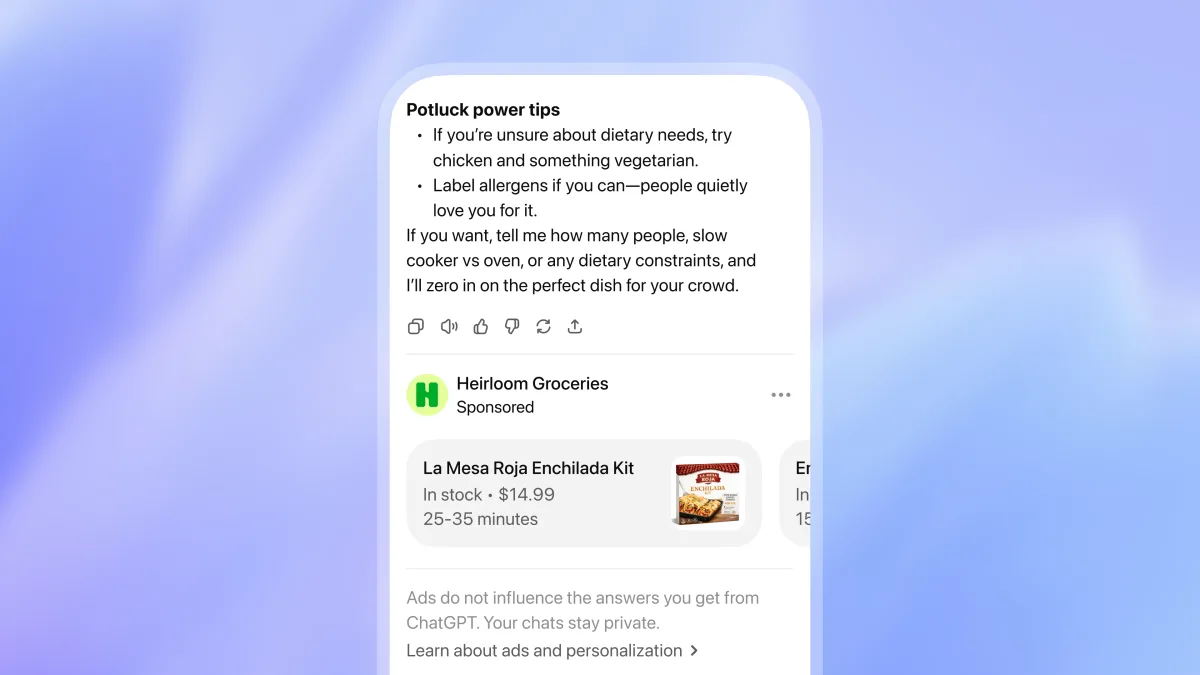
Example: Someone comparing meal options could see a clearly labeled sponsored product card related to that conversation, separated from ChatGPT’s organic response.
Key takeaway: OpenAI is scaling ads internationally, but it is doing so through pilots, regional teams, agency partnerships, and test budgets rather than an unrestricted global launch.
Business impact: Advertisers will need to prepare for a new intent-driven channel where the quality of the surrounding conversation, privacy safeguards, and clear separation from the answer may matter as much as the ad creative itself.
Which markets are being added to the ChatGPT ads pilot?
According to Digiday’s report, OpenAI is recruiting advertising leadership and commercial teams in Paris, Munich, Dublin, London, and Singapore as it prepares the next phase of the rollout. France, Germany, and Ireland would extend the European pilot beyond the United Kingdom, while Singapore would strengthen the company’s presence in Asia-Pacific.
The expansion follows a rapid sequence of launches: the United States in February; Canada, Australia, and New Zealand in March; and the United Kingdom, Japan, South Korea, Mexico, and Brazil in June. If the four new markets are added, OpenAI will have an advertising presence across North America, Europe, Latin America, and Asia-Pacific within its first year.
Why is OpenAI expanding through regional teams?
OpenAI’s hiring plans suggest that ChatGPT ads are being built as a locally managed media business, not simply switched on with one global settings panel. The company is looking for people who can manage advertiser relationships, agency and ad-tech partnerships, customer success, revenue strategy, and market prioritization.
That regional structure matters because advertising rules, buying habits, privacy expectations, and agency ecosystems differ across countries. It also gives OpenAI a way to test how people respond to ads in different markets before expanding access to the full available audience.
How are ChatGPT ads supposed to work?
OpenAI’s official advertising announcement says the pilot is limited to logged-in adult users on the Free and Go tiers; Plus, Pro, Business, Enterprise, and Education accounts do not receive ads. OpenAI says sponsored placements are labeled and visually separated, while the underlying answers remain independent of advertisers.
The format is designed around conversation context. OpenAI says ads may be matched to the topic of a discussion, past chats, and past interactions with ads, but advertisers do not receive access to chats, chat history, memories, or personal details. Advertisers instead receive aggregate information such as views and clicks.
This makes the product different from a standard keyword auction. Search ads usually begin with a query; ChatGPT ads can begin with a longer thread that reveals what a person is comparing, planning, or trying to understand. That context could improve relevance, but it also raises the standard for transparency: users must be able to tell where the answer ends and the sponsored placement begins.
Is ChatGPT already a mature advertising platform?
Not yet. Advertisers in launched markets can buy through OpenAI representatives or partners such as Criteo and StackAdapt. The beta self-serve ads manager is available in a smaller set of markets, including the United States, Canada, Australia, New Zealand, the United Kingdom, Japan, and South Korea. OpenAI is still asking advertisers to provide test budgets, which signals that measurement, inventory, targeting, and creative formats are continuing to develop.
The reported rollout pace is still significant. Digiday cited Criteo CEO Michael Komasinski saying that 2,000 clients were participating in the OpenAI pilot through the ad-tech company, with the advertiser count doubling in one month. That figure describes participation through one partner, not the total number of advertisers across the entire program, so it should not be treated as a complete market-size estimate.
What is OpenAI testing before it scales?
OpenAI’s global head of ads, David Dugan, described a staged approach at Cannes Lions: a new country may begin with roughly 10% of the available audience, then expand to 50% and 90% if the results show no significant problems. The company is watching exposure, repeat usage, query frequency, and whether people dismiss ads.
Dugan also said the rate at which users dismiss ads has fallen by more than 50% since the February pilot began. That is an OpenAI executive’s characterization of early internal results, not an independently audited benchmark, but it shows the company is treating user response as a core scaling metric rather than optimizing only for clicks.
What should advertisers prepare for?
Advertisers should treat ChatGPT as an emerging intent channel, not as a replacement for search, social, or performance marketing. The immediate priority is to identify products that naturally fit research and comparison moments, prepare concise value propositions, and define a test budget that can tolerate incomplete measurement while the platform matures.
The more important preparation is strategic: keep claims easy to verify, make landing pages answer the questions that led to the ad, and monitor whether the placement produces qualified interest rather than superficial engagement. In a conversational environment, an ad can be relevant to the topic and still fail if the brand cannot support the promise after the click.
What remains uncertain?
OpenAI has not published a complete global launch calendar, final pricing model, or universal self-serve availability for the four proposed markets. The company also still has to prove that sponsored recommendations can remain useful without weakening trust in the answers around them.
For now, the signal is clear but the product is unfinished: OpenAI is building the commercial infrastructure to make ChatGPT ads global, while its phased rollout leaves room to adjust the experience market by market. The next meaningful milestones will be broader advertiser access, clearer measurement, and evidence that users continue returning to ChatGPT at the same rate when sponsored placements become more common. See also OpenAI Is Shutting Down Atlas. The Browser Is Becoming a Feature.. Related reading: ChatGPT adoption: From answers to action worldwide. More on this: ChatGPT free users get unlimited text chats next week.
Frequently asked questions
Which countries is OpenAI adding to the ChatGPT ads pilot?
OpenAI is preparing to expand the pilot to France, Germany, Ireland, and Singapore. The additions would bring the program to 10 markets globally, following launches in the United States, Canada, Australia, New Zealand, the United Kingdom, Japan, South Korea, Mexico, and Brazil.
Can advertisers buy ChatGPT ads through a self-serve platform?
A beta self-serve ads manager is currently available in the United States, Canada, Australia, New Zealand, the United Kingdom, Japan, and South Korea. In other launched or emerging markets, advertisers can work through OpenAI representatives or agency and ad-tech partners. OpenAI is still requesting test budgets rather than presenting the program as a fully mature global buying channel.
Do ChatGPT ads influence the answers?
OpenAI says ads are clearly labeled and visually separated from organic answers, and that advertiser content does not determine ChatGPT's answers. OpenAI also says advertisers receive aggregate performance information rather than users' conversations, chat history, memories, or personal details.
Why are ChatGPT ads different from traditional search ads?
ChatGPT ads can be matched to an expressed conversational intent rather than only to a typed keyword or a page impression. That creates an opportunity for relevance when a person is researching, comparing, or deciding, but it also makes privacy, labeling, answer independence, and user control central to whether the format earns trust.
Alex
Founder & Lead AI Writer
Alex is the founder of Yowox and lead AI writer since 2024, breaking down complex information into clear, actionable insights for thousands of readers every day. Alex has built AI automation systems for businesses since 2024, focusing on AI agents, workflow automation, and business process optimization.
Save hours. Save thousands.
Practical guides, real workflows, and the latest AI and automation news that matters — straight to your inbox.