 By Alex
 Gemini app plans after AI Studio cancellation
Google canceled its planned AI Studio mobile app after roughly 800,000 pre-orders and says Gemini will create apps naturally through conversations on mobile and desktop.
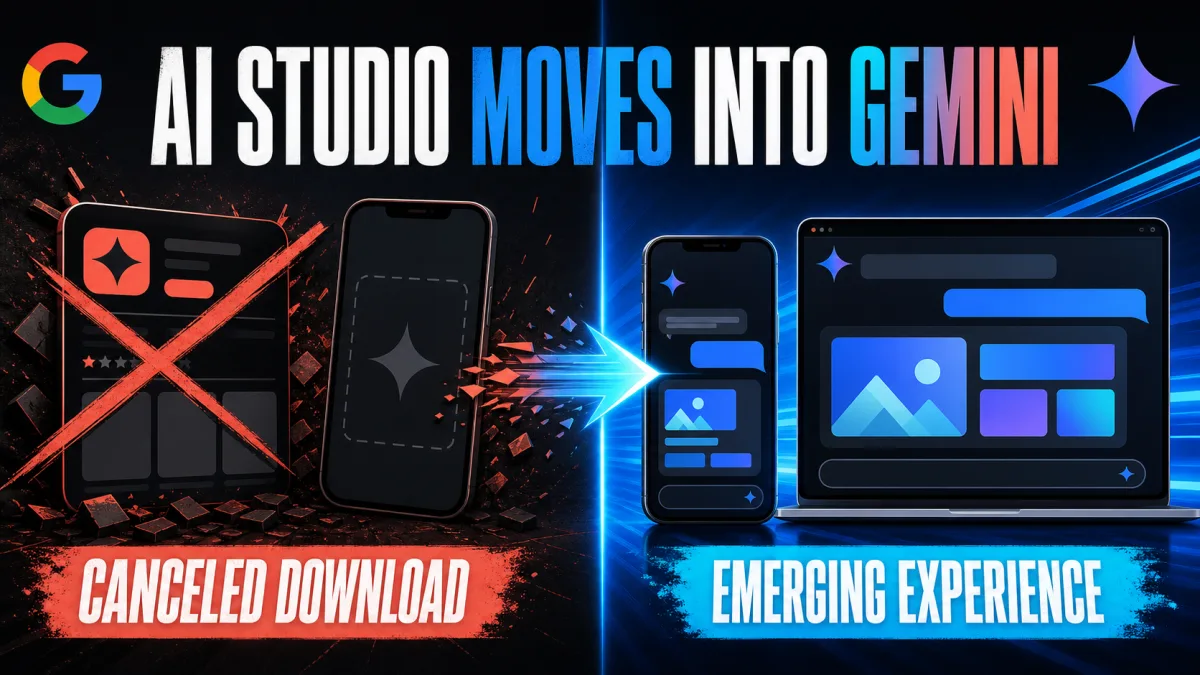
Google has canceled its planned AI Studio app for Android and iOS, but the company says the underlying idea will return through Gemini. The change follows roughly 800,000 pre-orders and moves the product from a separate mobile download toward apps that emerge inside conversations on mobile and desktop, according to 9to5Google’s report.
Definition: Google’s canceled AI Studio app was intended to help people capture an idea on a phone and have a working prototype ready by the time they reached a desk.
What changed: Google pulled the Android and iOS listings and says it is taking a Gemini-centered approach instead of releasing another standalone app.
Key takeaway: AI Studio is not being abandoned; its mobile future is being folded into the Gemini app direction.
Business impact: People who want to turn ideas into software should keep using the AI Studio web experience for now, while treating Gemini’s app-creation promise as a future direction rather than an available product.
What happened to the AI Studio mobile app?
The AI Studio mobile app was canceled before release, even after the team said more than 800,000 people had pre-ordered it on Google Play and the App Store. The planned app was meant to offer a mobile alternative to opening aistudio.google.com in a browser, so its cancellation changes the delivery model rather than the core idea of building from a prompt.
At Google I/O 2026, Google described the app as a way to capture an idea on the go and arrive at a working prototype by the time the user reached a desk. The project therefore targeted a specific transition: turning a fleeting mobile idea into a software artifact without requiring the user to wait until they were back at a computer.
Why is Google moving the idea into Gemini?
Google says it no longer wants users to download another dedicated app for this workflow. The company’s stated alternative is for apps to “emerge naturally” during everyday conversations with Gemini, which makes Gemini the proposed entry point for the experience instead of a separate AI Studio icon.
The official Google AI Studio announcement says the AI Studio team is partnering with the Gemini app team to make that approach work on mobile and desktop. That wording confirms the partnership and direction, but it does not define the final interface, the technical architecture, or a release schedule.
The product logic is clear even though the implementation is not. A dedicated app asks a user to decide in advance that they are entering a building workflow; a conversational experience can make the building step part of a broader request. That could reduce the distance between “I have an idea” and “show me something I can use,” but Google has not yet shown enough detail to judge how much control or editing the generated apps will provide.
What remains available in AI Studio?
The AI Studio website will continue for users who want to move from an idea to a prompt to a business. This keeps the browser-based workflow as the concrete product path while Google works on the Gemini integration, so the cancellation does not mean that AI Studio’s web experience has been shut down.
The distinction matters for anyone evaluating the announcement. The website is an existing surface described by the source, while conversational app creation on Gemini is a future project with more details still to come. Teams can therefore continue exploring the web experience without treating the canceled mobile listing as evidence that the Gemini version is already available.
What does the cancellation say about Gemini’s direction?
The cancellation points to a broader Gemini role: Google wants the assistant to become a place where software can appear in response to a user’s situation, not only a place where the user asks for information. That interpretation follows directly from Google’s description of apps emerging through everyday conversations, but the company has not announced the boundaries of those apps.
This is different from a conventional chatbot response because the intended output is described as an app rather than a paragraph. It is also related to the shift from chatbots toward AI agents that use tools and complete multi-step tasks, although the announcement does not say that the future Gemini experience will operate autonomously or connect to business systems.
Google’s own wording leaves several important questions open. It does not say whether a generated app will be temporary or persistent, whether it will run as a native Android or iOS application, how users will revise it after creation, or what data and permissions it will receive. Those unknowns are more important than the cancellation itself for businesses considering whether the idea could become a dependable workflow tool.
How does this fit Google’s other Gemini automation work?
The planned Gemini integration fits Google’s recent move toward software that acts across interfaces, but it should not be confused with a confirmed feature launch. Google has separately expanded Gemini task automation across supported apps on Samsung devices, a direction covered in our report on Gemini task automation and Android XR glasses, while this announcement concerns the creation of app-like experiences through conversation. Background: NotebookLM becomes Gemini Notebook, with code execution.
The two directions share a product question: how much of the user’s goal can Gemini turn into a useful result without making the user manage every intermediate step? The AI Studio announcement answers only that Google wants the experience to happen through Gemini on mobile and desktop; it does not establish that the two systems already share the same capabilities, permissions, or rollout plan.
What should users watch next?
The next meaningful update will need to explain what “apps emerge naturally” means in practice. For users, the useful evidence will be a concrete demonstration of how Gemini creates an app, where that app runs, how it stores or shares data, and how a person can inspect or change its behavior before relying on it.
For now, the confirmed sequence is narrower: Google canceled the Android and iOS AI Studio app, pulled the mobile listings, kept the AI Studio website moving, and said the Gemini and AI Studio teams are working toward a mobile-and-desktop alternative. That is a strategic pivot with substantial potential, but the product remains a promise until Google shows the experience.
FAQ
Why did Google cancel the AI Studio app?
Google said it chose a different approach rather than asking users to download another app. The proposed alternative is for apps to emerge through everyday conversations with Gemini. Google has not published a more detailed technical explanation for the cancellation. See also Create, edit and star in videos with two Google Vids updates.
Did the AI Studio website also get canceled?
No. Google said it would continue investing in the AI Studio web experience for people who want to go from an idea to a prompt to a business. The canceled product was the planned Android and iOS application.
Does Gemini already create native apps from conversations?
The announcement describes that as a future direction and says the teams are working to bring it to mobile and desktop. It does not establish that the final feature is available or explain whether the output will always be a native app.
What happened to the pre-orders?
The AI Studio team said roughly 800,000 people pre-ordered the mobile app on Google Play and the App Store. The report says the mobile listings were later pulled, and Google announced that it would not release the app in its planned form.
Frequently asked questions
Why was the AI Studio mobile app canceled?
Google says it chose a different approach instead of asking people to download another app: apps should emerge naturally during everyday conversations with Gemini. The company is partnering with the Gemini app team on that mobile and desktop direction. Google has not yet explained the final interface, how a generated app would run, or when the experience will launch, so the announcement describes a product direction rather than a released replacement.
How many people pre-ordered the AI Studio app?
The AI Studio team said more than 800,000 people pre-ordered the planned mobile app on Google Play and the App Store. Google did not turn that interest into a release, and the mobile listings were pulled. The figure shows strong early interest in building software from a phone, but it does not establish that every pre-order would have become an active user or that a future Gemini experience will have the same demand.
Will AI Studio itself disappear?
No. Google says work on the AI Studio website will continue for people who want to move from an idea to a prompt to a business. The canceled part is the planned Android and iOS app. The website is therefore the concrete AI Studio path described in the announcement, while the proposed Gemini-centered experience remains under development and may eventually change how users access app-building tools.
Will Gemini definitely create native mobile apps?
Google says it is partnering with the Gemini app team to make apps emerge through conversations on mobile and desktop, but it has not yet described the final product, launch date, supported platforms in detail, or whether every generated experience will be a native app. The announcement also leaves open how users would revise, save, share, or permission those generated experiences before relying on them.
What can people use today while they wait?
The source reports that the AI Studio website remains available and that its Progressive Web App works today. The exact capabilities and limits of any future Gemini-generated app experience have not been announced. Users can therefore evaluate the existing browser-based workflow now, but should not assume that the canceled Android and iOS app or the future Gemini direction is already available as a native mobile product.
Alex
Founder & Lead AI Writer
Alex is the founder of Yowox and lead AI writer since 2024, breaking down complex information into clear, actionable insights for thousands of readers every day. Alex has built AI automation systems for businesses since 2024, focusing on AI agents, workflow automation, and business process optimization.
Save hours. Save thousands.
Practical guides, real workflows, and the latest AI and automation news that matters — straight to your inbox.