 By Alex
 Alibaba’s Qwen3.8-27B Turns Local AI Into a Real Option
Alibaba’s Qwen3.8-27B is drawing rapid interest as a free, open-weight multimodal model that can run on users’ own computers, while its hardware demands and benchmark claims still need careful evaluation.
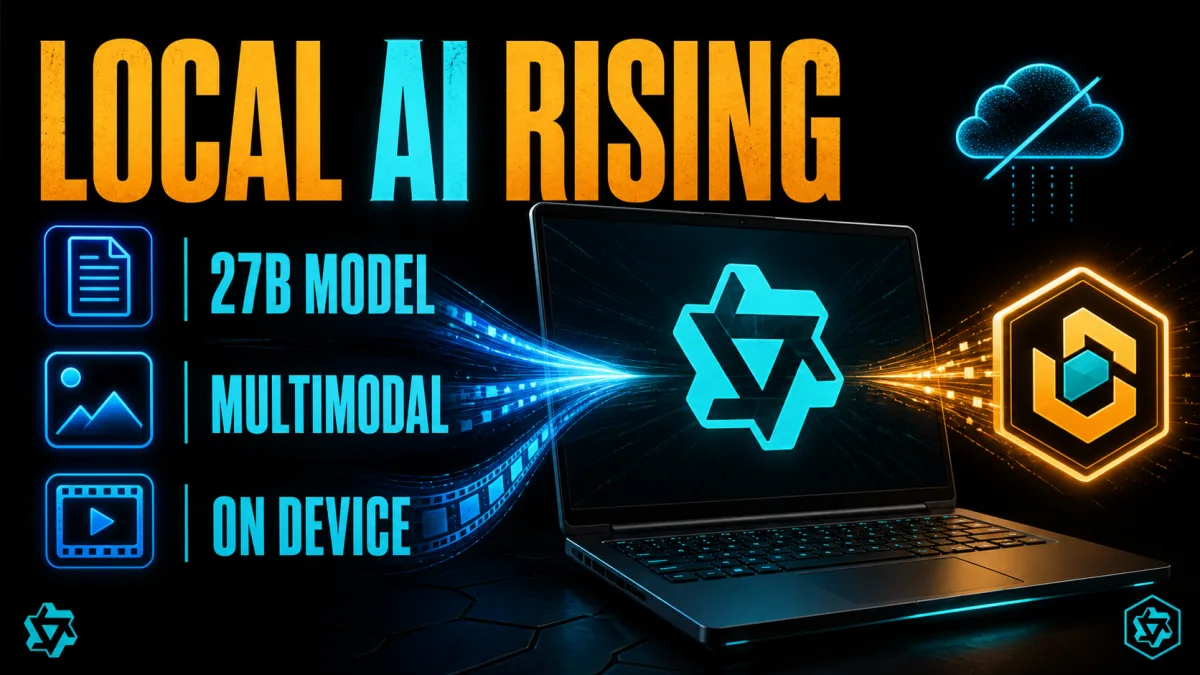
Alibaba’s Qwen3.8-27B is turning local AI into a practical option for more developers, but the early signal is adoption rather than a settled performance verdict. The Information reported that Alibaba said the 27-billion-parameter model had passed 1 million downloads within a few days of release, making it one of the company’s fastest-growing models. For operators, the takeaway is concrete: downloadable multimodal weights are attracting attention, while hardware fit and independent evaluation still determine whether a local deployment is useful.
Definition: Qwen3.8-27B is Alibaba’s 27-billion-parameter open-weight model for local and hosted inference.
Example: A developer can download the weights and run a quantized version on capable personal hardware instead of routing every request through a cloud API.
Key takeaway: Early download velocity shows strong community interest, not automatic production readiness.
Business impact: Local inference can change privacy, latency and infrastructure decisions, but teams must test the model against their own workloads and memory limits.
Why Qwen3.8-27B is attracting local users
Qwen3.8-27B is attracting local users because it combines free downloadable weights with a compact footprint relative to frontier models. Cybernews reported that the model passed 3 million Hugging Face downloads within three days of its August 14 release, while compressed variants around 17GB made local experimentation possible on capable consumer hardware. The actionable point is to treat downloads as a demand signal: teams can evaluate the model without first committing to a hosted API contract, but they still need to measure latency, memory use and output quality on representative tasks.
The licensing and distribution model also widen the audience for Qwen3.8-27B. Cybernews reported that the model uses the Apache 2.0 license and that quantized variants were appearing quickly in the open-source ecosystem. That combination matters for developers who need to modify or self-host a model, because the weights and surrounding tooling can be inspected before a deployment decision. It does not remove the work of checking the exact model files, dependencies, license notices and security controls used in a production stack.
What Qwen3.8-27B can do locally
Qwen3.8-27B is a native vision-language model rather than a text-only checkpoint, according to the official Qwen3.8-27B model card. The model card lists image and video understanding, coding, professional-work and long-horizon agentic capabilities, plus adjustable reasoning effort and a native 262,144-token context window. For a business team, that means a local proof of concept can include documents, screenshots or video alongside text, but the proof should use the team’s actual inputs rather than rely on benchmark tables alone. More on this: Qwen3.8-Max turns long-horizon work into feedback loops.
The model’s local appeal is therefore about deployment flexibility, not just parameter count. Qwen3.8-27B is a dense 27B model, and local operation depends on the chosen precision, quantization, runtime and available memory. A team evaluating it should first map the model to the target machine, then compare quality and throughput with a hosted baseline. Yowox’s Local LLM Hardware Calculator can help with the initial hardware-fit question; it cannot replace a workload-specific evaluation. Background: Best Privacy-Focused AI Tools in 2026: Local, Anonymous, and Cloud Options.
What the download numbers do not prove
The Qwen3.8-27B download surge does not prove that Alibaba has matched the best frontier systems across real workloads. Cybernews reported that independent testing was not yet available at the time of its coverage, while full-quality operation required substantially more memory than the smaller quantized variants. The practical conclusion is narrow but important: Qwen3.8-27B has demonstrated unusually strong early interest for a local model, not a universal performance win.
The distinction matters most for agentic use cases. A model that can understand images and videos or complete multi-step tasks still needs a reliable runtime, tool permissions, evaluation set and fallback path. Teams already exploring AI agents should test whether Qwen3.8-27B completes their full loop—context, reasoning, tool use and verification—rather than judging it from a single chat response or a vendor-reported score.
What operators should watch next
The next useful evidence for Qwen3.8-27B will be independent workload testing and clearer deployment data. The early reports establish three facts: Alibaba positioned the model for users’ own hardware, the official model card confirms native multimodal support, and download counts rose rapidly after release. Operators should now record memory requirements, tokens per second, error rates and task completion on their own data before moving beyond a sandbox. That evidence will show whether local Qwen3.8-27B is a meaningful privacy, latency or cost choice—or simply a popular model to keep on the evaluation list.
Frequently asked questions
What is Alibaba’s Qwen3.8-27B?
Alibaba’s Qwen3.8-27B is a 27-billion-parameter open-weight dense multimodal model. Its official model card describes native image and video understanding, coding and agentic-task improvements, configurable reasoning effort, and a 262,144-token native context window that can be extended to 1 million tokens. The model is designed for local deployment as well as compatible inference frameworks, so developers can download the weights and choose how to run them rather than relying only on a hosted API.
Why is Qwen3.8-27B described as an on-device model?
Qwen3.8-27B is described as on-device because users can download the model weights and run the model on their own hardware instead of sending every prompt to a remote service. In practice, the phrase is broader than phone AI here: the reported examples focus on capable personal computers, laptops, and workstations. Full-precision operation needs substantially more memory than a typical laptop, while quantized versions reduce the requirement and can trade away some accuracy.
How quickly did Qwen3.8-27B gain downloads?
The Information reported that Alibaba said Qwen3.8-27B had passed 1 million downloads in only a few days, making it one of Alibaba’s fastest-growing models. A contemporaneous Cybernews report said the model passed 3 million Hugging Face downloads within three days of its August 14 release. These figures describe downloads, not unique users, production deployments, or independently verified quality, so they show community attention rather than a complete adoption or performance measure.
Does the early traction prove Qwen3.8-27B beats larger frontier models?
No. Alibaba reports strong results on selected benchmarks, but early independent coverage said independent testing was not yet available. The model can be impressive for its size and local footprint while still falling short of the best hosted systems on some tasks. Teams should therefore separate three questions: whether the model fits their hardware, whether it performs well on their own workloads, and whether local execution offers enough privacy, latency, or cost value to justify operating it.
Alex
Founder & Lead AI Writer
Alex is the founder of Yowox and lead AI writer since 2024, breaking down complex information into clear, actionable insights for thousands of readers every day. Alex has built AI automation systems for businesses since 2024, focusing on AI agents, workflow automation, and business process optimization.
Save hours. Save thousands.
Practical guides, real workflows, and the latest AI and automation news that matters — straight to your inbox.