 By Alex
 Qwen3.8-Max turns long-horizon work into feedback loops
Qwen3.8-Max is Alibaba's new 2.4-trillion-parameter model, built around autonomous coding, research, real-world work and multimodal feedback loops.
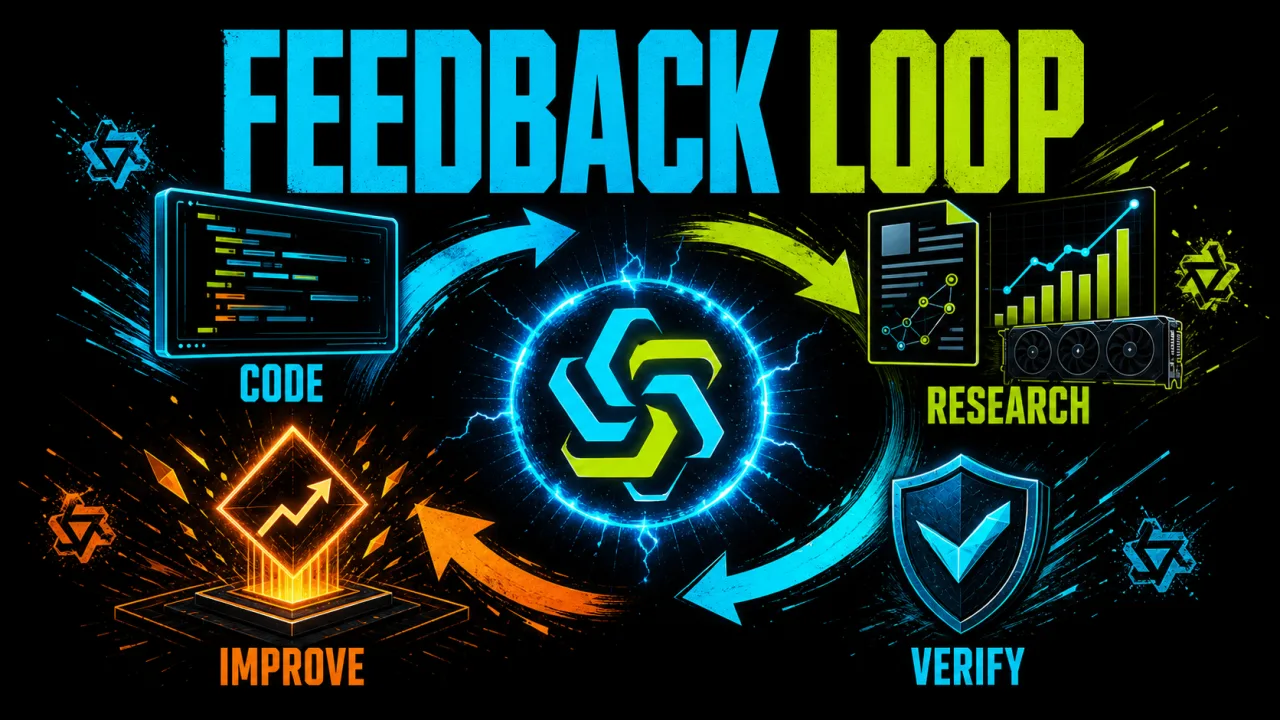
Qwen3.8-Max is Alibaba's new 2.4-trillion-parameter model for coding, research, work and long-horizon tasks. The model's defining pitch is not one benchmark score; it is the ability to keep a task moving through a cycle of planning, tool use, evaluation and revision. In its August 2 announcement, Qwen says the model has 95 billion active parameters, is available through QwenCloud, and will be the first Qwen-Max-class model with open weights.
Qwen3.8-Max matters because the demonstrations focus on work that cannot be completed in one response: building a project over more than 10 days, reproducing and improving a research paper over about five days, and iterating through 45 submissions in a 24-hour competition. For teams evaluating what an AI agent actually is, the useful question is therefore not whether Qwen3.8-Max can produce a good answer once, but whether it can produce a reliable result after many feedback cycles.
Definition: Qwen3.8-Max is Alibaba's new Max-class model, announced at 2.4 trillion total parameters and 95 billion active parameters, with a focus on coding, research, work and long-horizon execution.
Example: In Qwen's demonstrations, the model writes code, runs tests or experiments, studies the results, changes its method and continues until it reaches a stronger measured outcome.
Key takeaway: The release is positioned around sustained, feedback-driven execution rather than single-turn text generation.
Business impact: A model that can maintain state and respond to evidence could reduce supervision in multi-step work, but every claimed gain still needs testing on the workflow where a business plans to deploy it.
What Qwen3.8-Max changes for AI agents
Qwen3.8-Max is presented as an AI agent model because its demonstrations connect reasoning to external work. The model is shown reading a task, writing files, launching jobs, inspecting outputs and changing direction when the evidence is weak. That pattern is close to the loop-engineering approach: the useful unit is a bounded process with state and verification, not an isolated prompt.
The distinction matters for operators. A chatbot can explain how a training pipeline might work; a long-horizon agent must create the pipeline, run it, interpret the results and decide what to try next. Qwen3.8-Max's announcement gives examples of that broader behavior, but the evidence is still presented by the model's vendor. A production team should treat the demonstrations as a test plan, not as a substitute for its own evaluation.
How Qwen3.8-Max performed on autonomous coding
Qwen3.8-Max's first coding demonstration is a self-evolving harness built from scratch over more than 10 days. Qwen says the run converted GitHub Issues into executable work, dispatched agents through ready → leased → active states, triggered end-to-end tests and CI, and routed abnormal results back for repair. After roughly 16 days of autonomous operation, the cited repository had accumulated 265 commits, 127 pull requests and 151 issues; a team evaluating autonomous coding should begin with the same ingredients—explicit state, external checks and bounded recovery.
The important result is not the commit count by itself; it is the control loop around the agent. The harness combines task state, dispatch, monitoring, watchdog recovery, tests and previews, so new requirements can become work and failed checks can become new repair attempts. For a business considering autonomous coding, the practical lesson is to evaluate the harness, permissions and verifier together with the model rather than treating model quality as the whole system.
Qwen links the complete trace in the oh-my-cli GitHub repository, which gives readers a place to inspect the described project rather than relying only on a launch paragraph. That trace is useful evidence of the workflow's shape, but it does not prove that the same autonomy transfers to an unrelated codebase, team process or risk profile.
Can Qwen3.8-Max reproduce a research paper?
Qwen3.8-Max's research demonstration starts with a paper and GPUs, not starter code. Qwen says the model rebuilt the data-processing scripts, training code and evaluation setup for the paper “Unified Data Selection for LLM Reasoning”, then reproduced six main findings on a Qwen3-8B experiment. The announcement reports about five days of autonomous work, roughly 7,600 lines of code, more than 1,100 actions and 33 GPU-training rounds; research teams should use this kind of paper-to-reproduction task as a repeatable evaluation rather than a one-shot prompt test.
The second stage is where the feedback-loop thesis becomes concrete. Qwen says Qwen3.8-Max tested 18 improvement ideas across four rounds, with each round feeding results into the next set of hypotheses. The reported best method improved the AIME24 score by 2.71 points over the reproduced baseline, from 49.58% to 52.29%. Those figures are Qwen's report of its own experiment; reproducing the work independently will require the paper, code, data, evaluation settings and released model to line up.
How did Qwen3.8-Max use a 24-hour competition?
Qwen3.8-Max also entered the WWW2025 Multimodal Dialogue Intent Recognition Challenge on Alibaba Cloud's Tianchi platform, where Qwen says 526 human teams were competing. The task combined Chinese customer-service dialogue with screenshots, requiring the system to infer a fine-grained customer intent from both text and images; evaluators should therefore test Qwen3.8-Max on multimodal workflows rather than relying on text-only scores.
The model's reported approach was an ensemble: BERT, MacBERT and RoBERTa for text, a fine-tuned Qwen2.5-VL-7B plus Chinese-CLIP support for images, and weighted voting to combine the predictions. Across 45 submissions in the 24-hour window, Qwen says accuracy rose from 0.60 to 0.853, beating 458 of 526 human teams, or 87% of the field. The operational takeaway is that Qwen3.8-Max was used as a decision-making system around several models and repeated submissions, not as a single zero-shot classifier.
What professional work does Qwen3.8-Max target?
Qwen3.8-Max's work demonstrations extend the same loop into professional tasks. Qwen reports examples including a compliance review that surfaced 1,284 clauses from hundreds of documents in under an hour, an eight-screen banking prototype with no human revision rounds, and a 26-dish menu generated from more than 100 ingredient-supply briefs while maintaining a reported 33.8% food-cost ratio; businesses should treat those examples as candidate workflow templates to reproduce with their own inputs and quality gates.
The announcement also describes a quant-research workflow that generated around 330 sub-agents and about 6,000 backtests from six short factor descriptions. Qwen says the system changed its strategy when validation results exposed overfitting and used multi-seed validation when path dependence became a concern. For an operator, this is the meaningful pattern: dynamic orchestration should respond to measured results instead of blindly executing a fixed script.
These professional examples remain vendor-reported demonstrations, so their numbers need careful interpretation. A business should ask which inputs were available, which constraints were enforced, how quality was checked, what human review remained, and whether the result was genuinely production-ready or a controlled showcase. Without those details, the examples are informative but not comparable to a normal procurement benchmark.
Why does Qwen3.8-Max need long-horizon feedback?
Qwen3.8-Max's clearest technical theme appears in its chip-design demonstration. Qwen says the model ran an edit–simulate–synthesize–layout loop on a GCD/RSA hardware accelerator, using cocotb, Icarus Verilog, Yosys and OpenROAD. Over approximately 500 turns and 71 evaluations, the reported design fell from 8,298 gates to 678 while preserving functional checks; hardware teams should evaluate long-horizon agents with a similarly external, machine-checked objective.
The same demonstration reports a physical-layout change from a 106×106 micrometre die to 46×46 micrometres, with wire length dropping from 33,369 micrometres to 4,187 micrometres and timing closure reaching 500 MHz. Whether those results generalize is a separate question, but the example makes the model's intended role clear: it is expected to stay inside a measurable optimization loop long enough to find structural improvements, not stop after the first plausible implementation.
What remains unproven about Qwen3.8-Max
Qwen3.8-Max has a strong launch narrative, but several deployment questions remain open until the model, documentation and independent tests are available. The announcement does not by itself establish a general failure rate, tool-use reliability across vendors, inference cost, serving requirements, context limits, license details or the reproducibility of every showcase.
The open-weight timeline is also a separate milestone. Qwen says the weights will be released the week after the August 2 announcement, while hosted access is already available through QwenCloud. Teams interested in local deployment should wait for the actual checkpoint, license and technical documentation rather than planning hardware or compliance decisions from the parameter count alone.
The safest evaluation path is narrow and reversible: choose one workflow, define an external verifier, cap time and spend, log tool calls, keep a human approval boundary for irreversible actions and compare Qwen3.8-Max with a simpler model or deterministic automation. That process tests the property Qwen3.8-Max is actually selling — reliable improvement across a long run — instead of rewarding a short demo.
What should businesses test in Qwen3.8-Max?
Qwen3.8-Max signals a shift in how frontier models are being presented. The headline capability is no longer only reasoning quality in a single answer; it is the ability to operate inside a long-lived loop that produces evidence, learns from that evidence and continues toward a result. Qwen's coding, research, competition, work and chip-design examples all use that structure.
For businesses, the announcement is a reason to test long-horizon agents more seriously, not a reason to remove human controls. The useful question is whether Qwen3.8-Max can complete one valuable workflow with bounded permissions, durable state and an independent verifier. If it can, the model may be a strong component in an agent system. If it cannot, a simpler workflow may still be the better production choice.
Frequently asked questions
What is Qwen3.8-Max?
Qwen3.8-Max is Alibaba's latest Qwen model, announced on August 2, 2026. Qwen says it scales to 2.4 trillion total parameters with 95 billion active parameters, improves coding, work, research and long-horizon tasks, and is available through QwenCloud. Alibaba also says this is the first Qwen-Max-class model whose weights will be open-sourced, with the release planned for the following week. Those are the vendor's announced specifications and plans; independent evaluation should follow once the weights and methodology are available.
What makes Qwen3.8-Max different from a normal coding assistant?
Qwen3.8-Max is presented as a long-horizon agent rather than a model that only writes a function on request. In Alibaba's demonstrations, it works for days, runs code and experiments, uses evaluation feedback, changes its approach and continues toward a measurable result. The examples include a 16-day autonomous coding harness, a five-day paper reproduction and improvement run, and a 24-hour multimodal competition. These are vendor demonstrations, not a guarantee that every deployment will achieve the same autonomy or reliability.
Are Qwen3.8-Max's open weights available now?
Not according to Alibaba's August 2 announcement. Qwen says Qwen3.8-Max is currently available through QwenCloud and that the open weights will be released the following week. Until that release is published, teams cannot independently verify the checkpoint, license, serving requirements or reproducibility of the announced results. Hosted API access and open-weight availability are separate milestones, so a team planning a local deployment should wait for the actual model files and license terms.
What should a business evaluate before using Qwen3.8-Max?
A business should test Qwen3.8-Max on its own workflow with a fixed task set, explicit success criteria, tool permissions, cost limits and human escalation. The announcement emphasizes long-running execution and self-correction, but those properties still need to be measured on the company's data, integrations and failure cases. Start with a reversible process, log every tool call and compare the model with a simpler workflow or a human baseline. Treat impressive demonstrations as hypotheses to test, not as a production safety case.
Alex
Founder & Lead AI Writer
Alex is the founder of Yowox and lead AI writer since 2024, breaking down complex information into clear, actionable insights for thousands of readers every day. Alex has built AI automation systems for businesses since 2024, focusing on AI agents, workflow automation, and business process optimization.
Save hours. Save thousands.
Practical guides, real workflows, and the latest AI and automation news that matters — straight to your inbox.