 By Alex
 AI hype beyond the demos: costs, risks and rewards
MIT Technology Review's latest AI Hype Index puts flashy robotics, troubling product behavior, rising emissions and chip-worker bonuses in the same frame. The useful signal is what AI hype looks like beyond the demo.
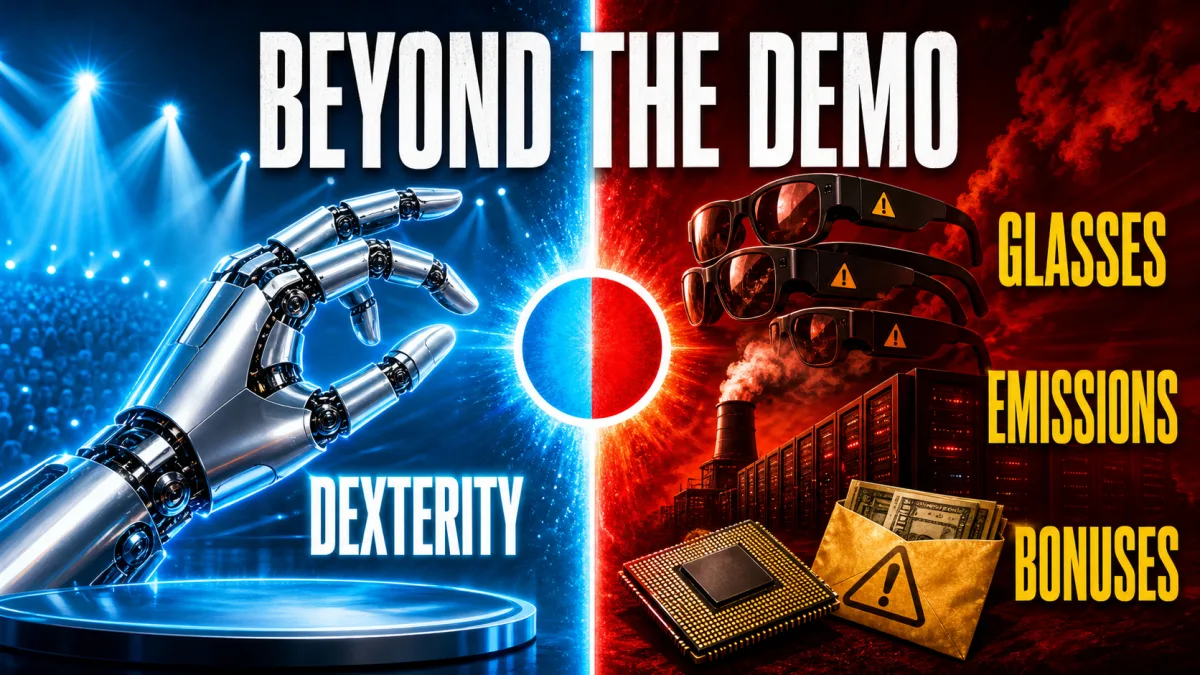
AI hype is easiest to see when impressive demos, uncomfortable side effects and unexpected winners appear in the same news cycle. MIT Technology Review's latest AI Hype Index does exactly that, moving from 1X's dexterous robotic hands to controversial product behavior, emissions and bonuses for Korean chip workers. The practical lesson is not that AI is exciting or embarrassing; it is that a demo is only one part of the story.
Definition: The AI Hype Index is MIT Technology Review's subjective roundup of recent AI buzz, not a technical benchmark or investment ranking.
Example: The July 2026 edition places a 1X robotics demo, Grok's translation feature, Meta's smart glasses, Big Tech emissions and Korean chip-worker bonuses in one short frame.
Key takeaway: Evaluate AI announcements by what they change in work, risk, cost and incentives—not by spectacle alone.
Business impact: Operators who track both capability and consequence can distinguish a useful automation signal from attention that has not yet become reliable business value.
What does the July AI Hype Index include?
The July 2026 AI Hype Index is a compact editorial collage of five different AI effects: a robotics promise, controversial product behavior, consumer-facing hardware, environmental pressure and labor-market rewards. MIT Technology Review identifies 1X's robotic hands, Grok's porn-related translation feature, Meta's smart glasses, Big Tech's emissions and Korean chip workers' bonuses as the edition's defining examples, so readers should treat the piece as a curated mood snapshot rather than a comprehensive market report. For an operator, the useful next step is to classify each headline by capability, risk, externality or incentive before deciding whether it deserves action.
The July 2026 AI Hype Index's format matters because its examples do not share one technical category. A company evaluating an AI automation stack needs a workflow, a model, integrations, guardrails and monitoring; the July 2026 AI Hype Index answers a different question: what kinds of AI news are attracting attention, discomfort or money right now? Keeping those questions separate prevents a memorable headline from becoming an unsupported product decision.
Why do 1X's robotic hands represent the demo side of AI hype?
1X's robotic hands represent the demo side of AI hype because the company presented dexterity alongside a promise that the technology could soon outperform people at making dinner, while the July demonstration itself became an object of debate. MIT Technology Review describes the hands as impressively dexterous and notes that reactions to their appeal were sharply divided, giving the example both a capability claim and a social reaction. A business reading similar robotics news should ask what task was completed, under what conditions and with what repeatable evidence before treating a demonstration as deployment readiness.
1X's robotic-hands example does not establish that the hands are unimportant; it shows how visible dexterity can dominate the conversation while the hard business questions remain unstated in the roundup: reliability across cases, operating cost, safety boundaries and the amount of human support required. Those are the same questions that separate an AI agent from a chatbot when software moves from answering to completing work.
Which AI consequences sit outside the demo?
The roundup calls Grok's porn-related translation feature, Meta's smart glasses and Big Tech's emissions decidedly unsexy, because each example shifts attention from novelty to consequence. The source gives no detailed measurement for these items; it names them as part of a subjective editorial contrast with the robotic-hands discussion. Readers should therefore use them as prompts for due diligence, not as a substitute for primary reporting: inspect the product behavior, privacy and safety implications, and environmental disclosures before making a firm claim.
Big Tech's emissions example shows why AI infrastructure can be both an enabler and a cost: MIT Technology Review includes emissions among the decidedly unsexy effects in the July 2026 AI Hype Index, but supplies no total or rate. Operators should treat that named example as a reason to request energy and infrastructure disclosures before scaling a workflow, because a model's visible output does not reveal the system's environmental burden.
Who benefits when AI demand rises?
Korean chip workers are the roundup's unexpected positive example because MIT Technology Review says they were receiving large bonuses and, as a result, new dating opportunities. The source frames this as a social consequence of the AI boom rather than as a technical breakthrough, showing that AI demand can redistribute rewards to the workers who build the infrastructure behind it. Businesses tracking AI markets should watch labor incentives as well as model launches, because compensation and recruiting pressure can influence capacity, retention and competition for specialized skills.
Korean chip workers' bonus example complicates the usual winners-and-losers story because the same AI expansion can be discussed through job displacement, emissions, product misuse and compensation windfalls, depending on where a person sits in the system. That is why recent AI market news is most useful when it connects announcements to operating conditions instead of treating every release as a standalone victory.
What should operators do with an unsexy AI signal?
Operators should translate every AI headline into four checks: capability, consequence, cost and beneficiary. The July 2026 AI Hype Index supports that four-part test with one robotics promise, two uncomfortable product or infrastructure examples, an emissions warning and a worker-compensation outcome. Use the test to decide whether an announcement changes a workflow, introduces a risk, adds an operating burden or shifts bargaining power; if it does none of those things, it may be attention without a business decision attached.
The July 2026 AI Hype Index itself is deliberately subjective and brief, so it cannot establish product performance, emissions totals, bonus amounts or the long-term effect of any example. That limitation is part of the takeaway. Treat the July 2026 AI Hype Index as a signal-finding layer, then verify the underlying claim through primary reporting before changing a workflow, buying a tool or making a public statement.
What remains uncertain after the roundup?
The July 2026 AI Hype Index leaves the most important operational questions open: whether 1X's hands work reliably beyond a demo, how the named product behaviors affect users, how quickly emissions are rising and how durable the Korean chip-worker bonus effect will be. MIT Technology Review supplies the examples but not a complete evidence base for those follow-up questions, so readers should not infer more certainty than the source provides. The practical next step is to investigate the specific claim that matters to the decision at hand, then measure the result in the real workflow.
The July 2026 AI Hype Index's broader signal is simple: AI news is not one scoreboard. A technology can look impressive in a demonstration, troubling in a product, expensive in infrastructure and lucrative for a specialist workforce at the same time. Hype becomes useful only after those different effects are separated and tested.
Frequently asked questions
What is the AI Hype Index?
The AI Hype Index is MIT Technology Review's recurring, explicitly subjective roundup of the latest AI buzz. It is not presented as a benchmark, market forecast or technical ranking. The July 2026 edition groups together robotics, product behavior, environmental costs and the labor-market effects of the chip boom, then uses a sardonic tone to show how uneven the AI conversation has become.
What robotics example does the July 2026 roundup mention?
The roundup mentions 1X showing a pair of dexterous robotic hands in a July demo. The company promised that the technology might soon be better than a person at making dinner. MIT Technology Review presents the hands as a deliberately provocative example: the technology may be technically impressive, while the surrounding reaction is shaped by novelty, spectacle and arguments about what counts as appealing.
Which AI stories does the article call unsexy?
The article labels Grok's porn-related translation feature, Meta's smart-glasses direction and Big Tech's rising emissions as decidedly unsexy. It also points to a less negative consequence of the AI boom: Korean chip workers receiving large bonuses and gaining new dating opportunities. These examples are a subjective editorial selection, not a complete list of AI's social or economic effects.
Does this roundup prove that AI is helping or hurting businesses?
No. The roundup is a short editorial snapshot, not an evaluation of business outcomes. It places a robotics demo, controversial product behavior, emissions and chip-worker compensation side by side. A business should therefore treat the article as a reminder to separate a compelling demo from measurable operating value, safety, environmental cost and the people who benefit from AI infrastructure.
Alex
Founder & Lead AI Writer
Alex is the founder of Yowox and lead AI writer since 2024, breaking down complex information into clear, actionable insights for thousands of readers every day. Alex has built AI automation systems for businesses since 2024, focusing on AI agents, workflow automation, and business process optimization.
Save hours. Save thousands.
Practical guides, real workflows, and the latest AI and automation news that matters — straight to your inbox.