 By Alex
 How Much Agentic Memory Does Your Model Need?
IBM Research's ALTK-Evolve results show why agent memory should be calibrated to model capability, task headroom and token cost—not simply accumulated.
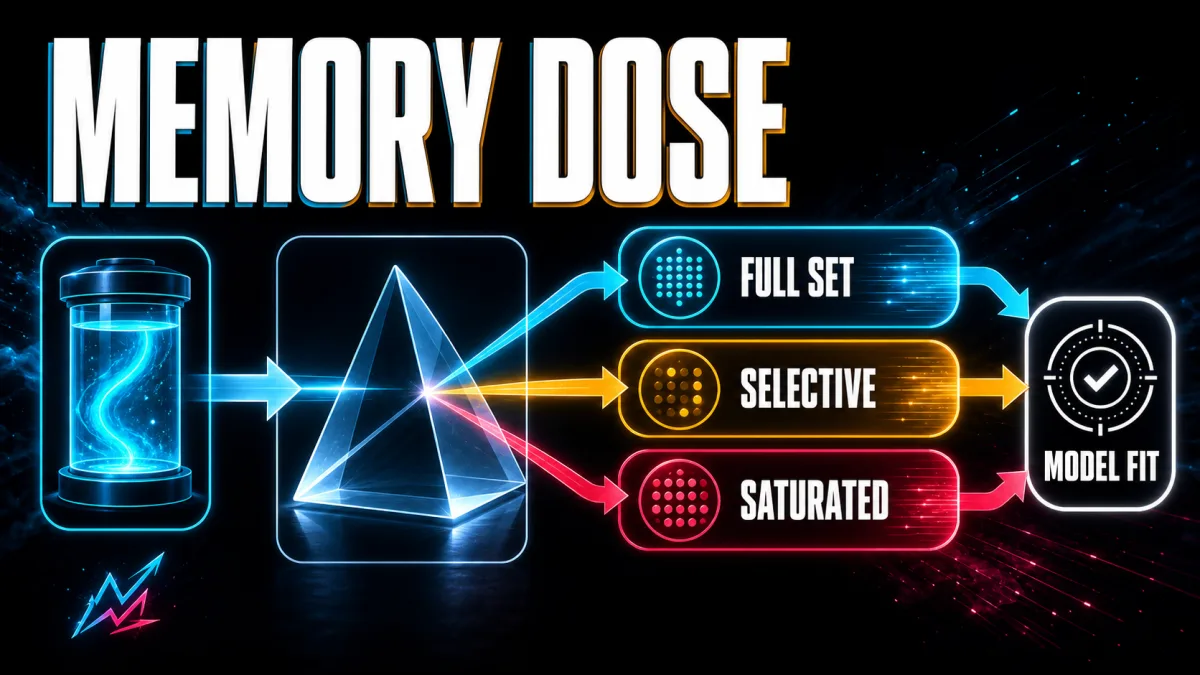
Agentic memory is not a setting to turn on once; it is a context budget to calibrate to the model. In an August 18, 2026 Hugging Face article from IBM Research, ALTK-Evolve improves an agent by distilling lessons from earlier trajectories into reusable guidelines and feeding them back at inference time. The reported evaluation across eight models points to a practical rule: give strong models enough memory to use their remaining headroom, give weaker models a compact relevant subset, and do not assume saturated models will improve just because more context is available. For the broader components around an agent, see what an AI agent actually is and how the AI automation stack fits together.
Definition: ALTK-Evolve is a no-weight-update memory loop that distills an agent's successful and unsuccessful trajectories into reusable guidelines.
Example: A model can receive every guideline on each reasoning step, or a fixed high-confidence core plus a few guidelines retrieved for the current task.
Key takeaway: Memory quantity should follow model capability and task headroom, not a universal "more is better" rule.
Business impact: Selective memory can raise task completion without imposing the full input-token cost of injecting every stored lesson.
What changed in IBM Research's agent memory results?
IBM Research's ALTK-Evolve results change the operational question from whether an agent should have memory to how much guideline context a particular model can use. The study scaled its evaluation to eight models, including dense and mixture-of-experts systems as well as proprietary frontier models, and observed three recurring patterns rather than one universal memory curve. The practical next step is to test memory dose by model tier instead of copying one context policy across every workflow. More on this: Persistent memory for Claude through a local MCP server.
The reported results are measured on AppWorld, a benchmark with 585 multi-step tasks across nine simulated applications, including calendars, messaging and payments. IBM Research used the training split to mine one shared guideline set and evaluated delivery strategies on held-out test tasks, which makes the comparison about context delivery rather than mixing test data into memory creation. Teams evaluating their own agents should preserve that separation between memory construction and evaluation.
Which models want more agentic memory?
The ALTK-Evolve evaluation found that strong models with remaining headroom generally benefited from the full guideline set. DeepSeek-V3.2 improved task completion by 9.5 percentage points when it received all of its self-mined guidelines, while Claude Opus 4.6 and GPT-5.5 also improved under full delivery. For a capable model that still has identifiable failure modes, testing the complete guideline set is reasonable before adding an aggressive selector.
The ALTK-Evolve evaluation found that a weaker model can benefit more from selective memory than from a larger context dump. On gpt-oss-120b, curated retrieval raised task completion by 16.1 percentage points, while the full guideline set produced a smaller improvement and used about 50% more tokens than the baseline. For a cost-sensitive workflow, start with a compact high-confidence core and retrieve only a few task-relevant guidelines per task.
The ALTK-Evolve evaluation also found a saturated pattern: GLM-5 showed no measurable gain in the reported runs. IBM Research labels this an observation rather than a proven cause, because a near-ceiling benchmark score, irrelevant guidelines or weak application of the guidance could each explain the result. When a model is already strong on a task, measure the remaining failure modes before paying for more context.
| Model pattern | Memory policy that performed best in the reported runs | What an operator should test |
|---|---|---|
| Strong with headroom | Full guideline set | Whether rare edge-case lessons improve reliability enough to justify input cost |
| Weaker or selective | Compact core plus task-relevant retrieval | Whether a small retrieved subset improves outcomes at near-baseline token use |
| Saturated | No measurable gain observed | Whether the benchmark leaves meaningful failure modes for memory to address |
How does the memory loop work without retraining?
ALTK-Evolve changes the guidance around the model, not the model weights. The agent first produces task trajectories, the system extracts reusable guidelines from successful and unsuccessful runs, and the system consolidates those guidelines into a reusable set. At inference time, the agent receives either the full set or a selected portion, so teams can adopt the loop without a weight-update cycle or human annotation step.
That distinction matters for production architecture. A memory layer can be changed, evaluated and rolled back independently from the model, while the model's original weights remain fixed. Businesses should therefore log which guideline set and delivery policy each run used; without that link, a change in task outcomes cannot be attributed to the memory policy with confidence.
What does agent memory cost in tokens?
The ALTK-Evolve results show that memory overhead depends on delivery strategy, not just on the existence of memory. In the AppWorld measurements, DeepSeek-V3.2 rose from 148K to 263K tokens per task with full guideline injection, an increase of 78%; gpt-oss-120b rose from 110K to 166K, an increase of 51%, while curated retrieval raised gpt-oss-120b to 116K tokens, or 5% above baseline. Operators should compare cost per completed task, not only raw accuracy.
Prompt caching is the main production lever identified in the report for making a full guideline set more affordable. Because the static part of the guideline context can remain identical across reasoning steps, a cache-aware prefix can avoid paying the full repeated-input cost every time. The source presents this as an engineering recommendation and hypothesis about efficiency, not as a controlled result isolating every provider's cache behavior.
What should teams measure before choosing a memory dose?
Teams should compare baseline, full-guideline and curated-retrieval configurations on the same task distribution and held-out evaluation split. The ALTK-Evolve study reports both Task Goal Completion, which asks whether an individual task finished correctly, and Scenario Goal Completion, a stricter measure that requires every variant in a scenario to pass. Use both where reliability matters, because an average task score can hide repeated edge-case failures.
Teams should also measure token use, latency, failure categories and the quality of retrieved guidelines alongside task completion. The ALTK-Evolve findings show why: DeepSeek's full-memory policy added input tokens without materially lengthening its ReAct trajectories, while gpt-oss-120b's selective policy improved completion at near-baseline token use. A memory policy is production-ready only when its quality gain survives a cost and reliability check.
What remains uncertain about model memory?
The ALTK-Evolve results do not establish that parameter count alone determines the right memory dose. IBM Research identifies benchmark headroom, context-window size, model architecture, guideline quality and task distribution as factors that may shape the observed pattern, while noting that controlled separation of these factors remains ongoing. Treat the three patterns as an operating hypothesis, not as a lookup table that predicts every model.
The evaluation also covers AppWorld rather than every real-world deployment. IBM Research lists a learned guideline selector, memory for very weak models, broader agent benchmarks and controlled context-window experiments as next steps. The practical implication is straightforward: use the results to design a calibration experiment, then keep revisiting the policy as the model, task mix or memory corpus changes.
What should operators do with this finding?
Operators should begin with three comparable runs: no memory, full guideline injection and curated retrieval from the same mined guideline set. For each model and workflow, record task completion, strict scenario reliability, tokens per task and the failure modes that memory changes. That small matrix reflects the evidence from ALTK-Evolve without assuming that the best policy for one model transfers to another.
The durable lesson from the IBM Research study is not to accumulate every lesson an agent can extract. It is to match the amount and delivery of memory to what the model can apply, then keep the static context cacheable when production economics require it. Memory becomes useful when it targets a measurable failure mode; beyond that point, extra context can be cost without additional capability.
Frequently asked questions
What is ALTK-Evolve memory?
ALTK-Evolve is a memory approach in which an agent's previous task trajectories are distilled into reusable behavioral guidelines. Those guidelines are consolidated and then supplied during inference as either the full set or a task-relevant selection. The approach does not update model weights and does not require human annotation, so it changes the guidance available to an agent without retraining the underlying model.
Should an AI agent always receive all of its learned guidelines?
No. The useful amount of agent memory depends on the model and task. IBM Research reports that stronger models with remaining benchmark headroom benefited from the full guideline set, while gpt-oss-120b performed best with a compact core plus task-specific retrieval. A model that is already near its ceiling may show no measurable gain. Compare full and selective delivery on a fixed task set before choosing a production policy.
Which agent memory strategy is cheapest?
In the reported AppWorld evaluation, curated retrieval was the cheapest winning strategy for gpt-oss-120b: task completion rose by 16.1 percentage points while token use increased by 5% over the no-memory baseline. Full guideline injection for the same model increased tokens by about 51%. Production systems should also keep static guideline prefixes stable so prompt caching can reduce the effective cost of repeated context.
Does agent memory improve every model?
No. The ALTK-Evolve evaluation found three practical response patterns: strong models with headroom can use a full guideline set, weaker models can benefit from selective retrieval, and saturated models may show no measurable improvement. The result is not a universal parameter-count rule. Context-window size, guideline quality, task mix and benchmark headroom can all affect the outcome, so each model tier needs its own test.
Alex
Founder & Lead AI Writer
Alex is the founder of Yowox and lead AI writer since 2024, breaking down complex information into clear, actionable insights for thousands of readers every day. Alex has built AI automation systems for businesses since 2024, focusing on AI agents, workflow automation, and business process optimization.
Save hours. Save thousands.
Practical guides, real workflows, and the latest AI and automation news that matters — straight to your inbox.