 By Alex
 I Gave Claude a Memory That Survives Between Conversations — Here’s the MCP Server That Does It
A new hands-on walkthrough shows how to build a local MCP server that gives AI agents persistent memory, reinforcement, decay, pruning and deduplication.
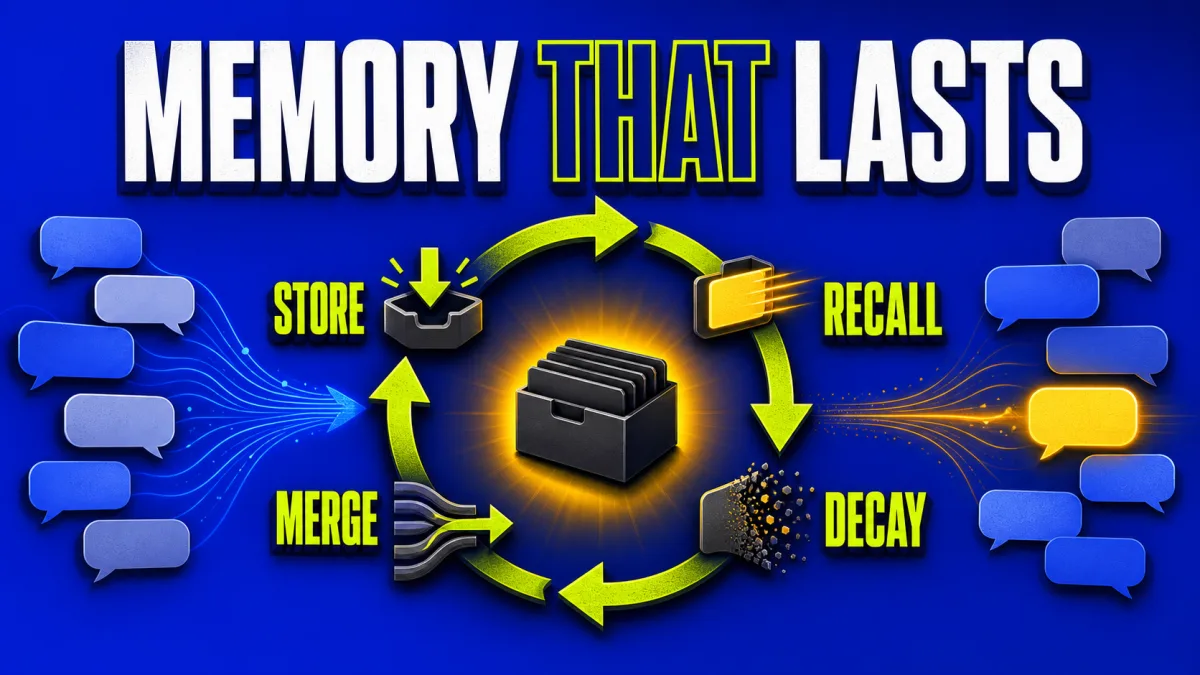
AI agents still reset when a conversation ends, but a new hands-on walkthrough shows a practical way around that: put memory behind an MCP server. The original article from Sai Insights walks through a tested, file-backed server that exposes memory tools to an MCP-compatible host and records the protocol interaction, rather than presenting memory as a prompt trick.
Definition: Persistent agent memory is a separate store that survives a chat session and can be queried by a compatible AI host through tools.
Example: A Claude-compatible client can call
rememberto save a preference,recallit in a later conversation, and let maintenance reduce the score of memories that are never used.Key takeaway: The interesting part is not saving text; it is combining persistence with reinforcement, decay and consolidation.
Business impact: A memory layer can reduce repeated context-setting for long-running assistants, but it also introduces new requirements for access control, deletion and evaluation.
What problem does long-term agent memory solve?
The stateless-agent problem has two halves: information disappears when a session closes, and the naive fix of saving everything creates an uncurated junk drawer. The source walkthrough frames a useful memory system as one that persists facts and preferences while also deciding what remains worth retrieving. That distinction matters for coding assistants, support agents and personal assistants that may accumulate context over months rather than one chat.
A conversation summary is not automatically a memory. A summary records what happened in one interaction; a memory system decides which facts deserve to be carried into a future interaction, how strongly they should be ranked, and when they should be forgotten. The walkthrough treats those decisions as part of the server rather than leaving them to a growing system prompt.
Why use MCP for memory?
MCP gives an AI host a standard client-server structure: the host creates an MCP client, the client connects to a server, and the server exposes tools or other context. That makes memory a replaceable capability instead of a feature that must be reimplemented inside every agent application.
The architectural benefit is portability. A local memory server can expose the same surface to Claude Desktop, Claude Code or another MCP-compatible client, while its persistence layer, scoring rules and extraction strategy remain on the server side. MCP handles context exchange; it does not decide whether the server should use JSON, SQLite, a vector database or a hosted service.
This separation also makes the boundary easier to inspect. Instead of silently writing every message, the agent has an explicit set of operations such as remember, recall, forget, list and consolidate. That tool surface becomes part of the memory policy: the host can see what actions are available, and operators can audit which calls change stored data.
What makes this different from a memory file?
A plain memory file persists text, but it does not by itself provide retrieval, ranking or a forgetting policy. The server described in the source adds four mechanisms around persistence:
| Mechanism | What it does | Why it matters |
|---|---|---|
| Importance scoring | Assigns a strength value to a stored memory | Gives retrieval something to rank |
| Reinforcement | Raises a memory’s score when recall uses it | Lets useful facts survive repeated use |
| Decay and pruning | Reduces unused scores and removes weak records | Prevents indefinite accumulation |
| Consolidation | Merges near-duplicate memories | Keeps repeated facts from fragmenting the store |
The key design choice is that forgetting is intentional. A preference that gets recalled repeatedly can remain strong, while a one-off detail can fade when no future task needs it. That is closer to curation than to transcript storage.
How does the memory loop work?
The request-time loop starts when an agent decides that a fact is worth saving or needs to be retrieved. The server writes or searches the persistent store, then returns the result through MCP. The maintenance loop runs separately: it applies decay, prunes records below a threshold and consolidates duplicates.
The source walkthrough demonstrates this behavior through a real MCP client and server over stdio. It includes a demo mode with rule-based extraction, plus a live mode that switches extraction to Claude-backed processing through a configuration change. The distinction is useful: the protocol and storage pipeline can be tested locally before a remote model becomes part of the write path.
The important branch is reinforcement. If a memory is recalled, its score increases; if it is ignored, time-based decay lowers its score. A maintenance pass can therefore keep the store compact without requiring a human to review every record manually. The policy is not universal — the reinforcement bump, decay rate and pruning threshold are application choices — but making them explicit is better than pretending a memory file has no maintenance cost.
Which tools does the server expose?
The walkthrough centers on a small tool surface rather than a large framework. remember stores a candidate memory, recall retrieves relevant records, forget removes one, list inspects the store, consolidate merges duplicates, and run_maintenance applies cleanup behavior. The names describe operations an agent can reason about directly, which is consistent with Anthropic’s guidance on simple, composable agent patterns.
That surface also makes permissions concrete. A read-only client might be allowed to call recall and list but not forget; a trusted local assistant might receive the full set. The protocol does not solve authorization by itself, so the host, transport and server still need an explicit security model.
What does the implementation actually store?
The example uses a file-backed store created locally on first run. That keeps the project easy to run and makes the behavior visible: stored records can be inspected, the decay pass can be exercised, and the MCP handshake can be verified without provisioning a hosted database.
The source is careful to separate demo extraction from live extraction. Rule-based demo mode is enough to prove the plumbing, but it is not the same thing as a production memory policy. Live extraction adds a model dependency and therefore adds latency, cost, failure handling and privacy questions to every operation that asks the model to decide what is memorable.
That trade-off is more important than the choice of file format. A local JSON file may be appropriate for a single-user experiment; a multi-user service will need isolation, concurrency control, backups, retention rules and likely a different storage engine. The MCP interface can stay stable while those implementation details change.
What are the limits of the approach?
Persistent memory does not make an agent automatically reliable. A wrong fact can survive between sessions just as easily as a correct one, and reinforcement can strengthen a mistake if the retrieval or evaluation loop is wrong. A production system needs explicit correction and deletion paths, provenance for sensitive records, limits on what can be remembered, and tests that measure both useful recall and harmful recall.
Memory also adds another stateful system to debug. Operators must distinguish a model failure from an extraction failure, a retrieval miss, a stale record, a decay-policy mistake and a transport problem. Logging tool calls and maintenance decisions is therefore part of the design, not an optional observability upgrade.
Security is equally central. A memory server may contain personal preferences, internal project details or secrets copied from a conversation. Local stdio transport reduces the network surface for a single-user setup, while a remote HTTP server makes sharing easier but requires authentication, authorization, encryption and tenant isolation. The fact that MCP makes a server easy to connect does not make every stored memory safe to expose.
What should builders watch next?
The practical lesson from this implementation is that durable agent memory is becoming a systems problem rather than a prompt-formatting trick. MCP supplies the connector, but the quality of the result depends on the policy around that connector: what gets stored, how it is ranked, how it decays, how a user corrects it and how an operator proves that it works.
For a prototype, a local file-backed server with remember, recall, forget, consolidation and maintenance is a useful boundary. For production, the next questions are stricter: can every memory be deleted, can every retrieval be explained, can one user’s records be isolated from another’s, and can the team measure whether recall improves task outcomes instead of merely increasing context?
The source article’s strongest contribution is its insistence on demonstrating the full loop over the real MCP protocol. The durable pattern is not “give Claude a bigger prompt.” It is a small, inspectable server that turns memory into an explicit capability — and a maintenance policy that knows when not to remember.
FAQ
Is an MCP memory server the same as a vector database?
No. MCP defines how an AI host connects to a server and calls its tools; it does not require a vector database. The walkthrough uses a local file-backed store and demonstrates persistence, scoring, decay and consolidation around that store. A production implementation could use SQLite, a relational database, a vector index or a hybrid retrieval system behind the same MCP-facing tool surface. The important architectural separation is between the protocol boundary and the storage/retrieval implementation.
Should every conversation message be saved as a memory?
No. Saving every message is the fastest way to create noisy retrieval and privacy risk. A useful memory policy should distinguish durable facts or preferences from one-off context, provide a way to correct or delete records, and evaluate whether recalled memories improve the task. Importance scoring, reinforcement, decay and consolidation help with curation, but they do not replace explicit retention rules or human review for sensitive domains.
Does MCP provide memory automatically?
No. MCP provides a standard way for an AI host to connect to a server that exposes tools, resources or prompts. A memory server still needs persistence, retrieval, extraction, scoring, maintenance and security logic. The value of using MCP is that the capability can be built once and connected to multiple compatible hosts instead of being embedded separately into each application.
What is the safest first deployment for an MCP memory server?
Start locally with a narrow memory policy, a file or SQLite store, explicit remember and forget tools, and test data that contains no secrets. Add logging for writes, reads, deletions and maintenance decisions before connecting real user conversations. If the server later moves to remote HTTP, add authentication, authorization, encryption, tenant isolation, retention controls and a deletion workflow before treating it as a shared production service.
Frequently asked questions
What does the memory MCP server do?
The memory MCP server gives an AI agent tools for storing, retrieving, listing and deleting memories across conversations. The walkthrough also adds importance scoring, reinforcement when a memory is recalled, decay for memories that are ignored, pruning below a threshold, and consolidation of near-duplicates. The storage is file-backed, so the demo can run locally without a hosted database or external API.
Why is memory exposed as an MCP server instead of built into Claude?
Exposing memory through MCP separates the memory capability from the AI application. A compatible host such as Claude Desktop or Claude Code can connect to the same server through standard tools, while the memory store remains independently replaceable. MCP standardizes the connection and tool-discovery layer; it does not prescribe the database, extraction model, scoring formula or forgetting policy behind the server.
How does the server decide which memories to keep?
The implementation gives each memory an importance score, reinforces it when recall uses it, and applies time-based decay when it is not accessed. Maintenance can prune memories below a threshold, while consolidation merges near-duplicates. The result is an explicit curation loop rather than a file that grows forever with every passing remark.
Can the memory server run without an API key?
Yes, the walkthrough includes a demo mode with rule-based extraction that runs locally. It also describes a live mode that uses Claude-backed extraction after a configuration change. The local demo is useful for testing the MCP protocol, persistence and maintenance behavior without making the server depend on a remote model for every memory write.
Alex
Founder & Lead AI Writer
Alex is the founder of Yowox and lead AI writer since 2024, breaking down complex information into clear, actionable insights for thousands of readers every day. Alex has built AI automation systems for businesses since 2024, focusing on AI agents, workflow automation, and business process optimization.
Save hours. Save thousands.
Practical guides, real workflows, and the latest AI and automation news that matters — straight to your inbox.