 By Alex
 OpenAI & ReliaQuest: Partnership for Agentic Cybersecurity
OpenAI and ReliaQuest are joining the Daybreak Cyber Partner Program to bring OpenAI’s frontier cyber capabilities into GreyMatter, combining model access with security-operations expertise and explicit controls for enterprise use.
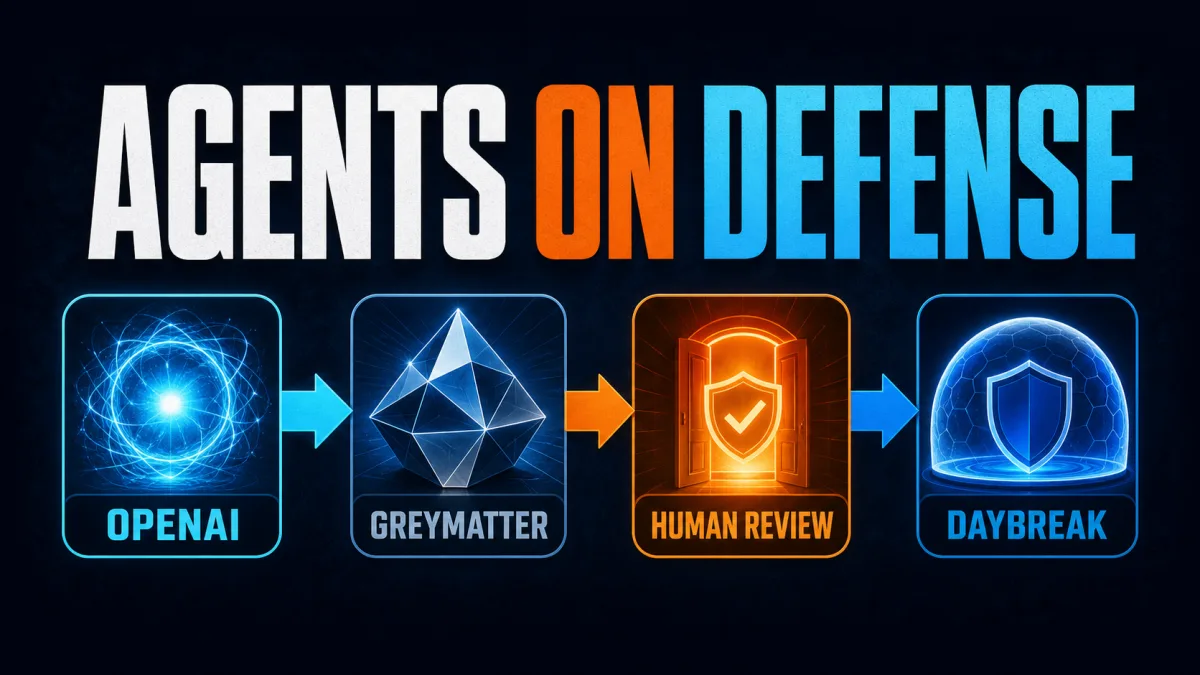
OpenAI and ReliaQuest are partnering to put frontier cyber models inside an enterprise security-operations platform. The AI Magazine report says ReliaQuest is joining OpenAI’s Daybreak Cyber Partner Program and will work with OpenAI on capabilities for its GreyMatter platform. For context, an AI agent is useful here only when it can operate inside a bounded workflow with permissions, monitoring and human escalation—not merely produce a security-themed answer.
Definition: The partnership is a joint development and deployment arrangement, not an announcement that OpenAI is handing ReliaQuest an unsupervised cyber-operator.
Proof: The companies plan to identify high-impact security-operations use cases, then collaborate through development, testing, evaluation and production rollout in GreyMatter.
Takeaway: The important product question is whether model capability can be made operationally useful and governable inside the tools security teams already run.
What exactly did OpenAI and ReliaQuest announce?
ReliaQuest is joining the OpenAI Daybreak Cyber Partner Program, which OpenAI describes as a way to bring defensive AI capabilities into products, services and workflows that security organizations already trust. The official Daybreak partner page says the program is intended to help cybersecurity companies and service providers develop governed solutions for defenders, including workflows that identify, validate and remediate threats faster.
The agreement gives ReliaQuest access to advanced OpenAI models and cyber capabilities, alongside closer technical collaboration. The work will focus on selecting security-operations use cases where AI can have a practical impact, then taking those use cases through development, testing, evaluation and production rollout inside GreyMatter and related managed workflows.
That sequence is more significant than the word “partnership.” It describes a path from model access to a controlled operational feature. The announcement does not claim that every GreyMatter workflow becomes autonomous or that a model can safely make every security decision without review.
Why is GreyMatter the center of the deal?
GreyMatter is ReliaQuest’s agentic AI security-operations platform. Its job is to bring data from security technologies into workflows for detection, investigation, threat hunting and response. ReliaQuest’s platform description presents GreyMatter as a system that uses agentic personas, skills and tools to work toward an objective rather than only completing isolated tasks.
That is the layer where a frontier model can become operationally relevant. A model in a chat window can explain a suspicious domain. A model connected to a security platform can potentially correlate the domain with alerts, inspect related activity, propose a response and route the result to the team responsible for approval. Every additional action also creates a new permission, audit and failure boundary.
ReliaQuest says GreyMatter uses a model-agnostic AI layer that selects the most appropriate model for a task based on factors such as the use case, data type and performance requirements. The OpenAI partnership therefore adds another capability option and a deeper collaboration path; it does not necessarily turn GreyMatter into an OpenAI-only product.
What will the companies build together?
The companies plan to jointly identify and prioritize high-impact security-operations use cases. They will then collaborate across the full delivery chain: development, testing and evaluation, followed by production rollout within GreyMatter and associated managed workflows.
The public announcement does not provide a complete feature list or promise a specific launch date for a named capability. That distinction matters. It is reasonable to say the partnership is aimed at faster investigation, vulnerability work and defensive response because those are the stated goals. It is not reasonable to claim that a particular automated remediation feature is already available because the partnership has been announced.
The likely value is in connecting model reasoning to the context that security teams already collect: alerts, detections, threat intelligence, exposures and investigation history. The model can be useful when it shortens the path between a signal and a well-supported next action. It is much less useful when it produces a confident summary that an analyst still has to reconstruct from five disconnected consoles.
How does OpenAI’s Daybreak program fit?
OpenAI’s Daybreak cybersecurity page frames the program around a broader defensive loop: finding vulnerabilities, validating them and helping fix them before attackers exploit them. It combines cyber models, Codex Security, trusted workflows and ecosystem partnerships, with access and safeguards that vary according to the defender and the work being performed.
The program’s design is important because cyber capability has an obvious dual-use problem. A model that can help validate an authorized exploit can also be misused against a system without permission. OpenAI says Daybreak is built around authorization, human judgment, monitoring, safeguards and collaboration with the security community. ReliaQuest says it will contribute real-world security-operations expertise and help codify standards for safety, abuse prevention and controls that monitor and prevent unsanctioned activity.
Those controls are not side notes. In an agentic security workflow, the system may be allowed to read sensitive telemetry, call investigation tools or prepare a response. The boundary between “recommend,” “execute” and “execute after approval” must be explicit for each action.
Why are AI-driven attacks raising the urgency?
The partnership arrives as security teams face adversaries that can use AI to automate and scale parts of cyber operations. The AI Magazine report cites Anthropic’s analysis of 832 accounts involved in cyber activity: 560, or 67%, used AI while preparing for an attack. It also reports that the share of actors classified as medium risk or higher rose from 33% in the first six-month period to 56% in the second.
Those figures describe the research cited by the report, not a universal measurement of every cyberattack. The narrower point is enough: AI is changing the speed and economics of parts of the threat lifecycle, so defenders cannot treat AI assistance as a future-only consideration.
A defensive system therefore needs more than a strong model. It needs broad telemetry, reliable context, clear authorization, reversible actions where possible, monitoring and an audit trail that lets a human understand why the system made a recommendation. The model is one component of that system.
What could agentic cybersecurity improve?
Investigation speed is the clearest target. ReliaQuest’s CEO Brian Murphy said the partnership is intended to help security teams investigate and respond to threats in minutes. An agent that can gather evidence, normalize terminology and explain its reasoning may reduce the manual time spent assembling an initial case.
Vulnerability work is another target. OpenAI’s Daybreak materials describe defensive workflows that help find, validate and remediate vulnerabilities. ReliaQuest says access to OpenAI’s cyber capabilities can help enterprises find and patch vulnerabilities faster. The operational test is whether the system can prioritize the right issues and produce evidence that a developer or security engineer can act on, not simply generate more findings.
Response coordination is the harder target. A security platform may have authority to disable an account, isolate a device or block an indicator. Connecting an agent to those actions can reduce response time, but it also raises the cost of a mistaken action. The more consequential the tool call, the stronger the need for narrow permissions, confirmation and rollback.
| Layer | What the partnership can add | What still needs governance |
|---|---|---|
| Model | Frontier cyber reasoning and task-specific capability | Scope, permitted use and evaluation |
| Platform | GreyMatter context, telemetry and managed workflows | Data access and tenant isolation |
| Agent | Investigation, prioritization and coordinated tool use | Approval boundaries and action permissions |
| Operations | Faster movement from signal to response | Auditability, rollback and human escalation |
What should enterprise security teams watch?
Look for production evidence, not just model access. The announcement promises a path through testing and evaluation, but the useful evidence will be the controls, failure rates, escalation behavior and measurable workflow outcomes of released capabilities.
Separate reasoning from authority. An agent can analyze an incident without being allowed to contain it. Teams should map permissions to individual actions and make the transition from recommendation to execution visible to operators.
Test the model against real context. Cybersecurity data is noisy, duplicated and incomplete. Evaluation should include stale indicators, conflicting evidence, missing telemetry and benign activity that resembles an attack. A polished demo with clean inputs is not a security control.
Keep model choice flexible. ReliaQuest describes GreyMatter as model-agnostic. That is strategically useful for security teams because the best model may depend on latency, cost, data sensitivity, task difficulty and the need for a particular cyber capability. A partnership should improve the platform’s options rather than create a new single-model dependency.
Treat safety work as part of the product. ReliaQuest’s role in standards, abuse prevention and monitoring should be evaluated alongside the model’s task performance. In cyber defense, a capability that is powerful but difficult to constrain can create more operational risk than it removes.
Is this a replacement for security analysts?
No public detail in the announcement supports that conclusion. The stated goal is to help security teams investigate and respond faster by combining OpenAI models with GreyMatter and ReliaQuest’s operational expertise. That is an augmentation and workflow-acceleration claim, not a promise of unsupervised replacement.
Security analysts still define priorities, judge ambiguous evidence, approve consequential actions and investigate cases where the available data is incomplete. Agentic systems can compress repetitive work and coordinate tools, but accountability remains an organizational requirement. The partnership will be judged by whether it makes those human decisions faster and better informed without hiding the model’s uncertainty.
The bigger shift is from model demos to governed cyber systems
OpenAI and ReliaQuest are betting that enterprise cybersecurity will be won at the system layer, not inside a standalone chatbot. OpenAI brings frontier models and cyber capabilities. ReliaQuest brings GreyMatter, security-operations workflows and experience with the messy context that surrounds real incidents. Daybreak supplies a partner structure for turning those pieces into tested defensive products.
The hard part now is execution. A useful system must identify the right use case, connect the right data, choose the right model, keep permissions narrow and make every important action reviewable. If the partnership delivers that combination, security teams may get more time back without giving up control.
The announcement is therefore best read as a signal about where agentic cybersecurity is going: models are becoming components inside governed operational platforms. The winners will not be the systems that promise to “secure everything” autonomously. They will be the systems that help defenders move faster while making the boundaries of authority impossible to miss.
For a practical view of where agentic systems fit into a build-versus-buy decision, see Yowox’s AI agent build-versus-buy analysis.
Frequently asked questions
What is the OpenAI and ReliaQuest partnership?
ReliaQuest is joining OpenAI’s Daybreak Cyber Partner Program. The two companies plan to identify high-impact security-operations use cases and develop, test, evaluate and roll out capabilities using OpenAI models in ReliaQuest’s GreyMatter platform and managed workflows.
What is ReliaQuest GreyMatter?
GreyMatter is ReliaQuest’s agentic AI security-operations platform. It brings together security telemetry, investigations, detection, threat hunting and response workflows, with AI agents and an AI model broker that selects a model for a task based on the platform’s stated requirements.
What does ReliaQuest get from OpenAI Daybreak?
ReliaQuest gets closer technical collaboration and access to OpenAI’s frontier cyber capabilities and models. The stated purpose is to speed up development of defensive capabilities inside GreyMatter, not to announce an autonomous replacement for security teams.
Why does this partnership matter?
Attackers are using AI to automate and scale parts of cyber operations, while defenders need to investigate and respond faster. The partnership matters because it combines a frontier-model provider with a security platform and operational expertise, while explicitly including safety, abuse-prevention and monitoring controls.
Alex
Founder & Lead AI Writer
Alex is the founder of Yowox and lead AI writer since 2024, breaking down complex information into clear, actionable insights for thousands of readers every day. Alex has built AI automation systems for businesses since 2024, focusing on AI agents, workflow automation, and business process optimization.
Save hours. Save thousands.
Practical guides, real workflows, and the latest AI and automation news that matters — straight to your inbox.