 By Alex
 OpenAI is scared of open-weight models. Should the US be?
A dispute over Moonshot’s Kimi K3 has turned into a US policy question: should Washington protect closed frontier labs from Chinese open-weight competition, or make security and capability rules apply to models regardless of who publishes them?
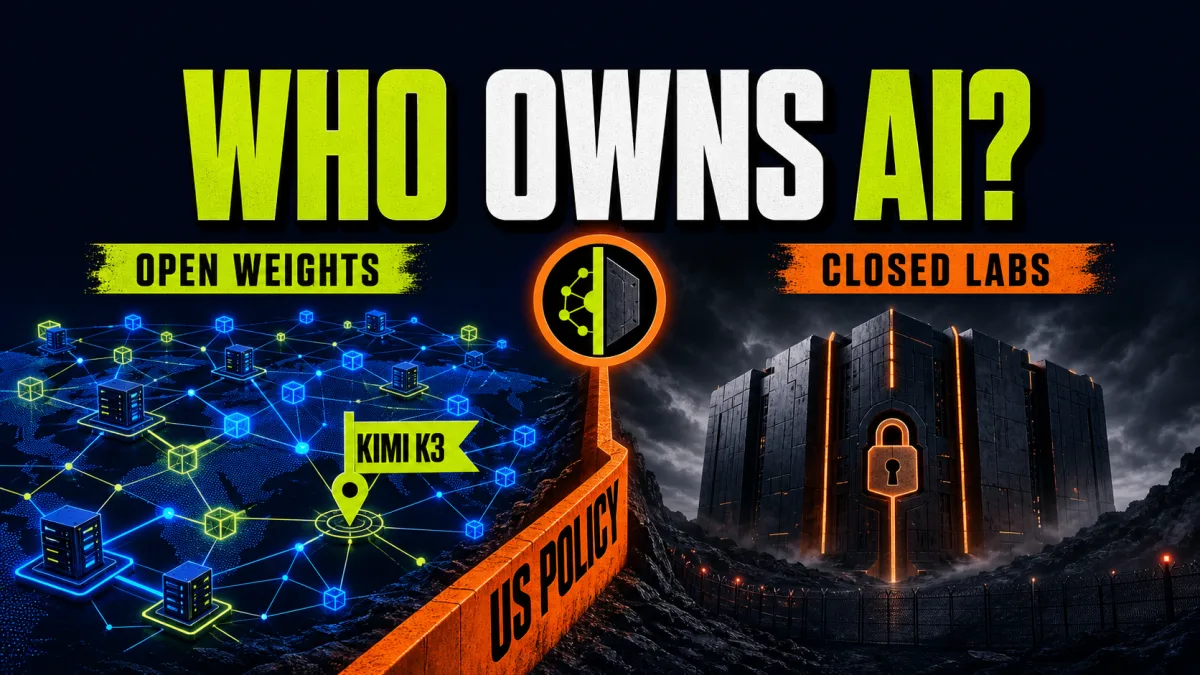
The Kimi K3 shock is exposing a conflict between America’s AI business strategy and its national-interest strategy. The TechCrunch report says comments from OpenAI strategic-futures leader Dean W. Ball helped turn Moonshot’s open-weight model into a US policy argument: should Washington create regulatory risk around Chinese models, or should it let cheaper competition spread and force the market to adapt? Yowox has already covered why Kimi K3 matters as an open-weight frontier model; this story is about what governments and frontier labs should do next.
Definition: An open-weight model publishes its trained parameters for others to download and run, unlike a model available only through a provider-controlled API.
The dispute: OpenAI’s business incentives favor keeping expensive frontier intelligence inside controlled services, while open-weight advocates argue that downloadable models expand experimentation, reduce prices and distribute innovation.
The policy test: A security rule should target a demonstrated capability or deployment risk—not quietly become a moat around a few companies.
What did the OpenAI executive actually argue?
According to TechCrunch, Dean W. Ball argued that the US government should create regulatory fear, uncertainty and distrust around advanced Chinese open-weight models because those models could deter capital spending by frontier labs. The article says he later retracted the claims that a regulatory crackdown was the White House’s best strategy and that open-weight models necessarily slow technological progress.
That retraction matters, but it does not erase the underlying strategic conflict. Open-weight models can be a national-security concern, a competitive threat and a public research asset at the same time. Treating one of those descriptions as the only valid one produces bad policy.
The commercial incentive is straightforward. A capable model that runs on a company’s own infrastructure can reduce dependence on OpenAI or Anthropic APIs. It may also let an enterprise keep more control over data paths, latency and customization. If more workloads move to open weights, the closed labs face pressure on pricing, usage and the return they need to justify enormous training and infrastructure costs.
That pressure is real. It is not, by itself, evidence that Americans should be prevented from using the competing technology.
Why did Kimi K3 make the debate urgent?
Kimi K3’s reported capabilities made the old argument—that Chinese open-weight systems are automatically far behind closed American models—harder to sustain. TechCrunch describes K3 as Moonshot’s impressive open-weight large language model and reports that it offers cheaper intelligence than leading closed systems when run on independent infrastructure or inside major enterprises.
The important change is not only model quality. Open weights change who can decide how a model is hosted, tuned and connected to a workflow. A company can inspect deployment behavior, run the model inside its own environment and adapt it to a specific task without making every request to a foreign or domestic provider. Those advantages come with engineering and governance costs, but they create options that a hosted-only model cannot provide.
The strategic risk for US labs is that adoption can compound. Developers build around an accessible model, researchers study and improve it, startups reduce their inference bills and enterprises develop internal expertise. The model can become infrastructure even if the original publisher never captures the same revenue as a closed API provider.
Is the US considering a ban?
There is no confirmed nationwide ban in the reporting reviewed here. TechCrunch says Axios reported that the Trump administration was considering banning K3 and other advanced Chinese models, while another Politico report said the Commerce Department would not take that step anytime soon.
The Axios account describes a wider set of possible pressure mechanisms: Entity List actions, procurement rules, hosting requirements, public warnings about backdoors and liability expectations for companies that deploy Chinese models. Axios also says previous efforts inside the administration were killed by officials concerned that regulation would stifle innovation, while momentum was returning as Chinese models improved and cybersecurity fears grew.
That is a crucial distinction. A government does not need to announce a formal ban to change the market. If procurement offices reject a model, regulators threaten the infrastructure that hosts it or companies fear future liability, the result can be a chilling effect without a single prohibition.
Policy uncertainty may be the point for firms that want customers to stay inside closed US platforms. It is also a blunt instrument: the same uncertainty can discourage American startups, researchers and enterprises from experimenting with useful open models.
What are the strongest arguments for restrictions?
Data security is the most concrete argument. A model connected to Chinese infrastructure or software could raise questions about telemetry, updates, supply-chain compromise and legal access to data. Those risks deserve technical testing and procurement controls, especially for government systems and sensitive industries.
But the deployment location matters. An open-weight model running on US-controlled servers is not identical to a Chinese-hosted API. A self-hosted model can still be compromised or misconfigured, yet it does not automatically send every prompt to the model’s country of origin. A country label is a reason to investigate the data path, not a substitute for investigating it.
Malicious capability is another legitimate concern. Open weights can make a capable model more available to actors who would not pass a provider’s access checks. Guardrails may be weaker, removable or absent. That can affect cyber abuse, fraud, biological research and other high-risk tasks.
The uncomfortable counterpoint is that a closed model’s refusal behavior can also create defensive friction. TechCrunch reports that US companies have turned to Chinese LLMs to close security gaps when US frontier models refused to perform the requested work. That does not prove Chinese models are safer. It shows that capability access and safety policy can pull in opposite directions, particularly for authorized defenders and researchers.
Military advantage is the broadest argument. If China can make advanced models widely available while US labs slow investment, policymakers may worry that China will own the innovation ecosystem and gain a strategic lead. Sam Bresnick of Georgetown’s Center for Security and Emerging Technology told TechCrunch that the military importance of AI gives the US a reason to support continued frontier-lab investment.
Supporting domestic research is different from blocking a cheaper competitor. The government can fund compute, research, security evaluation and domestic open-weight releases without promising closed labs protection from market competition.
Why does openness matter for US innovation?
Open-weight models can function like shared technical infrastructure. Researchers can inspect behavior, test modifications, build specialized systems and learn without negotiating access to a provider-controlled endpoint. Startups can experiment with lower per-request costs. Enterprises can choose whether the model should run in a managed cloud, a private environment or an edge deployment.
TechCrunch quotes advocates who compare this dynamic to open software such as PyTorch: a broad community can contribute to a shared foundation, creating an expanded workforce around the technology. That is not a guarantee that an open model wins, but it is a plausible mechanism for distributing research and reducing dependence on a small number of companies.
The risk of restricting open models is therefore not only higher prices. It is a narrower innovation funnel. Graduate students, nonprofits, government labs and small companies may lose the ability to reproduce results or explore alternatives to the leading commercial APIs. Clem Delangue of Hugging Face told TechCrunch that restrictions could concentrate power and make it harder for the next generation of builders and researchers to participate in AI safety and development.
Open does not mean automatically safe, community-governed or free of licensing restrictions. An open-weight model can have a restrictive license, opaque training data, difficult hardware requirements or poor operational security. The point is that these are separate questions and should not be collapsed into a single “open versus closed” label.
Is this really an OpenAI-versus-China choice?
No. The argument creates a false binary if it assumes the US must choose between closed frontier labs and Chinese open weights. US companies are also developing open models. TechCrunch notes that Nvidia is investing in Nemotron and that other American firms are trying to build businesses around releasing open models.
A healthier US strategy would make domestic open-weight capability part of the competition rather than treating openness as a defeat. That could mean funding evaluation infrastructure, supporting secure model distribution, helping researchers access compute, and giving enterprises clear procurement standards for models of different origins.
It could also mean separating strategic support from corporate rescue. If OpenAI or Anthropic require investment to continue frontier research, that case should be argued in terms of public value, research spillovers and national capability—not disguised as a reason to make their alternatives difficult for customers to buy.
| Policy question | Weak shortcut | Better question |
|---|---|---|
| Origin | Is the model Chinese or American? | Where is it hosted, who controls updates and what data can it access? |
| Openness | Are the weights public? | What capability is exposed, under what license and with what safeguards? |
| Security | Does the provider promise safety? | Can the deployment be audited, monitored, isolated and revoked? |
| Competition | Does it threaten US labs? | Does the policy protect national capability without protecting one business model? |
| Research | Is it commercially controlled? | Can independent researchers reproduce, evaluate and improve it? |
What should US policy target?
Target measurable capability. A rule tied to a specific dangerous capability is easier to explain and evaluate than a blanket rule tied to a model’s country of origin. It can cover hosted and open-weight systems alike when they cross the same threshold.
Target deployment risk. A model running on a government network, a hospital environment or a consumer laptop creates different risks. Procurement rules should examine data access, update control, logging, isolation and incident response rather than treating every deployment as equivalent.
Fund domestic open models. If the strategic concern is that China may own the open innovation layer, the answer is not to remove open competition from Americans. The answer is to make capable US open-weight alternatives available, support the researchers who evaluate them and keep the hardware and software ecosystem competitive.
Use chip policy for chip problems. Sam Bresnick told TechCrunch that export controls focused on advanced processors could address strategic compute concerns more directly than banning open-source technologies that US companies want to use. That approach may have its own trade-offs, but it is at least aimed at a relevant chokepoint.
Require evidence for security claims. Warnings about backdoors, bias and unsafe behavior should lead to reproducible tests, not only political messaging. If a model has a measurable problem, publish the test, define the affected deployment and specify the mitigation. Fear campaigns are not a substitute for security engineering.
What does this mean for US companies using open weights?
Companies should not treat Kimi K3 or any other open-weight model as safe simply because it can run locally. They should also not treat a US-hosted closed API as safe simply because it is American. Model origin, hosting, permissions, logging, update channels, network access and human review all belong in the deployment decision.
A practical evaluation should ask four questions. What data reaches the model? What actions can its output trigger? Who can update or replace the model? And how quickly can the organization detect and contain a bad result? Those questions apply to a local open-weight endpoint and to a managed frontier API.
For teams building tool-connected workflows, this is the difference between choosing a model and designing an operating boundary. The model can summarize a case, write code or route a request; the surrounding system decides whether that output can touch production data, send a message, change a record or launch a privileged action.
Should the US be scared of open-weight models?
The US should be cautious about dangerous capabilities, sensitive data and strategic dependence. It should not be scared of competition merely because competition threatens the economics of closed frontier labs.
The Kimi K3 debate is valuable because it makes the incentives visible. OpenAI has a legitimate interest in preventing dangerous models from being widely misused, but it also has a commercial interest in preventing customers from moving to cheaper models they can run themselves. Those interests can point in the same direction sometimes, but they are not the same thing.
The best US response is neither naïve openness nor protection by regulatory fog. It is a capability-based, deployment-aware policy that supports domestic research, tests concrete security claims and lets American users choose models without quietly turning national security into a private market moat.
Open-weight models may make frontier AI cheaper, more distributed and harder for any one company to control. That is a real governance challenge. It may also be exactly the competitive pressure that keeps the US AI ecosystem innovative. The question is not whether the US should fear open weights. It is whether the country can build rules strong enough to manage the risks without making concentration look like safety.
Frequently asked questions
What started the OpenAI open-weight model debate?
The debate followed the release of Moonshot’s Kimi K3 and comments from OpenAI strategic-futures leader Dean W. Ball. TechCrunch reported that Ball argued regulatory fear around advanced Chinese open-weight models could protect frontier-lab investment, then retracted his claims that a crackdown was the best US strategy and that open-weight models necessarily slow AI progress.
What is an open-weight model?
An open-weight model makes its trained parameters available for others to download, run and often adapt, subject to its license and technical requirements. Open weights can improve deployment control and lower access costs, but they do not automatically guarantee safe behavior, transparent training data, easy operation or a permissive license.
Is the US banning Chinese open-weight models?
No confirmed nationwide ban is described in the reporting reviewed for this article. Axios reported that parts of the Trump administration had considered measures including Entity List actions, procurement pressure and hosting requirements, while another report cited by TechCrunch said the Commerce Department was not planning to act soon.
Should the US restrict open-weight AI models?
The strongest case for restrictions concerns specific, demonstrated risks such as data security, malicious use and access to sensitive infrastructure. Protecting a closed lab’s margins is a different argument. A durable policy should regulate measurable capability, deployment context and misuse rather than treating openness or country of origin as a complete safety proxy.
Alex
Founder & Lead AI Writer
Alex is the founder of Yowox and lead AI writer since 2024, breaking down complex information into clear, actionable insights for thousands of readers every day. Alex has built AI automation systems for businesses since 2024, focusing on AI agents, workflow automation, and business process optimization.
Save hours. Save thousands.
Practical guides, real workflows, and the latest AI and automation news that matters — straight to your inbox.