 By Alex
 DXC Connects Legacy Banking to AI-Native Finance
DXC is combining legacy-core stability, CoreIgnite, Anthropic and ServiceNow partnerships to push AI-native financial services forward.
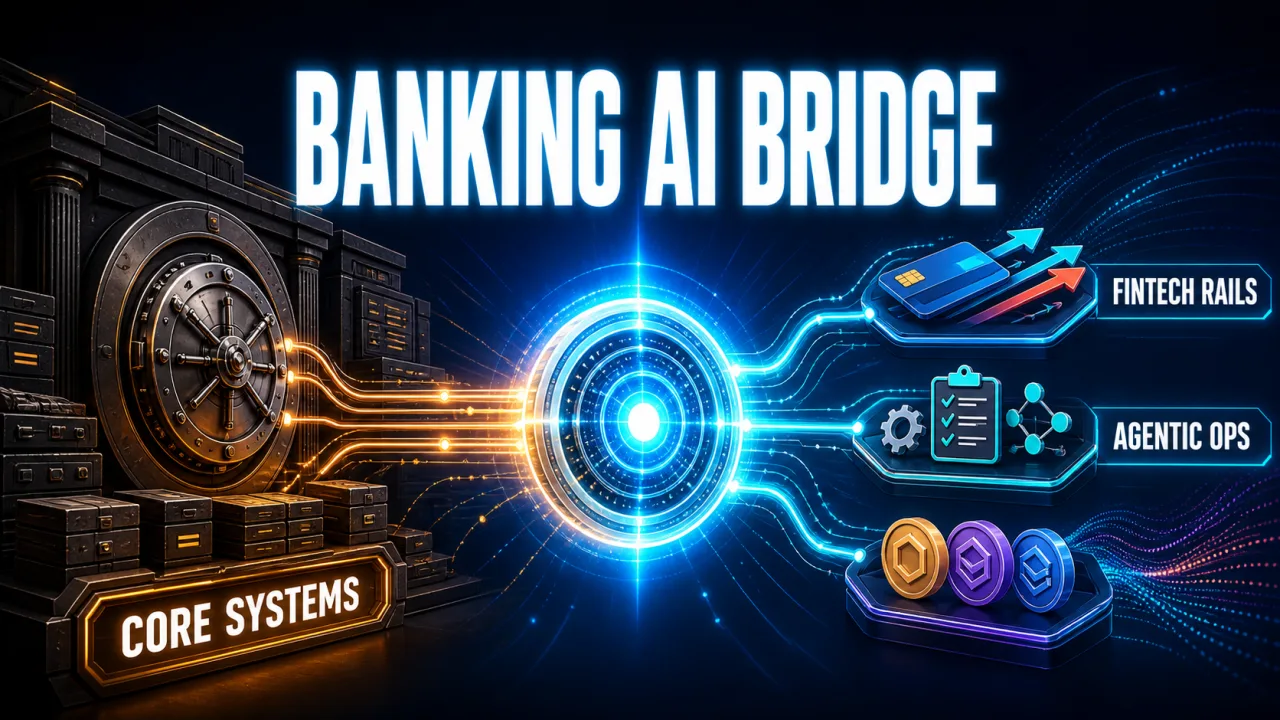
DXC is trying to make AI-native financial services compatible with legacy banking infrastructure. The company is pairing its existing core-systems footprint with CoreIgnite, an Anthropic alliance and a ServiceNow rollout, according to AI Magazine's report on DXC's strategy. For banks and insurers, the important signal is not one new model: it is a technology partner attempting to connect modern fintech and agentic AI capabilities to systems that cannot simply be switched off.
Definition: DXC's financial-services strategy combines legacy-system stability with AI-native products, fintech connectivity and agentic operations.
Example: CoreIgnite is designed to connect banks to embedded finance, digital assets and real-time payments without replacing the core infrastructure underneath them.
Key takeaway: Financial institutions can pursue AI adoption through integration and orchestration, not only through a full core-banking replacement.
Business impact: The approach could shorten the path from AI experimentation to production services, but the value still depends on governance, integration quality and measurable outcomes.
What is DXC's dual-track AI strategy?
DXC's Core and Fast Track strategy separates operational continuity from new AI-led growth. DXC says the plan is to keep legacy operations stable while creating AI-native revenue channels, with a target of 10% of run-rate revenue by the second quarter of fiscal 2029. For financial-services operators, that target explains why DXC is investing in both dependable infrastructure and new AI capabilities: the company is treating AI as a business line, not just an internal productivity experiment.
DXC's reported leadership changes reinforce that direction. CEO Raul Fernandez described the appointments of Paul Taylor as President of DXC Technology and Holly Grant as President of AI Innovation, Strategy & LabX as an acceleration of the dual Core and Fast Track approach. The practical takeaway is that DXC is organising its technology portfolio around two constraints at once: banks need modern capabilities, but they also need their existing systems to keep running.
How does CoreIgnite modernise banking without replacing the core?
CoreIgnite is DXC's answer to the integration problem between established banking platforms and newer fintech services. The cloud-native platform provides a unified connection point for embedded finance, digital assets and real-time payments while preserving existing core infrastructure. A bank evaluating CoreIgnite should therefore treat it as an orchestration layer for new capabilities, not as a promise that legacy systems disappear.
The scale of the underlying Hogan footprint gives the product its specific context. DXC says Hogan supports more than 300 million deposit accounts and over US$5tn in deposits globally, while CoreIgnite is also designed to work in non-Hogan environments. That combination matters because a connectivity layer is useful only when it can sit beside the systems a financial institution already operates. The immediate question for a bank is whether the platform can connect the required partners and payment rails without creating a new operational bottleneck.
CoreIgnite supports use cases including buy now, pay later, stablecoin-enabled offerings and payments orchestration across ACH, RTP, FedNow, wire and card networks. Its partner ecosystem includes Ripple, Euronet, Splitit, Aptys Solutions and ArcOne. These named integrations show the product's intended role: connect the bank to multiple financial capabilities through one controlled layer instead of forcing a separate custom integration for every new service.
What does the Anthropic partnership add?
The DXC-Anthropic partnership extends Claude from a model choice into an enterprise delivery capability. DXC has become a Global Premier partner in the Claude Partner Network and says it will integrate advanced AI functionality into mission-critical systems serving banks and insurers. For a regulated institution, the relevant test is not whether a model can produce an impressive answer; it is whether the surrounding system can control data, tools, permissions, monitoring and escalation.
DXC says Claude helped build DXC OASIS, its AI-native orchestration platform, with software delivery accelerated by an estimated ten times and more than 95% of code generated by Claude. Those figures are company-reported estimates, so they should be read as claims about DXC's development work rather than independent evidence of banking outcomes. The useful signal is the direction of travel: DXC is using an orchestration platform to connect model capability with enterprise systems, which is the broader pattern explained in the AI automation stack guide.
The partnership also includes forward-deployed engineers working inside customer environments. Those engineers are expected to design and govern agentic AI systems with training from the Anthropic Partner Academy. This makes implementation and governance part of the offer. In financial services, an AI agent must do more than generate text: it needs bounded tool access, an auditable execution path and a human escalation route, the same distinction covered in what an AI agent actually is.
Why is ServiceNow part of the strategy?
DXC's expanded ServiceNow agreement tests agentic AI inside DXC before wider customer deployment. As Customer Zero for ServiceNow's Core Business Suite, DXC is implementing agentic AI across its own business functions first. The stated logic is straightforward: an enterprise with complex, multivendor operations can expose the practical work required to move from AI experimentation to repeatable execution.
DXC's Chief Digital Information Officer Russell Jukes says the internal rollout is simplifying processes, reducing manual work and improving employee experiences. DXC also says the deployment is freeing capacity for employees to focus on building new AI capabilities. These are operational claims from DXC, not independently measured customer results, but they identify the proof point the partnership is designed to create: whether agentic AI can improve a real enterprise operating model before it is packaged for buyers.
What should financial institutions watch next?
Financial institutions should watch whether DXC's products turn partnerships into governed, measurable workflows. CoreIgnite must make fintech connectivity simpler without weakening reliability. Claude-powered systems must operate with appropriate controls inside mission-critical environments. ServiceNow's internal deployment must demonstrate repeatable process improvement rather than a one-off showcase. Each claim needs evidence from production operations, not only a launch announcement.
The larger lesson is that financial-services AI adoption is becoming an integration question. Banks do not choose between legacy infrastructure and AI in a single transaction; they must connect data, payment networks, model providers, workflows and oversight over time. DXC's strategy is notable because it addresses that transition through a portfolio of platforms and partnerships. Its success will depend on whether the resulting systems can preserve trust while delivering the speed and flexibility that fintech competitors have made customers expect.
Frequently asked questions
What is DXC changing in financial services?
DXC is pursuing a dual-track strategy: keep the legacy systems used by financial institutions stable while building AI-native products and revenue streams. The strategy combines CoreIgnite for connecting banks to fintech capabilities, an Anthropic partnership for AI inside mission-critical systems, and ServiceNow deployments for agentic operations. The practical change is an attempt to modernise banking around existing infrastructure rather than requiring every institution to replace its core systems first.
What does DXC CoreIgnite do for banks?
DXC CoreIgnite is a cloud-native connection point between financial institutions and fintech services. According to the reported launch, it can connect embedded finance, digital assets and real-time payments while operating across DXC's Hogan core banking platform and non-Hogan environments. The platform is intended to let banks add capabilities such as buy now, pay later, stablecoin-enabled offerings and payments orchestration without interrupting the core systems that process existing banking operations.
How is Anthropic involved in DXC's banking strategy?
Anthropic has entered a multi-year global partnership with DXC, making DXC a Global Premier partner in the Claude Partner Network. DXC says it is using Claude to develop DXC OASIS, an AI-native orchestration platform, and to bring AI functionality into mission-critical systems used by banks and insurers. The reported approach also includes forward-deployed engineers working in customer environments and training to design and govern agentic AI systems.
Why did DXC become ServiceNow Customer Zero?
DXC became Customer Zero for ServiceNow's Core Business Suite so it could deploy agentic AI across its own core business functions before offering similar solutions to customers. The stated purpose is to test AI-powered operations in a complex, multivendor enterprise rather than present an untested demo. DXC says the internal rollout is simplifying processes, reducing manual work and freeing employee capacity for further AI work.
Alex
Founder & Lead AI Writer
Alex is the founder of Yowox and lead AI writer since 2024, breaking down complex information into clear, actionable insights for thousands of readers every day. Alex has built AI automation systems for businesses since 2024, focusing on AI agents, workflow automation, and business process optimization.
Save hours. Save thousands.
Practical guides, real workflows, and the latest AI and automation news that matters — straight to your inbox.