 By Alex
 Coding agents in scientific computing: OpenAI's 8 cases
OpenAI’s new field report follows eight agent-assisted scientific-computing projects and finds that coding agents can reduce engineering bottlenecks, while validation and stewardship remain human responsibilities.
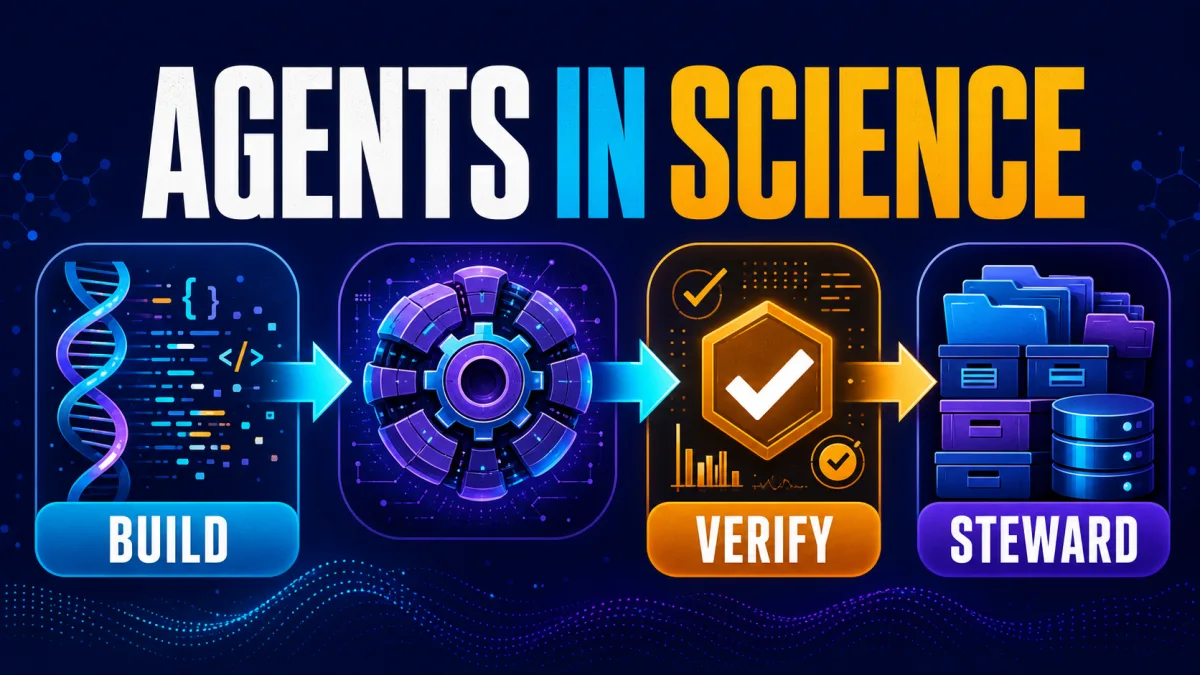
OpenAI’s Scientific computing in the age of agentic AI field report argues that coding agents can make scientific software easier to build and maintain, but they do not replace scientific judgment. The report follows eight agent-assisted projects, mostly in the life sciences, and shows a practical shift from scientists writing every implementation detail to scientists defining goals, designing checks, and judging whether results are valid. For teams deciding whether an AI agent is more than a chatbot, the important lesson is simple: agentic speed moves the bottleneck toward verification and stewardship.
Definition: Agent-assisted scientific computing uses coding agents to implement, maintain, optimize, migrate, or redesign software used in research.
Example: The report covers projects ranging from modernizing a genomic library’s build system to redesigning scientific software for GPU execution.
Key takeaway: Coding agents can reduce engineering friction, but a working implementation is not proof of scientific correctness.
Business impact: Research teams can attempt more ambitious software work with less implementation labor, provided they budget for validation and long-term ownership.
What did OpenAI’s field report examine?
OpenAI’s report examines eight early coding-agent projects rather than presenting a controlled comparison of models. The projects were primarily in computational biology and used Codex alone in five cases or Codex together with Claude Code in three cases, according to the published field report. The useful comparison is therefore not “which model wins,” but which kinds of scientific software work become more feasible when implementation labor falls.
The eight projects span six overlapping forms of engineering work: lightweight maintenance, targeted optimization, compatibility migration, translation into another programming language, performance-oriented rewrites, and new tools or capabilities. This range matters because a packaging cleanup and a scientific algorithm rewrite have very different failure modes; research teams should scope the agent’s authority to the software surface and validation target they can actually inspect.
Why is scientific software an unusually strong target?
Scientific software is a strong target for coding agents because many research tools are valuable long after their first paper, even though they were created by small teams with limited time for packaging, testing, optimization, and maintenance. OpenAI describes the resulting infrastructure as fragile and costly to keep running as datasets grow, so teams should treat engineering work as part of research reliability rather than as optional polish.
The report’s opportunity is practical: coding agents can handle tedious implementation work, including tests, documentation, packaging, and targeted optimization, while researchers focus on scientific direction. That division is most useful when the work has a clear acceptance target, because an agent can iterate against a reference or benchmark more reliably than against an unstated idea of “better.”
What changed in the researcher’s role?
Coding agents shift researchers toward verification and orchestration when the agent handles more of the implementation. Contributors in the report described humans specifying what to build, defining how correctness will be measured, interpreting discrepancies, and deciding when a project is ready to ship. A research team adopting an agent should therefore write the success criteria before delegating the code, not after the first plausible result appears.
The shift from implementation to verification is a change in emphasis, not an escape from technical work. Human contributors still need to understand the scientific method, the data-generating process, the intended behavior of the software, and the consequences of an incorrect result. The AI automation stack makes the same architectural point in a business setting: the model is only one layer, while context, tools, permissions, validation, and monitoring determine whether a system can be trusted.
Why does validation become the bottleneck?
Validation becomes the bottleneck because coding agents can execute a well-scoped request without reliably knowing whether the result is scientifically valid. OpenAI reports that agents sometimes expressed confidence despite clear errors, while the strongest case studies used external references, exact output agreement, parity with an existing tool, statistical behavior, or simulated data with known answers. The practical rule is to replace “the agent says it works” with a check that could prove the agent wrong.
The validation burden grows with the size of the software change and the amount of scientific behavior it can alter. A packaging change may be checked through installation and release tests, while a language rewrite or GPU redesign may require representative datasets, numerical tolerances, downstream workflow checks, and domain review. Teams should choose the narrowest change that can answer the research question, then expand only when the evidence supports the next step.
Why do feedback loops beat one-shot generation?
Feedback-driven iterations outperform one-shot delegation when scientific software contains edge cases or subtle numerical behavior. The field report describes projects that broke broad goals into smaller changes and used intermediate benchmarks and test systems to refine the implementation; initial code often arrived quickly, but the last mile took the most work. Research teams should plan for staged agent runs with explicit review points instead of treating the first complete-looking repository as a finished result.
Realistic data also matters because synthetic workloads can hide failures that appear in production-scale or domain-specific inputs. The report notes that real-world data repeatedly exposed additional edge cases beyond simulated tests, so a validation plan should include both fast feedback cases and representative workloads before a team trusts the result.
What does long-term stewardship require?
Long-term stewardship requires an owner, an upgrade path, and a plan for preserving compatibility after an agent-assisted change ships. OpenAI notes that changes to MHCflurry and cyvcf2 were incorporated into their upstream projects, while rustar-aligner moved under new community stewardship because its original project had been abandoned. Before merging a rewrite, maintainers should decide who answers user questions, reviews future patches, and protects undocumented conventions that source-code translation alone cannot preserve.
Lower implementation costs can create a new fragmentation problem if every team produces a slightly different rewrite of the same scientific tool. The risk of fragmentation is not an argument against agents; it is an argument for coordinating with original maintainers early and publishing provenance, compatibility expectations, and maintenance responsibility. A fast rewrite without a credible owner is not durable infrastructure—it is deferred abandonment.
What should scientific teams do next?
Scientific teams should begin with a bounded engineering task whose intended result can be independently checked. The field report supports a sequence of goal definition, small implementation steps, measurable validation, human interpretation, and explicit stewardship; teams can use that sequence to modernize one library or workflow without handing an agent authority over an undefined scientific problem.
The broader implication is that agentic AI may expand what small research teams can build, but the quality bar remains human and domain-specific. OpenAI’s report is exploratory and its case studies are contributor-reported rather than independently reproduced in full, so readers should treat the evidence as an early field signal, not a universal performance guarantee. The durable advantage will belong to teams that pair faster implementation with stronger validation and visible ownership.
Frequently asked questions
What did OpenAI’s scientific-computing field report study?
OpenAI’s report studied eight early projects in scientific computing, primarily in the life sciences. The projects used coding agents for tasks including maintenance, targeted optimization, software migration, language rewrites, GPU-oriented redesign, and new tool development. Five projects used Codex alone and three combined Codex with Claude Code. The report is exploratory and retrospective, so its results describe contributor experiences and case-specific outcomes rather than a controlled benchmark of agent performance.
What role do coding agents play in scientific software?
Coding agents can take on implementation and maintenance work that scientific teams often struggle to staff, including packaging, testing, optimization, migration, and documentation. Their value is highest when the requested result is well scoped and can be checked against an external reference, a known answer, a measurable performance target, or a defined acceptance criterion. Coding agents do not remove the need for scientists; they shift more human effort toward specifying the goal, designing validation, interpreting discrepancies, and deciding whether the software is scientifically ready.
Why is validation the main limit on agentic scientific computing?
Scientific validity is not the same as code that runs or an agent that reports success. Agents can implement a plausible change while missing a numerical, methodological, or workflow-level error, especially when the intended behavior is not fully specified. The report’s case studies used independent references, exact-output comparisons, simulated data, benchmarks, and domain-specific checks to evaluate results. A scientific team should define those checks before asking an agent to make broad changes, then treat the evidence—not the agent’s confidence—as the release decision.
What is the stewardship problem in agent-assisted research software?
Lower engineering costs can produce more rewrites, but every rewrite still needs an owner, compatibility decisions, documentation, and long-term maintenance. The report describes changes that returned to original upstream projects, such as MHCflurry and cyvcf2, alongside rustar-aligner moving under new community stewardship after abandonment. Before accepting an agent-assisted rewrite, a research team should identify the maintainer, preserve user trust and documented behavior, and make the maintenance plan visible to downstream users.
Alex
Founder & Lead AI Writer
Alex is the founder of Yowox and lead AI writer since 2024, breaking down complex information into clear, actionable insights for thousands of readers every day. Alex has built AI automation systems for businesses since 2024, focusing on AI agents, workflow automation, and business process optimization.
Save hours. Save thousands.
Practical guides, real workflows, and the latest AI and automation news that matters — straight to your inbox.