 By Alex
 OpenAI Presence packages agents as a managed service
OpenAI Presence packages governed AI agents, integrations, evaluation and deployment help as a managed enterprise service rather than a self-serve product.
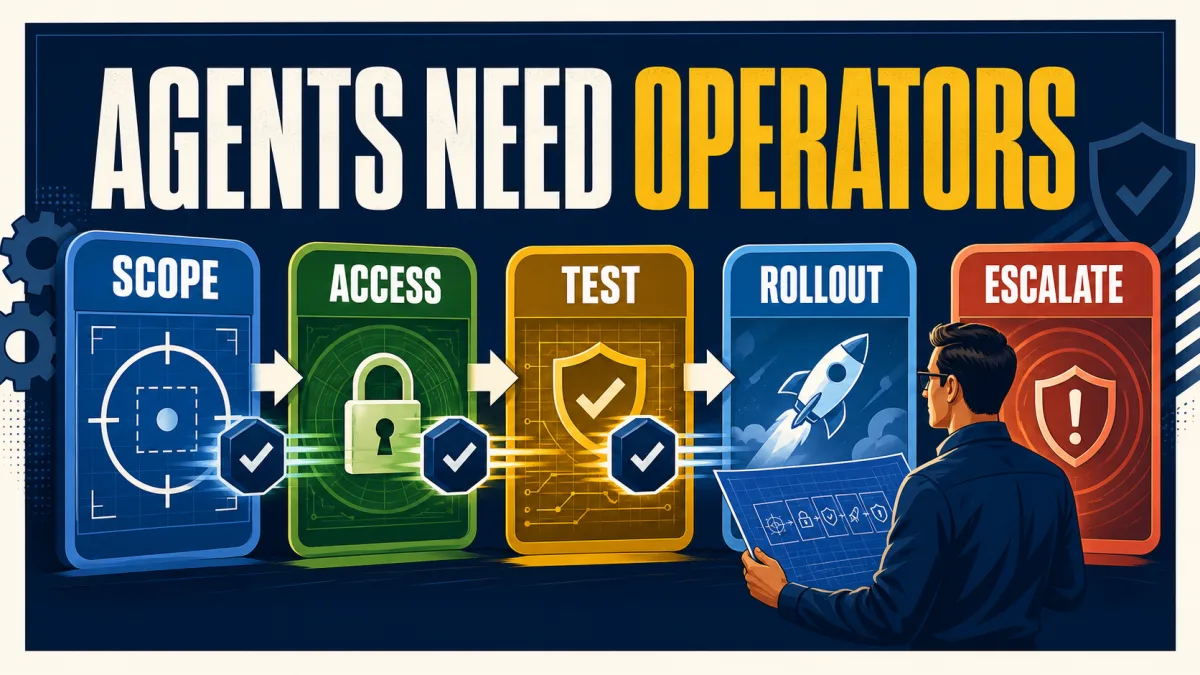
OpenAI Presence is an enterprise AI-agent product sold with implementation capacity attached. Instead of asking a customer to start with an API key, a workspace seat or a blank agent builder, OpenAI starts with a business workflow, connects the required systems, defines the boundaries, tests the agent and helps operate it in production.
Definition: OpenAI Presence is a managed platform for governed enterprise AI agents.
Example: An agent can resolve a billing issue, verify information, use approved business systems and escalate to a person when policy requires it.
Key takeaway: OpenAI is selling deployment discipline alongside model capability.
Business impact: Buyers may get a shorter path to a production workflow, but availability and economics are constrained by the engineers and partners who deliver it.
What OpenAI Presence actually sells
OpenAI’s introduction to Presence describes a product for agents that answer questions, resolve issues, use company systems, take approved actions and escalate to people. The central promise is not simply that an agent can call tools. It is that the agent can operate inside a controlled business process.
Each deployment begins with a specific job. OpenAI gives examples such as billing support, insurance claims and employee IT requests. The customer decides what knowledge and system access the agent receives, what actions are permitted, when approval is required and when a human must take over.
That makes Presence closer to a managed production programme than to a feature a team switches on. The product bundles several layers that are often split across an enterprise AI project:
| Layer | What the deployment has to establish |
|---|---|
| Workflow | The business outcome, initial use case and success criteria |
| Access | The systems, knowledge and scoped permissions the agent may use |
| Policy | Approved actions, escalation rules and required human sign-offs |
| Evaluation | Simulations, graders and acceptance tests for normal and risky cases |
| Operations | Monitoring, session records, rollout controls and rollback |
| Improvement | A tested process for turning production evidence into changes |
The model is important, but it is only one layer in that table.
The engineers are part of the product boundary
The news is the delivery model. According to Artificial Intelligence News, Presence is available through a limited general availability programme rather than as a self-serve product. Deployments are led by OpenAI Forward Deployed Engineers and selected global systems integrators.
That choice is a direct response to where enterprise agents tend to fail. A company may have a capable model and still lack a safe permission design, a reliable handoff, realistic test cases, an evaluation set or a change process for when the underlying product changes.
Putting engineers into the deployment helps OpenAI control the difficult part of the sale. It can scope the workflow, connect the right tools, encode the customer’s policies and make sure the agent is not given more access than the job requires. The customer still has to define what “good” and “safe” mean, but the vendor is no longer pretending that a prompt and a document upload are a complete implementation.
The trade-off is obvious: software can scale faster than cleared engineers who understand a customer’s systems. OpenAI’s help documentation says access depends on workflow fit, implementation readiness and available delivery capacity. That is not a minor footnote. It is part of the product’s availability model. See also OpenAI & ReliaQuest: Partnership for Agentic Cybersecurity.
Presence treats governance as an operating loop
OpenAI says a Presence agent is tested before release against common requests, edge cases and higher-risk scenarios. Simulations and graders check whether it reached the right outcome, followed policy, used tools correctly and escalated when appropriate. Guardrails can intervene when an interaction moves outside the company’s boundaries.
The more interesting part happens after launch. Production sessions, escalations and quality signals become evidence about where the agent is working and where it is failing. Codex can investigate those signals and propose updates. The customer then tests the proposed version against the one in production and approves a controlled rollout.
That is a different mental model from “deploy the agent and monitor a dashboard.” It treats the agent as a changing production system with a release process. A new policy, product change or user behavior pattern can make an old behavior wrong even when the underlying model has not changed.
For teams thinking through this broader problem, the enterprise agent orchestration gap is the useful comparison point: the hard work is often in connecting agents to real operations, not in producing another impressive demo.
The proof points are promising—and company-reported
OpenAI says Presence powers its English-language phone support channel at 1-888-GPT-0090. The company reports that the agent now resolves 75% of inbound issues without human assistance and that a Codex-powered improvement loop reduced human handoffs by 15 percentage points in ten days.
Those figures are relevant because they show the kind of workflow OpenAI wants to sell: open-ended requests, caller verification, account context, approved actions and escalation. They also need to be read precisely. The measurements come from OpenAI’s own channel and internal grading criteria. They are not an independent benchmark of Presence across enterprise deployments.
The same caution applies to the named launch customers. BBVA is exploring voice support for everyday banking in Mexico, SoftBank is testing Japanese-language conversations and IAG is exploring support during high-demand events such as severe weather. These examples show the range of workflows being explored, but they should not be read as proof that Presence is already running each process at large scale.
This distinction matters for buyers. “Battle-tested” can mean a product shaped by years of deployment experience, while “proven for our workflow” requires a customer-specific evaluation with the customer’s policies, systems, escalation rules and acceptance criteria.
What remains undisclosed
Presence does not come with a public price sheet. OpenAI says pricing and implementation scope are specific to each customer and deployment. The model configuration is also selected for the workflow and may change as the workflow evolves.
That flexibility can be useful. Production teams often need a combination of real-time interaction, deeper reasoning and tool execution, and a frozen model choice can become a liability. But a changing configuration also means the contract and evaluation process need to define what remains stable.
A buyer should ask at least five questions before treating the managed service as an operating plan:
- Which business outcome is the first deployment accountable for?
- What actions may the agent take without approval?
- Which quality, safety and escalation metrics determine release?
- How are model or configuration changes tested against the production version?
- What happens when delivery capacity, integration scope or workflow requirements change?
The answers should live in the deployment architecture and contract, not only in a sales description.
Presence is not the same as a workspace agent
OpenAI positions Presence separately from ChatGPT Workspace Agents. Workspace agents are created and used inside supported ChatGPT and Slack experiences. Presence is a managed production deployment for workflows that require integrations, testing, guardrails, monitoring and deployment support.
That separation reveals the commercial logic. OpenAI is offering a self-serve path for teams that want to build inside a workspace, an API path for teams that want to develop their own systems, and Presence for customers that want OpenAI and its partners to help deliver the system.
The underlying capability may overlap, but the buyer is paying for a different responsibility boundary. Presence is an attempt to make OpenAI accountable for more of the distance between “the model can do this” and “the workflow is safe to run every day.”
The strategic bet
OpenAI is betting that enterprise customers will pay to avoid assembling the entire agent deployment stack themselves. The model vendor becomes the implementation partner, evaluator, integration guide and improvement operator—not just the provider of inference.
That is a sensible response to the enterprise agent market’s biggest constraint. It is also a move into a services-heavy layer where scale, accountability and delivery capacity matter as much as model quality.
The product’s success will therefore be measured less by a single impressive conversation than by whether customers can run repeatable workflows with clear permissions, predictable escalation, observable changes and acceptable total cost. Engineers attached to the sale may be exactly what gets the first deployment over the line. The harder question is how much of that discipline can become repeatable product infrastructure before capacity becomes the bottleneck.
The bottom line
OpenAI Presence sells a managed path to enterprise AI agents, with OpenAI engineers and selected integrators attached to the deployment. It packages workflow scoping, system access, policies, evaluations, guardrails, human handoffs and post-launch improvement around a specific business job.
That makes the offer more credible than a self-serve agent demo for high-stakes operations, but less scalable and less transparent on price. Buyers should treat Presence as a managed production engagement with model capability inside it—not as a magic agent that becomes reliable when fed enough documents.
The important product is the operating loop: define the job, constrain the access, test the behavior, launch carefully, inspect the evidence and approve changes. OpenAI is selling that loop with engineers attached.
Frequently asked questions
What is OpenAI Presence?
OpenAI Presence is a managed enterprise platform for deploying and improving governed AI agents across high-volume workflows. It combines OpenAI models with scoped system access, policies, guardrails, evaluations, monitoring and human escalation paths.
Is OpenAI Presence self-serve?
No. Presence is available to eligible enterprise customers through a limited general availability programme. Deployments are led by OpenAI Forward Deployed Engineers, selected systems integrators, or both, with access depending on workflow fit, implementation readiness and delivery capacity.
What workflows can Presence agents handle?
OpenAI describes use cases including billing issues, insurance claims, employee IT service requests, customer support and other internal or external workflows. The exact capabilities, channels and integrations are scoped for each deployment.
How does Presence improve an agent after launch?
Production sessions, escalations and quality signals can reveal gaps. Codex can investigate those signals and propose updates, which the customer tests against the production version before approving a controlled rollout.
Does OpenAI publish Presence pricing?
No public price is given. OpenAI says pricing and implementation scope are specific to each customer and deployment.
Alex
Founder & Lead AI Writer
Alex is the founder of Yowox and lead AI writer since 2024, breaking down complex information into clear, actionable insights for thousands of readers every day. Alex has built AI automation systems for businesses since 2024, focusing on AI agents, workflow automation, and business process optimization.
Save hours. Save thousands.
Practical guides, real workflows, and the latest AI and automation news that matters — straight to your inbox.