 By Alex
 OpenAI brings Daybreak cyber models to Amazon Bedrock
OpenAI is making Daybreak Blue and Daybreak Red available through Amazon Bedrock, giving eligible security teams a way to use frontier and cybersecurity models inside existing AWS environments.
OpenAI is making Daybreak Blue and Daybreak Red available through Amazon Bedrock, giving eligible security teams a way to use frontier and cybersecurity models inside the AWS environments where they already build, secure, and operate software. The announcement is the next step after OpenAI's frontier models and Codex became generally available on AWS earlier this year, according to OpenAI's announcement.
Definition: Daybreak is OpenAI's access program for frontier and purpose-trained cybersecurity models used in authorized defensive security work through Amazon Bedrock.
Example: A security team could use Daybreak Red for authorized vulnerability research and exploit validation, then use the same AWS operating environment to develop and validate a mitigation.
Key takeaway: AWS customers can now apply Daybreak through the Bedrock console or the Responses API, but access requires enrollment and approval rather than an unrestricted public endpoint.
Business impact: The announcement reduces the infrastructure gap between specialized cybersecurity models and enterprise operations, while leaving security review, governance, access control, and procurement as part of the deployment decision.
What does Daybreak add to Amazon Bedrock?
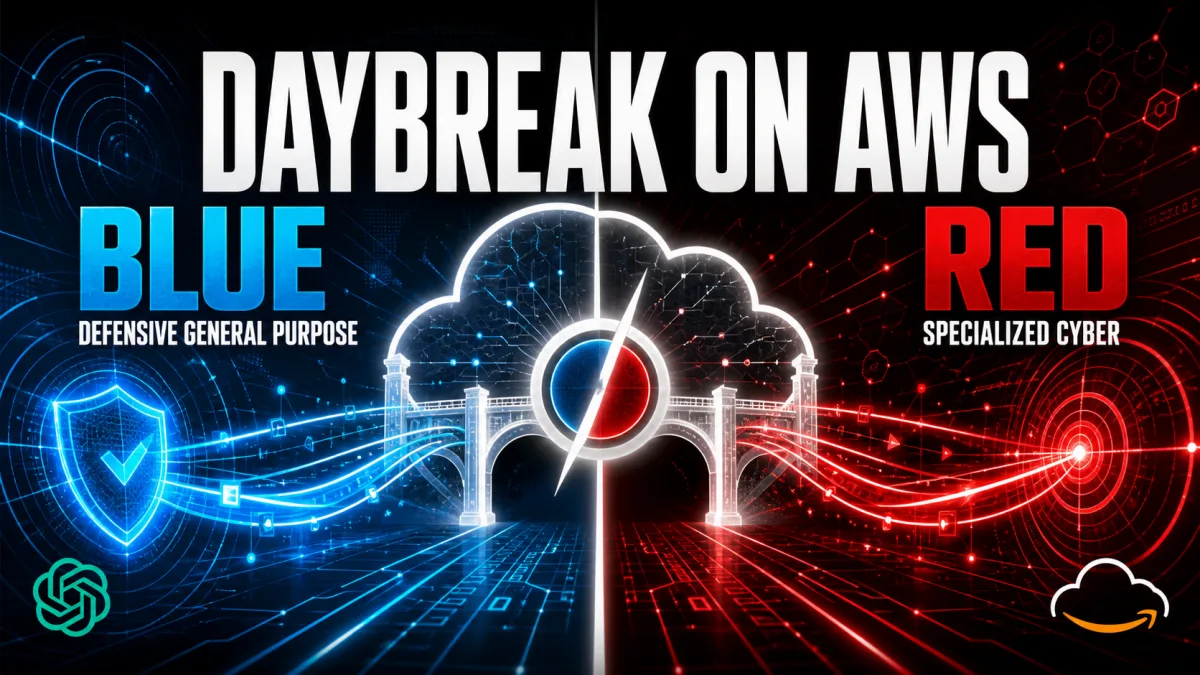
Daybreak adds OpenAI's defensive cybersecurity capabilities to Amazon Bedrock, a familiar AWS environment for eligible customers. The source distinguishes two access levels: Daybreak Blue includes frontier general-purpose models, including GPT-5.6 Sol, while Daybreak Red provides purpose-trained cybersecurity models. For an enterprise, the practical change is not simply another model catalogue entry; it is a route to place approved cyber workflows inside the cloud environment where security teams already operate, subject to OpenAI's access process.
How do Daybreak Blue and Daybreak Red differ?
Daybreak Blue is the broader model tier for authorized defensive security work, pairing frontier general-purpose capability with safeguards tailored to that use. Daybreak Red is the specialized tier for authorized vulnerability research, exploit validation, and security testing. The distinction matters when an organization designs model access: a general-purpose model may support a wider range of defensive tasks, while a purpose-trained cyber model is positioned for more specialized security workflows. OpenAI does not describe the two tiers as interchangeable or as a single unrestricted capability. Related reading: OpenAI Daybreak expands trusted access to cyber models.
Which security workflows can Daybreak support?
OpenAI says Daybreak can support vulnerability research, detection engineering, and incident response from initial discovery through a validated fix. The models also support complex workflows such as exploit reproduction and mitigation development. This positions Daybreak as a workflow component rather than only a question-answering interface: the value is in helping a security team move from finding a weakness to testing and developing a response. The announcement frames those uses around authorized defensive work, so deployment teams still need their own scope, approvals, and controls.
The workflow is adjacent to the broader agent pattern described in Yowox's explanation of AI agents: a model contributes to a multi-step process, while the surrounding system determines what information, tools, and actions are allowed. Daybreak's AWS availability does not by itself define an organization's automation policy; it gives that policy a model-access path inside an existing environment. Teams evaluating model routing can also compare the tiering logic with OpenAI's GPT-5.6 model family, where capability, speed, and cost are separated across models.
Why does Bedrock availability matter to enterprises?
Amazon Bedrock availability matters because enterprise adoption involves more than raw model performance. OpenAI explicitly names security review, governance, procurement, access controls, and an operating model that teams can support as requirements for specialized cybersecurity capabilities. Making Daybreak available within AWS can fit those conversations into an environment where an organization already builds, secures, and operates software. The takeaway for buyers is to evaluate the model and the surrounding controls together, not to treat cloud availability as proof that a production workflow is ready.
How can an organization get started?
Daybreak Blue and Daybreak Red require enrollment in OpenAI's Daybreak Access program. Once approved, customers can access the models through the Amazon Bedrock console or through the Responses API using the bedrock-mantle endpoint, as described in the announcement. The immediate next step for a security or platform team is therefore eligibility and access review: define the authorized use case, confirm the required controls, and determine whether console access or API integration fits the operating model. OpenAI points customers to AWS documentation for the model details.
OpenAI's announcement makes the availability change clear, but it does not publish a general performance benchmark, pricing table, or universal access timeline for Daybreak in the source. Those are separate diligence questions for any team considering a production deployment. The concrete shift is narrower and useful: approved AWS customers now have a path to use OpenAI's frontier and specialized cybersecurity capabilities through Bedrock, with authorization and governance remaining central to the rollout.
Frequently asked questions
What are OpenAI's Daybreak models on AWS?
Daybreak is a set of OpenAI capabilities for defensive cybersecurity work that is now available through Amazon Bedrock for eligible customers. OpenAI describes two access levels: Daybreak Blue provides frontier general-purpose models, including GPT-5.6 Sol, with safeguards for authorized defensive security work; Daybreak Red provides purpose-trained cybersecurity models for authorized vulnerability research, exploit validation, and security testing. Access requires enrollment in Daybreak Access rather than an unrestricted public sign-up.
What is the difference between Daybreak Blue and Daybreak Red?
Daybreak Blue is the general-purpose access level, combining frontier models such as GPT-5.6 Sol with safeguards tailored to authorized defensive security work. Daybreak Red is the specialized cybersecurity access level, designed for authorized vulnerability research, exploit validation, and security testing. Both are available through Amazon Bedrock after the customer is approved for Daybreak Access, but they serve different operational needs: broad model capability on Blue and purpose-trained cyber work on Red.
How can an enterprise access Daybreak through AWS?
An eligible organization must first enroll in OpenAI's Daybreak Access program and receive approval. After approval, OpenAI says customers can use Daybreak Red and Daybreak Blue through the Amazon Bedrock console or through the Responses API with the bedrock-mantle endpoint. The model access therefore sits inside an existing AWS environment, while approval, security review, governance, access controls, and the organization's operating model remain part of the deployment process.
What cybersecurity work can Daybreak support?
OpenAI says Daybreak can help with vulnerability research, detection engineering, and incident response, including workflows that run from initial discovery through a validated fix. The models also support exploit reproduction and mitigation development. Those capabilities are described for authorized defensive security work, vulnerability research, exploit validation, and security testing; the announcement does not present Daybreak as an unrestricted model for offensive activity.
Alex
Founder & Lead AI Writer
Alex is the founder of Yowox and lead AI writer since 2024, breaking down complex information into clear, actionable insights for thousands of readers every day. Alex has built AI automation systems for businesses since 2024, focusing on AI agents, workflow automation, and business process optimization.
Save hours. Save thousands.
Practical guides, real workflows, and the latest AI and automation news that matters — straight to your inbox.