 By Alex
 Nemotron VoiceChat brings live tool calls to open speech AI
NVIDIA's 11B NemotronLabs VoiceChat is an open full-duplex speech model that can call tools during a live conversation instead of stopping the dialogue first.
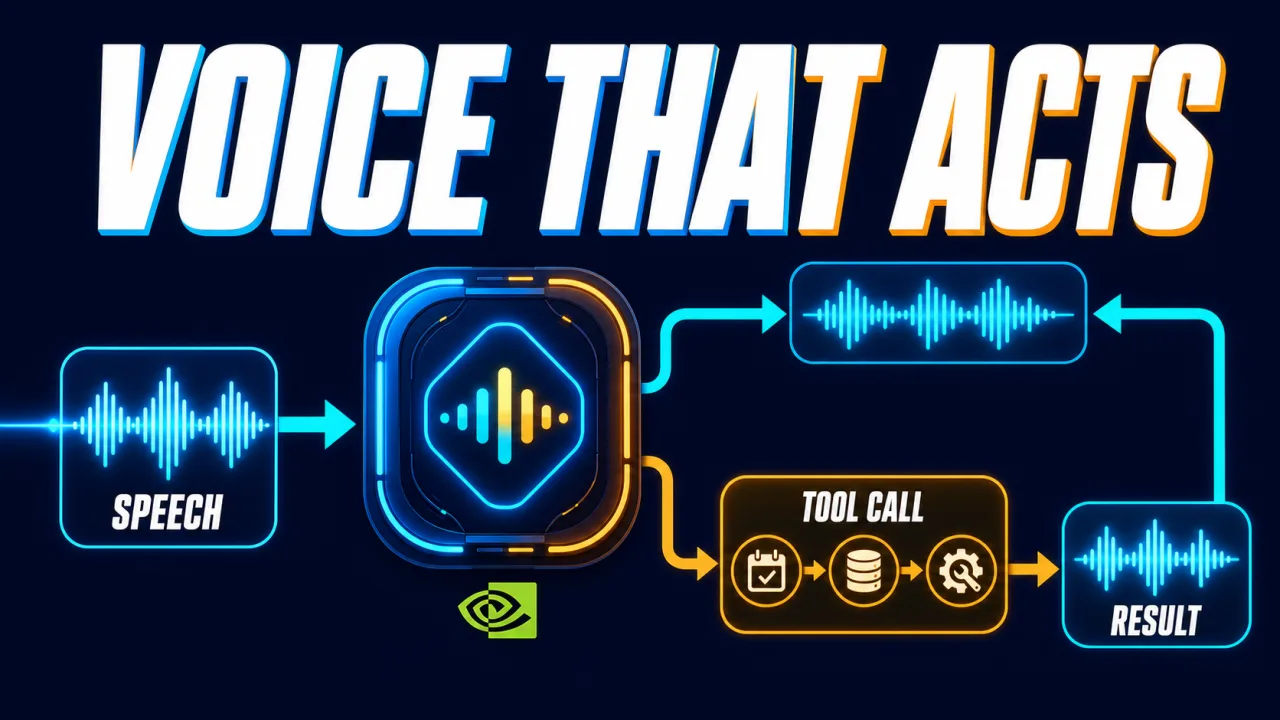
NVIDIA NemotronLabs VoiceChat 11B is an open full-duplex voice model that can keep speaking naturally while it calls a tool. The model card describes it as the first open full-duplex model with tool calling, putting an action channel next to the conversation rather than forcing developers to pause the voice session and build a separate orchestration layer.
The distinction matters because most voice agents are still assembled as a chain: automatic speech recognition, a text LLM, then text-to-speech. NemotronLabs VoiceChat processes speech in a unified streaming architecture, which is designed for turn-taking, interruption and tool execution in the same live interaction.
Definition: NVIDIA NemotronLabs VoiceChat is an 11B end-to-end speech-to-speech model that listens and speaks in full duplex while producing tool-call scripts on a separate output channel.
Example: A user can ask for the weather, the model can begin an on-hold response, call a weather tool, and then speak the returned result in the same conversation.
Key takeaway: The important release is not only lower voice latency; it is the combination of natural conversation and externally verifiable actions.
Business impact: Voice assistants can move from answering questions to completing bounded tasks, but teams still need to own permissions, tool reliability and human escalation.
What did NVIDIA actually release?
NemotronLabs VoiceChat 11B is a research model for real-time speech interaction, not a finished voice-assistant product. The release is an 11-billion-parameter hybrid Mamba/Transformer model that accepts user speech and text prompts, then returns agent speech, agent text and a transcription of the user's speech. NVIDIA's model card marks it as ready for research purposes only, so developers should treat the release as an inspectable foundation for experiments rather than a production guarantee.
The naming is worth watching. NVIDIA also lists a separate 12B Nemotron 3 VoiceChat model in its NIM catalog, described as an early-access full-duplex speech model without the same tool-calling claim. This article is about the 11B NemotronLabs VoiceChat checkpoint and its live function-calling path, not the separate 12B NIM listing described in NVIDIA's model catalog.
The open boundary is also specific. The model card publishes the checkpoint, architecture description, evaluation results and deployment instructions, but “open” does not mean a ready-made connector to every business system. A team still has to define the tools, expose their schemas, execute calls, return safe responses and decide which actions require approval.
Why does full duplex matter for tool-calling voice agents?
Full duplex lets a voice agent manage listening and speaking as an ongoing interaction instead of treating each turn as a sealed request. In the older cascaded pattern, the system usually waits for audio to finish, transcribes it, generates text, synthesizes speech and only then starts speaking. NemotronLabs VoiceChat is designed to stream speech understanding and speech generation together, with the model card reporting roughly 450 milliseconds for turn-taking in its highlighted results.
That architecture changes the user experience during a slow external action. A conventional voice assistant may go silent while a search, database lookup or API request runs. NemotronLabs VoiceChat lets a developer define a tool-specific “on-hold” message that can be spoken as soon as the model generates the call, giving the user an explicit status update while the tool response is prepared. See also Claude voice mode can switch models mid-conversation.
The difference is practical, not cosmetic. A basic AI agent is useful because it can observe a goal, select tools and act on a result; a voice agent adds the harder requirement that this loop remain understandable while a person is speaking. NemotronLabs VoiceChat targets both problems in one model, although its published limitations show that the interaction still needs careful boundaries.
How does Nemotron VoiceChat call a tool?
NemotronLabs VoiceChat separates spoken conversation from tool-call generation, so an external runtime can execute the model's structured request. Its architecture uses a fast Conformer speech encoder, a Nemotron Nano V2 language-model backbone and a TTS decoder for spoken output, plus a separate output channel for tool-calling scripts. That separation gives the serving layer something actionable to parse instead of asking it to infer an API call from audio alone.
The documented flow is straightforward:
User speech → audio encoding → language-model decision → spoken response
                                      └──────────────→ tool-call script
Tool response → conversation context → spoken answer
A tool call still needs an ordinary agent runtime around it. The runtime advertises the available tools, validates arguments, invokes the external service, converts the result into concise speech-friendly text and sends that result back. This is related to the broader Model Context Protocol discussion, but the release itself documents a model-level function-calling format and a WebSocket serving interface; it does not claim that the checkpoint automatically supports MCP.
The model card's offline example makes the boundary explicit: it can predict a call such as generate_random_number from spoken input, but the response comes from a pre-written JSON file. Live execution belongs to the interactive streaming deployment, where NVIDIA documents a bidirectional WebSocket service with function-calling support.
What can developers run today?
Developers have two different evaluation paths: offline checkpoint inference and interactive streaming. Offline inference is useful for checking speech-to-speech behavior and inspecting predicted calls without connecting a live service. Interactive streaming is the path for testing the actual voice experience, including tool execution, interruptions and the delay before a tool result returns.
The interactive path is packaged as an NVIDIA inference container around CUDA, Triton and vLLM, with a bidirectional WebSocket interface. NVIDIA's voice-chat deployment instructions separate prerequisites, container deployment, model-repository generation and the API reference, so the operational work is closer to deploying an inference service than installing a small desktop assistant.
The published hardware list for the 11B checkpoint includes NVIDIA A100, H100, H200, B100, B200 and RTX 6000 systems, with Linux and vLLM as the documented software path. That makes deployment hardware a first-order design decision: the model's “open” availability does not make real-time serving inexpensive or hardware-independent. Teams estimating local inference requirements can start with a local LLM hardware calculator, then validate the actual latency and concurrency they need.
How strong is the tool use?
NemotronLabs VoiceChat's tool calling is promising but not yet reliable enough to treat as general-purpose autonomy. On the model card's audio tool-calling evaluation, the model reports an average score of 56.1% on AU Harness, with higher results for simple calls than for parallel or multi-step combinations. On Full-Duplex-Bench v3, it reports 82.5% tool-selection accuracy, 44.2% argument accuracy and 33% Pass@1.
Those numbers describe different failure surfaces. Selecting the right tool is not the same as producing correct arguments, and either can fail even when the spoken conversation sounds fluent. For a business workflow, the relevant test is therefore not “does the demo feel natural?” but “does the agent choose the allowed action, preserve the user's exact arguments and recover safely when the tool rejects the request?”
NVIDIA's published guidance recommends no more than five tools per session and notes that multiple simultaneous calls are not yet handled reliably. Long tool responses can delay speech, tool execution cannot currently be interrupted by the user, and tool use may be intermittent, with wrong or skipped tools, invented arguments or mis-spoken results. Those are constraints for system design, not footnotes to hide behind a smooth demo.
What are the biggest limitations?
The first release is best suited to narrow, supervised voice workflows with small tool sets. The repository's known-limitations section lists generation artifacts, repeated or truncated speech, runaway continuation, clarification loops, unreliable instruction following and transcription drops. It also warns that the model can struggle with noisy or highly reverberant environments and was not explicitly trained for broad reasoning or alignment.
Tool permissions should be narrower than the conversation suggests. A voice request can sound casual while triggering a consequential action, and a fluent response is not evidence that the requested argument was preserved. A safe deployment should begin with read-only tools, explicit schemas, short TTS-friendly results, logging and human confirmation for writes or irreversible actions.
That operating model is consistent with the difference between AI agents and chatbots: the moment a system can affect an external service, permissioning and verification become part of the product. NemotronLabs VoiceChat makes the interaction more natural, but it does not remove the need for an agent harness, monitoring or an escalation path.
The practical conclusion
NemotronLabs VoiceChat makes open voice AI more operationally interesting by combining full-duplex speech with tool calls in one research checkpoint. The model's strongest idea is not simply that it can speak quickly; it is that a user can continue a conversation while the agent prepares and executes a bounded external action.
The gap between that idea and a dependable business assistant is still substantial. The model requires NVIDIA GPU infrastructure, a serving runtime, carefully designed tools and task-specific evaluation. Its own documentation reports failures in argument accuracy, parallel calls, interruption handling and long-running conversations, so the right first deployment is a narrow experiment rather than an unrestricted voice operator.
The direction is nevertheless clear: voice agents are moving from speech interfaces toward action interfaces. The teams that benefit first will be the ones that keep the tool surface small, make every action observable and measure whether the agent completed the user's task—not merely whether it sounded human.
Frequently asked questions
What is NVIDIA NemotronLabs VoiceChat?
NVIDIA NemotronLabs VoiceChat is an 11-billion-parameter, end-to-end full-duplex speech-to-speech model for real-time conversational AI. It combines streaming speech understanding and speech generation in one architecture and adds a separate output channel for tool-calling scripts.
What is new about NemotronLabs VoiceChat's tool use?
NVIDIA describes NemotronLabs VoiceChat as the first open full-duplex model to support tool calling while preserving a natural conversation flow during tool execution. Developers can configure an on-hold message for a tool so the agent keeps the user informed while an external action is running.
Can Nemotron VoiceChat run a live tool locally?
Yes, the release includes an interactive streaming path built around an NVIDIA inference container, CUDA, Triton, vLLM and a bidirectional WebSocket interface with function-calling support. The model card also provides offline examples, but those use a pre-written tool response rather than invoking a live service.
Is Nemotron VoiceChat ready for production?
The model is marked for research purposes only. NVIDIA's documentation also lists limitations around tool reliability, multiple simultaneous calls, long tool responses, interruption during tool execution, runaway speech and noisy environments, so production use would require narrow tools, monitoring and task-specific evaluation.
Alex
Founder & Lead AI Writer
Alex is the founder of Yowox and lead AI writer since 2024, breaking down complex information into clear, actionable insights for thousands of readers every day. Alex has built AI automation systems for businesses since 2024, focusing on AI agents, workflow automation, and business process optimization.
Save hours. Save thousands.
Practical guides, real workflows, and the latest AI and automation news that matters — straight to your inbox.