 By Alex
 Instagram AI engagement: why human signals still matter
Instagram is automating ranking, content production and first-line replies, but meaningful interaction, brand judgment and human handoff still shape trust.
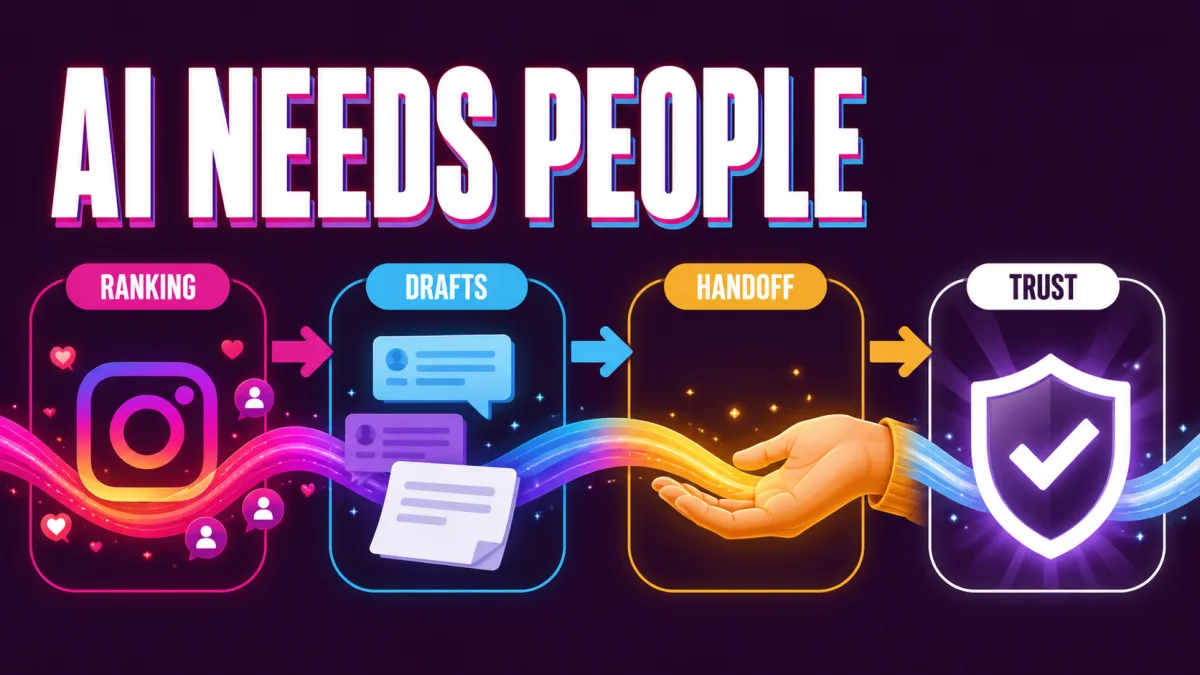
Instagram AI engagement is settling into a division of labour rather than a clean handover from people to machines. A sponsored analysis published by Artificial Intelligence News argues that automation is taking over ranking mechanics, content production and first replies while human reactions still determine whether a post earns trust. For a brand, the useful takeaway is simple: automate the repeatable layer, but keep meaning, judgment and exceptions with people.
Definition: Instagram AI engagement is the use of machine-learning ranking and automation systems to decide what people see, help produce content and handle routine conversations.
Example: An AI system can draft a caption or answer an order-status question, while a person decides the brand voice and takes over a sensitive complaint.
Key takeaway: Instagram rewards meaningful human signals even as AI handles more of the mechanical work around them.
Business impact: Businesses can respond faster and produce more consistently without turning every customer interaction into an automated exchange.
What does Instagram's AI rank?
Instagram does not use one universal algorithm: Feed, Stories, Explore, Reels and Search use different ranking systems for different user behaviours. In its official explanation of Instagram ranking, Instagram says those systems use signals about a person's activity, the post, the person who published it and the viewer's interaction history. The practical implication for a business is to design content for the action it wants — a useful share, a considered reply or a profile visit — instead of treating “the algorithm” as one opaque switch.
Instagram's published description also says its systems make predictions about actions such as time spent, comments, likes, shares and profile taps. That does not guarantee that any particular format will win reach, and it is not evidence that a single metric controls distribution. It does show why genuine audience response remains important: the ranking system is trying to predict whether a person will find a post worth their time, not merely count how many assets a brand produced.
Why do human signals still matter?
Human signals matter on Instagram because actions such as sharing a post with a friend, replying to a Story or returning to an account carry context that automated production cannot create by itself. The supplied analysis describes sends per reach and early interaction as meaningful indicators, while Instagram's own ranking explanation lists shares, comments, likes and viewing behaviour among its predictions. Businesses should therefore make content useful enough to discuss or pass on, then use analytics to learn which ideas create that response.
What can AI automate behind the scenes?
AI can reduce the production work around Instagram without owning the editorial decision. The source story describes tools that draft first versions of captions, create on-brand visual variations, repurpose one video into multiple formats and estimate which audience segment may respond to a post. Those capabilities are most valuable when a human still chooses the angle, checks the facts, protects the brand voice and decides whether the finished asset deserves to be published.
That boundary matters because speed can multiply weak content as easily as strong content. An AI system that generates ten caption variants does not prove that any of them is accurate, distinctive or appropriate for the audience. A business should treat the model's output as a production draft, with a person responsible for the final claim, tone and context. Teams already thinking about this distinction can compare it with the difference between an AI agent and a chatbot: generation is not the same as completing a trustworthy task.
What should businesses automate first?
Businesses should automate narrow, repetitive Instagram tasks before delegating open-ended brand communication. Good first candidates include caption drafts, format changes, FAQ replies, lead-intent tagging and conversation summaries. A customer support workflow is a useful comparison: AI agents for customer support are safest when they triage, retrieve trusted context, draft and escalate before they receive permission to act independently. The same staged logic applies to Instagram DMs.
A sensible control is to separate “can draft” from “can send.” The AI system may prepare a reply, gather the relevant product or order information and identify the likely intent, while a person approves high-risk responses. Once the team has measured acceptance, correction and escalation patterns for a narrow category, it can expand automation cautiously. This keeps productivity gains visible without confusing more output with better engagement.
How is AI changing Instagram DMs?
Instagram DMs are moving toward a first-response model in which automation handles routine questions and a person handles the conversation that needs judgment. The supplied story describes rule-based bots for fixed prompts and more capable AI agents that interpret unusual questions using a brand's information. For a business, the operational question is not whether the bot sounds natural; it is whether the system knows what it is allowed to answer, what data is authoritative and when to stop.
Research summarized by Harvard Business School shows why this model can work. In a field experiment involving 256,934 online customer-service chats, AI assistance helped human agents respond about 20 percent faster, while the researchers also found that its benefits varied by customer intent. The takeaway for Instagram operators is to use assistance to remove lookup and drafting time, then preserve human attention for conversations where empathy, explanation or discretion determines the outcome. Related reading: AI Evaluation Needs Human–AI Team Results.
When should a human take over an Instagram conversation?
A human should take over an Instagram conversation when the customer is angry, the request is unusual or sensitive, a refund or dispute is involved, the answer could create a legal or safety risk, or the system lacks reliable context. Human handoff is not an admission that automation failed; it is the boundary that makes automation safe enough to use. The handoff should preserve the conversation history, the customer's stated intent, the facts checked and the reason the AI stopped, so the customer does not have to repeat the problem.
What changes as Instagram adds more AI?
The source story expects AI to expand further into content production and customer support while Instagram becomes more attentive to what counts as genuine. That forecast should be treated as a direction, not a promise that every platform rule or ranking signal is already settled. Instagram says its ranking systems evolve, and its public explanation separates recommendation, safety and account-eligibility decisions rather than reducing them to one test for “human” content.
The durable business lesson is therefore narrower than “AI will change Instagram.” Brands that use AI well will remove repetitive work while protecting the parts customers notice most: a recognisable voice, a relevant answer, an honest limitation and a real person when the situation becomes important. The same trust problem appears in the debate around Meta's Content Seal: identifying synthetic media is not the same as deciding whether it is useful. AI can increase the surface area of engagement, but people still decide whether that engagement feels worth having.
Frequently asked questions
Does AI replace human engagement on Instagram?
No. AI can rank content, draft captions, repurpose media, answer routine questions and route conversations, but it does not create the meaning or trust behind a useful reply, a thoughtful share or a sensitive customer decision. Instagram's own explanation of ranking describes predictions built from how people interact with posts and accounts. The practical model is division of labour: use AI for repetitive mechanics, and keep humans responsible for voice, judgment, exceptions and relationship-building.
Which Instagram signals matter for reach?
Instagram says its surfaces use different ranking systems, but its published Feed explanation names signals such as a person's activity, information about the post, information about the poster and the history of interaction between the viewer and the poster. It also says the system predicts actions including time spent, comments, likes, shares and profile taps. Those signals are not a promise of reach, but they explain why genuine interest and useful content matter more than simply producing a larger volume of posts.
What should a business automate first on Instagram?
A business should start with low-risk, repetitive work: first-draft captions, content resizing or repurposing, frequently asked questions, simple routing and conversation summaries. The automation should use approved brand information and clear escalation rules. A human should review brand-sensitive copy, unusual requests, complaints, refunds, disputes and any response where tone matters more than speed. This staged approach lets a team measure response quality before giving an AI system more authority.
Why does Instagram DM automation need human handoff?
Instagram DM automation needs human handoff because a fast first reply is not the same as a correct or appropriate resolution. Routine questions can be answered quickly, while emotional, sensitive, high-value or unusual conversations may require context and judgment that an automated flow does not have. Research summarized by Harvard Business School found that AI assistance helped human service agents respond faster, while also warning that AI works best as a complement rather than a one-size-fits-all replacement.
Alex
Founder & Lead AI Writer
Alex is the founder of Yowox and lead AI writer since 2024, breaking down complex information into clear, actionable insights for thousands of readers every day. Alex has built AI automation systems for businesses since 2024, focusing on AI agents, workflow automation, and business process optimization.
Save hours. Save thousands.
Practical guides, real workflows, and the latest AI and automation news that matters — straight to your inbox.