 By Alex
 How to get more coding productivity with LLMs
A programmer's 16-week experiment suggests that LLM coding speed comes from better specifications, continuous reading, and deliberate verification—not from handing over software design.
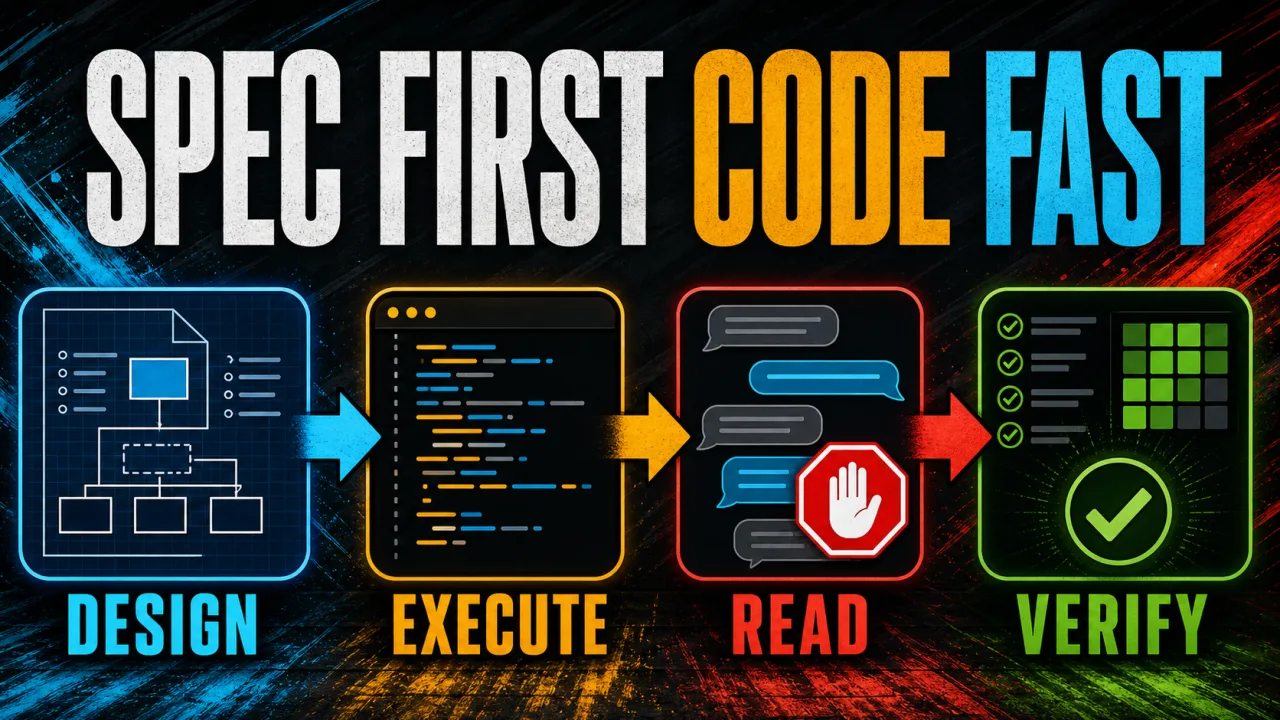
The clearest lesson from this source is to keep software design human-owned and make LLM implementation highly explicit. In a Hacker News post about coding productivity with LLMs, programmer and entrepreneur Dave Park City describes a 16-week personal workflow built around specifications, continuous reading, and deliberate verification. The author reports a 40–50x increase in coding output, measured in lines of code, but also labels that metric imperfect. The practical takeaway is to copy the control loop—not the headline multiplier.
Definition: LLM-assisted coding is software development in which a large language model drafts or changes code while a developer supplies context, constraints, design decisions, and acceptance criteria.
Example: A developer can settle the architecture in a design specification, describe the implementation sequence, and then ask an LLM to execute one bounded step at a time.
Key takeaway: LLM coding becomes more predictable when the model is given fewer unresolved design decisions.
Business impact: Teams can pursue faster implementation without pretending that generated code removes the need for architecture, review, or testing.
What productivity claim does the source make?
The Hacker News author reports producing roughly 40–50 times more coding output than before AI over 16 weeks, using lines of code as the measurement. The author says a previous pace of up to 60,000 lines per year became about 60,000 lines per week on average while working on a codebase exceeding 350,000 lines. Those are self-reported figures from one experienced programmer, not a controlled benchmark, so readers should treat them as a workflow case rather than a forecast; measure shipped features and maintenance cost before using any multiplier for planning.
The source also supplies its own limitation: lines of code are an imperfect metric. More generated code can mean more functionality, but it can also mean more review, more defects, or more future maintenance. For a team evaluating LLM productivity, the safer unit is a completed change that passes the project's acceptance criteria, tests, review, and production checks. Use output volume as a diagnostic, not as the definition of engineering value.
Why should developers write the design before the code?
The source's first technique is to frontload design-time thinking into two artifacts: a design specification and an implementation specification. The author says that ambiguity is resolved before the LLM starts coding, which lets the model spend its speed on execution instead of repeatedly revisiting architectural choices. Developers using this method should write down the intended boundaries, tradeoffs, sequence, and acceptance criteria before delegating a change.
This division matters because the source argues that current LLMs are much weaker at software-design tradeoffs than at fast, knowledgeable execution. An LLM can implement an algorithm, create a small application, or produce a plausible interface, yet still choose the wrong abstraction for a real codebase. The takeaway is to ask the developer to decide what should be built and why, then ask the LLM to implement a design that is concrete enough to inspect.
A specification is useful only when it is testable
A design document improves LLM output only when it contains decisions the implementation can be checked against. The source describes a large, interconnected layered codebase, so the specification-first method is most relevant when a change has architectural consequences rather than when a developer is generating an isolated snippet. Turn a vague request into named constraints, an ordered implementation path, and observable acceptance checks before handing it to the model.
A useful specification should make disagreement visible. If the model proposes a different data boundary, dependency direction, or feature sequence, the developer can stop the session before a large diff accumulates. This turns the LLM from an opaque author into a fast implementation instrument: the model still produces text and code, but the developer has a reference against which every meaningful choice can be compared.
Why does continuous reading matter?
The source's second technique is to remain connected to the session and read most of the LLM's verbal output. The author stops the model whenever it says something wrong or inconsistent with the intended design, treating that statement as evidence that the context is misaligned. Developers should use an early contradiction as a reason to correct the context immediately, not as a reason to wait for the final code and hope tests reveal the misunderstanding.
This method changes the review point. Instead of reviewing only a completed pull request, the developer reviews the model's interpretation while the task is still cheap to redirect. The AI agent explainer on Yowox describes the same general principle for tool-using systems: a useful automated loop needs context, action, verification, and escalation. In an LLM coding session, reading is the human verification and escalation step.
The Hacker News discussion adds a related warning about context windows. One commenter says that important rules should be documented and supplied at the beginning of a chat, because the model cannot reliably tell a developer whether a task is complete or correct. The practical takeaway is to treat project rules and specifications as durable inputs, not as assumptions that exist only in a long conversation.
How should developers prioritize the implementation order?
The source's third technique is to design the order of feature development so the path from A to B minimizes architecture risk. The author recommends resolving unknowns early, watching the system take shape before adding complexity, and building harnesses that keep the LLM's iteration loop visible. Developers should therefore sequence a coding task around the riskiest assumptions and the most informative checks, not around whichever file the model can edit first.
A risk-first order produces better evidence. An early prototype can test an uncertain integration; a small vertical slice can expose a bad boundary; a focused harness can turn subjective inspection into a repeatable check. The source gives pixel-correct font and shape tests against Skia as an example of using an external oracle instead of relying only on visual judgment. The general lesson is to give the LLM a concrete feedback signal wherever correctness can be measured.
What should the LLM own—and what should it not own?
The source positions an LLM as a very fast, knowledgeable implementation partner rather than an autonomous software architect. The author says LLMs can be effective at one-shot applications, mostly-correct algorithm implementations, and semi-pretty interfaces, but cannot reliably choose the right real-world tradeoffs for a product or codebase. Developers should delegate repetitive execution and use the resulting speed to spend more time on architecture, constraints, and evidence.
That boundary is also why a green result is not enough. The Yowox analysis of the hidden cost of AI-generated tests explains how generated tests can pass while missing the behavior that matters. The same risk applies to generated implementation: a clean diff or passing local check proves only what that check actually exercised. Keep the acceptance criteria independent from the model's self-assessment and test the boundaries where the design could fail.
A practical LLM coding loop
A specification-first LLM coding loop has five stages. First, the developer defines the design, constraints, and implementation sequence. Second, the LLM restates the plan so misunderstandings are visible before edits begin. Third, the LLM implements one bounded slice while the developer reads the session output. Fourth, a harness, test, or external oracle checks the result. Fifth, the developer either corrects the context, accepts the slice, or escalates the design question back to human decision-making.
This loop is a direct synthesis of the source's three recommendations: frontload the design, stay attentive to the conversation, and order the work around risk. It is not a promise of 40–50x output. It is a way to capture the upside of fast implementation while limiting the cost of an LLM that confidently follows the wrong interpretation. Start with one repository task, record rework and review time as well as code volume, and expand only when the quality signal stays stable.
The practical verdict
The news is not that every developer can multiply output by 50. The stronger lesson is that LLM coding rewards a developer who supplies architecture, context, prioritization, and verification instead of outsourcing those decisions by accident. The source's self-reported result is compelling as an experiment, but its measurement is narrow and its workflow is the part other teams can test honestly.
Use the LLM for speed where the task is explicit. Keep the design and tradeoffs with the developer. Stop on the first sign of context drift. Build feedback loops that can prove whether the code works. That combination makes productivity a measured engineering process rather than a larger stream of unreviewed code.
Frequently asked questions
What is the main productivity idea in the Hacker News post?
The post argues that coding productivity improves when a developer makes the design decisions before asking an LLM to implement them. The author describes writing a design specification and an implementation specification, then using the model for fast execution while staying close enough to catch misunderstandings. The practical lesson is not to remove the developer from the loop. It is to move human attention toward architecture, prioritization, context, and verification, where the author says current LLMs are weaker.
Why does the author recommend turning thinking down while coding?
The author says the design-time thinking should happen before the coding pass. Once the specification has resolved the important ambiguity, a lower reasoning setting can keep the LLM from reopening decisions that the developer already made. This is a workflow preference, not a universal model rule: it assumes the design is genuinely complete enough for implementation and that the developer continues reading the model's output. If the specification is unclear, lowering reasoning can make a wrong implementation faster rather than safer.
How should developers keep an LLM coding session aligned?
The post recommends reading most of the model's verbal chat output and stopping the session as soon as the model says something wrong or inconsistent with the intended design. That moment is treated as an alignment signal, not a minor wording issue. A practical implementation is to keep the design rules visible, ask the model to confirm them after a task, and inspect the diff and tests before accepting the result. The linked Hacker News discussion also describes documenting important rules because a chat window is not a durable project specification.
Does the post prove that LLMs make programmers 40–50 times faster?
No. The 40–50x figure is the author's self-reported result over 16 weeks, measured in lines of code. The author explicitly calls lines of code an imperfect metric, and the Hacker News post is not a controlled comparison with a matched baseline, task set, defect rate, or maintenance study. The useful conclusion is narrower: the author believes a specification-first, tightly supervised workflow produced a large personal increase in output. Teams should measure their own cycle time, review effort, defects, rework, and shipped outcomes before treating the number as a planning assumption.
Alex
Founder & Lead AI Writer
Alex is the founder of Yowox and lead AI writer since 2024, breaking down complex information into clear, actionable insights for thousands of readers every day. Alex has built AI automation systems for businesses since 2024, focusing on AI agents, workflow automation, and business process optimization.
Save hours. Save thousands.
Practical guides, real workflows, and the latest AI and automation news that matters — straight to your inbox.