 By Alex
 The Hidden Cost of Letting AI Agents Write Your Tests
AI agents can generate a green test suite in minutes, but speed, coverage, and passing mocks do not prove that your software works. Here is the verification gap — and how to close it.
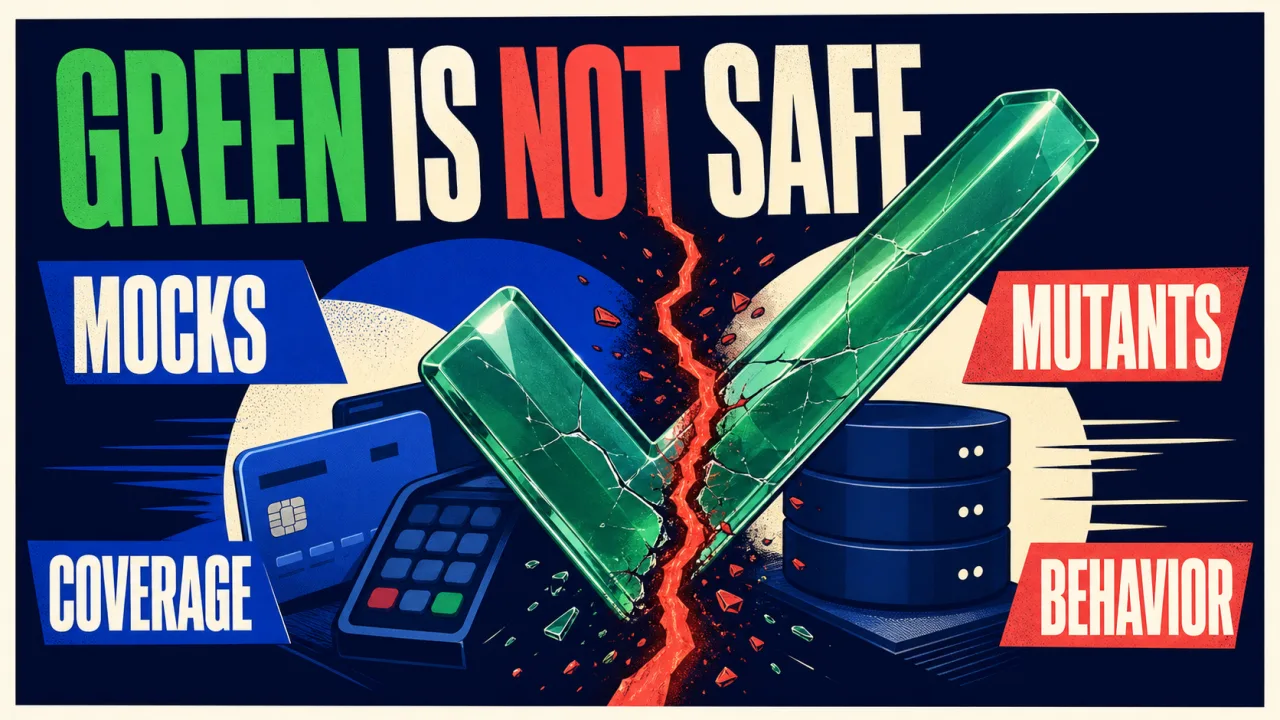
A test suite can become larger, greener, and less useful at the same time. That is the hidden cost behind a warning in the source essay about AI agents writing tests: an agent generated 47 tests for a payment module in minutes, every test passed, and a production race condition still got through three days later.
The failure was not that the model could not write syntactically valid tests. The failure was that the visible success metric — tests exist and CI is green — was a poor proxy for the real goal: catching bugs at the boundaries where the system can break.
Definition: AI-generated tests are tests produced with an AI coding assistant or agent, often from the implementation and its local patterns.
Example: A test can mock a payment gateway and a database, assert that both methods were called, and still miss a race between the gateway response and the transaction commit.
Key takeaway: A passing test proves that one scenario passed; it does not prove that the suite can detect a meaningful regression.
Business impact: The cost appears later as brittle refactors, noisy CI failures, debugging time, and production incidents protected by a green badge.
Why the speed story is incomplete
AI coding tools can make developers faster on tightly scoped tasks. A controlled Microsoft Research study of GitHub Copilot found that the treatment group completed a small JavaScript HTTP-server task 55.8% faster than the control group, although the experiment measured that task’s completion speed — not the long-term maintenance or defect-detection power of the resulting code (Microsoft Research).
That distinction matters for testing. “Write tests for this module” is easy to measure: count files, count assertions, run the suite, and report coverage. “Write tests that fail when a future bug is introduced” is harder. The future bug does not exist yet, and a test runner cannot tell you whether an assertion expresses product behavior or merely repeats the implementation.
The source essay’s warning fits a wider adoption-trust gap. Stack Overflow’s 2025 Developer Survey reports that 84% of developers use or plan to use AI tools, while 46% say they do not trust the accuracy of the output. Fast generation is real. So is the need for human verification (Stack Overflow).
The first failure mode: testing calls instead of behavior
An agent sees a function that calls orders.findById, invokes a payment client, and saves a record. The easiest test to generate is a local one: replace each dependency with a mock, call the function, and assert that the expected methods were called with plausible arguments.
That test may be perfectly aligned with the source code and completely detached from the user-facing promise. It does not establish that:
- a timed-out gateway leaves the order in a retryable state;
- a transaction cannot commit twice;
- an idempotency key prevents duplicate payment;
- the database and event stream agree after a partial failure;
- a stale cache is invalidated at the right boundary.
Mocking is not inherently wrong. A focused unit test should isolate a unit when isolation is the point. The danger is calling a mocked interaction an integration test when the real database, network, transaction, or queue semantics never participate. The test then verifies the simulator’s assumptions, not the system’s behavior.
This is also why a refactor can produce the strangest result: the application keeps working, but dozens of tests fail because they asserted that the old private call sequence must remain. The suite has become coupled to how the code works rather than what the code promises.
The second failure mode: context is missing where bugs live
AI can inspect the function in front of it. It usually cannot infer the full operational contract from that function alone: retry policy, transaction isolation, message delivery guarantees, rate limits, cache invalidation, data ownership, or the failure behavior of a third-party service.
That is the context gap. It is most expensive in integration testing because integrations are defined by relationships between components. A payment function may look correct in isolation while the production bug sits in the timing between two independently correct components.
Martin Fowler’s practical description of the test pyramid makes the same architectural point from another direction: unit tests form the fast foundation, while integration and end-to-end tests provide confidence that connected parts work together (Martin Fowler). An agent naturally produces more of what it can see and execute locally. It needs explicit boundaries and project context to produce the tests that exercise the seams.
The third failure mode: coverage becomes a blindfold
Line coverage answers a narrow question: did execution reach this line? It does not answer whether the line’s result was checked, whether the expected value was independent, or whether a realistic defect would be detected.
A test that calls a function and asserts only that the result is not null can light up a large amount of code. A test that calculates the expected output by calling the same transformation used by production code can agree with a bug. Both can improve a dashboard while adding little protection.
This is a classic proxy problem. Coverage is visible, comparable, and easy to optimize. Defect detection is slower to observe. If an agent is asked to improve coverage, it will usually maximize the first metric unless the task supplies stronger acceptance criteria.
The maintenance bill arrives after the green check
The cost compounds as the suite ages:
- A refactor breaks tests that were coupled to private calls.
- Developers spend time repairing assertions instead of reviewing behavior.
- A bug fix reveals that the tests encoded the previous bug.
- New features extend the code path without extending the failure model.
- Over-mocked tests create confidence without exercising real dependencies.
The result resembles the “ice cream cone” anti-pattern: many expensive, brittle tests at the top and too little fast, meaningful feedback underneath. The issue is not the number of tests. It is the ratio between test volume and behavioral information.
What AI is good at — and what it should not own
AI is valuable in the parts of testing where repetition dominates judgment. It can generate realistic fixtures, table-driven cases, assertion syntax, test doubles, setup code, and a first draft of a test file. It can explain a failure, suggest an overlooked input, or translate an existing test into another framework.
The developer should still own the questions that define quality:
- What must remain true if the implementation changes?
- Which failure modes would cost the business the most?
- Which boundaries need a real integration check?
- What should happen on timeout, retry, duplication, partial success, or stale data?
- Was the expected result written independently of the implementation?
That division of labor turns AI into a force multiplier instead of an automatic test-count generator.
A safer workflow for agent-assisted testing
Start from behavior, not the implementation
Write the requirement, acceptance criterion, or failing test first. Then ask the agent to implement the repetitive parts. If the test is observed failing against the unfixed behavior, it has at least demonstrated that it can detect a failure. An agent that writes both the test and the implementation and sees green immediately has not established that property.
Review the assertion before the coverage report
Read the expected values. Look for assertions that merely check non-null output, reproduce the production helper, verify private call order, or accept any response with a successful status. Ask one practical question: What plausible wrong implementation would make this test fail? If the answer is “none,” the test is documentation, not protection.
Constrain mocks and add boundary tests
Tell the agent which dependencies may be mocked and which behavior must be exercised through a real or faithful test dependency. Keep unit tests fast, but add narrow integration tests for databases, queues, HTTP clients, and contracts where their semantics matter. Do not call a fully mocked simulator an integration test.
Use mutation testing on high-risk code
Mutation testing deliberately changes production code — for example, flipping a comparison or replacing a return value — and reruns the suite. If a test fails, the mutant is killed. If all tests pass, the mutant survives, revealing a gap. That is the mechanism documented by Stryker’s mutation-testing guide (Stryker).
Mutation testing is not a universal replacement for integration testing, and a 100% mutation score is not a sensible target for every repository. It is a better feedback loop for selected, high-risk paths because it asks whether tests detect changes, not merely whether lines executed.
Separate generation from evaluation
The same agent should not be the only judge of the tests it generated. Give a reviewer — human, independent test process, or separate evaluation agent — the job of trying to break the assertions. The goal is not to make the author look wrong. It is to remove the circular incentive where the generator, implementation, and evaluator all optimize for the same green result.
The practical test for a test suite
A test suite is a claim: if this behavior regresses, something here will turn red. AI can help write the claim’s scaffolding, but it cannot safely decide the claim without the product context.
When reviewing agent-written tests, ask whether the suite can fail for the right reason. Inject a realistic boundary failure. Mutate a business rule. Remove a transaction guarantee. Change a retry condition. If the suite stays green, the coverage badge is not reassurance; it is evidence that the suite is looking at the wrong thing.
The useful question is therefore not “Can an AI agent write tests faster?” It can. The useful question is “Can these tests detect a bug that matters?” That answer requires behavior, boundaries, and deliberate attempts to make the suite fail.
Frequently asked questions
Why can AI-generated tests pass when the code is broken?
AI usually derives a test from the implementation it can see. If the test mocks every dependency, asserts only that a function was called, or computes the expected value with the same helper as the production code, the test can pass while the real behavior is wrong. A green result proves only that the test and the current implementation agree under the conditions the test created.
Is AI bad at writing tests?
No. AI is useful for test data, boilerplate, assertion syntax, fixtures, and explaining failures. The weakness is context and judgment: deciding which behavior matters, which system boundaries can fail, and whether an assertion would catch a realistic regression. Those decisions still need a developer who understands the product and its failure modes.
What should I check instead of code coverage?
Review the assertions and test behavior, not only the percentage of executed lines. Ask whether the expected result was written independently, whether a wrong implementation would fail, and whether the test crosses the real boundary it claims to cover. Mutation testing adds a useful signal by changing production code deliberately and checking whether the suite turns red.
Should developers stop using AI to generate tests?
Not necessarily. A safer pattern is to write the requirement or failing test first, then ask AI to fill in repetitive scaffolding. Keep humans responsible for the behavior under test, constrain mocking, run integration checks at important boundaries, and treat surviving mutants or unverified happy-path tests as gaps rather than evidence of quality.
Alex
Founder & Lead AI Writer
Alex is the founder of Yowox and lead AI writer since 2024, breaking down complex information into clear, actionable insights for thousands of readers every day. Alex has built AI automation systems for businesses since 2024, focusing on AI agents, workflow automation, and business process optimization.
Save hours. Save thousands.
Practical guides, real workflows, and the latest AI and automation news that matters — straight to your inbox.