 By Alex
 How AI is turning entertainment apps into all-purpose hubs
Netflix, Spotify, YouTube and TikTok are expanding beyond one format as AI improves recommendation, creation and cross-format discovery.
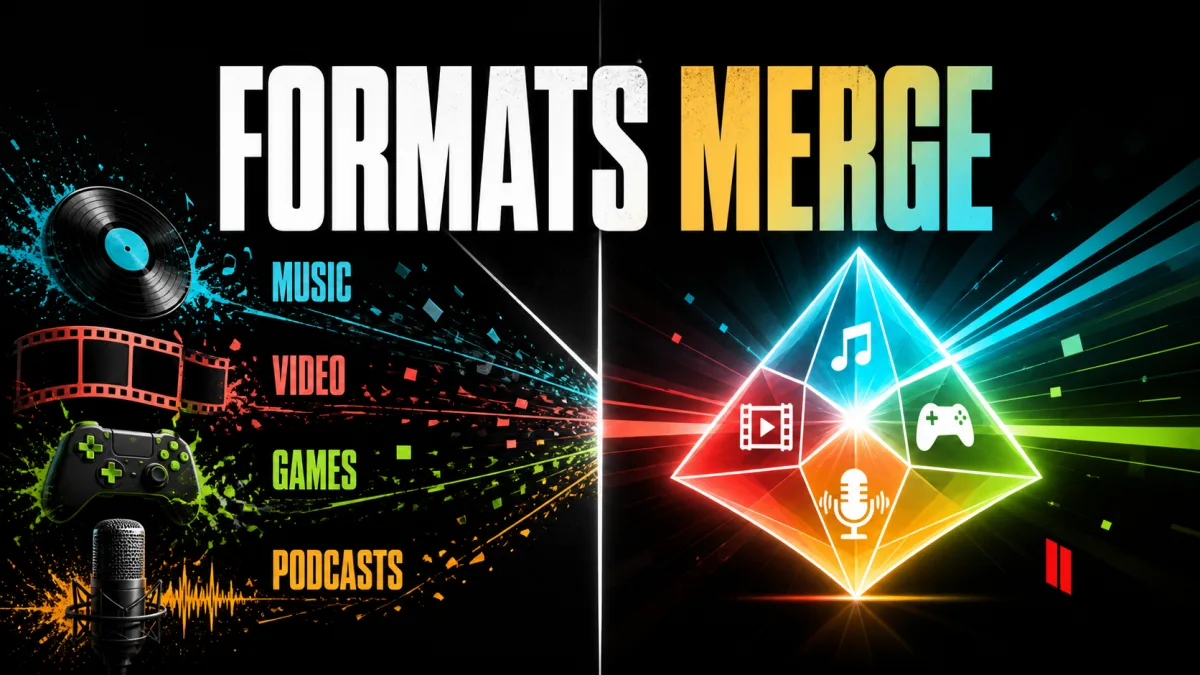
Netflix, Spotify, YouTube and TikTok are competing to become the default place for a person's spare time, not merely the best app for one content format. A July 21, 2026 TechCrunch report describes a shift from separate music, video, podcast and audiobook categories toward broader entertainment destinations. AI matters because it helps these platforms recommend, organize and produce content across those boundaries.
Definition: A universal entertainment app is a platform that tries to serve multiple entertainment formats from one destination.
Example: Netflix combines film and television with games, live events, short clips and podcasts, while Spotify has moved from music into podcasts, audiobooks, fitness and social features.
Key takeaway: Format breadth is becoming easier to copy, so recommendation quality and the ability to keep users engaged across formats matter more.
Business impact: The winning platform may capture more time, subscription value, advertising value and behavioral data, but it also takes on wider content, rights and product complexity.
Why are entertainment apps converging now?
Entertainment apps are converging because the market is becoming mature, creators increasingly publish across formats, and companies are competing for time spent and revenue per user. The TechCrunch report names those three forces before documenting Netflix's move into games and live events, Spotify's move into books and fitness, and YouTube's expansion across video, music, sports and shopping. For operators, the implication is to evaluate an entertainment platform by the jobs it can cover across a user's day, not just by its original category.
AI strengthens that strategy because one company can manage a broader content mix with better recommendation, search and creation tools. The report points to Spotify's conversational discovery, YouTube's AI playlists and TikTok's AI search and recommendations as concrete examples of software connecting different content choices. A wider catalog can fill more short periods of free time, but operators should treat that as a strategic possibility rather than a guarantee: broader inventory only helps when the service can connect users to something relevant.
How are Netflix, Spotify, YouTube and TikTok expanding?
Netflix is moving beyond film and television by adding games, live sports and other events, short video clips and podcasts. The expansion gives Netflix more ways to occupy the moments when a user does not want a full-length show, including the short sessions often associated with social video or casual games. Netflix therefore illustrates the move from a single-format catalog toward a wider time-spent strategy.
Spotify is extending its music base with podcasts, video podcasts, audiobooks, narrated magazines, fitness classes, social features, stories, messaging and physical book sales. Spotify's expansion is notable because it combines adjacent media with community and commerce features rather than stopping at audio. The result is a service that can compete for listening time, reading time, social interaction and purchases from one account.
YouTube is expanding in the opposite direction from a creator-video base: it now includes short-form video, podcasts, gaming, music, movies and television, sports, news, shopping and live content. YouTube's range means users can watch ad-supported movies, follow live events, rent or buy video, or move between long and short formats without leaving the platform. This broader surface makes distribution and discovery as important as any single video format.
TikTok is also widening its role beyond short video through longer content, travel planning, shopping, local exploration, event ticketing, a standalone microdrama app and TikTok Pro Events. TikTok's additions connect entertainment with activities that follow from discovery, such as planning a trip or buying a ticket. That makes the platform's expansion a bridge from attention to action, not only a larger video library.
What does AI change inside the entertainment platform?
AI changes entertainment platforms by making cross-format discovery more conversational, personalized and adaptable. Spotify is testing an editable Taste Profile and AI features that let people discuss what they want or build playlists that include more than music. For the user, the concrete change is greater control over the input to recommendation; for Spotify, the strategic value is a richer model of intent across formats.
Netflix says newer model architectures are improving personalization and allowing faster iteration, while AI-assisted coding helps the company build and launch new content areas more quickly. Those statements describe an operational advantage rather than a new entertainment format: better models can help Netflix decide what to surface and reduce the effort required to ship supporting product features. Teams studying the broader shift can also read how AI is becoming infrastructure under products, because the important layer is increasingly the system around the model.
YouTube is applying generative AI to creator tools, search, conversational discovery, playlists and auto-dubbing. The source reports that YouTube said more than one million channels used its AI creation tools and that 20 million consumers used its Gemini-powered content discovery tool in December. Those figures show the scale YouTube associates with AI-assisted creation and discovery, but they do not by themselves prove that AI recommendations are better than human-curated alternatives.
TikTok has assembled a similar AI layer through an in-app chatbot, video-creation tools, AI-driven search and recommendations, and accessibility features such as AI-generated alt text. TikTok's example shows why the universal-app contest is not only about adding catalogs: AI can also change how people find, create and understand content inside the same product. The relevant comparison is therefore the full discovery loop, from user intent to recommendation to creation or action.
Why does the universal entertainment app matter to businesses?
The universal entertainment app matters because platform convergence can increase time spent, advertising opportunities and subscription value while making switching less attractive. The TechCrunch report explicitly connects a wider content mix with more time in the app, ad revenue and subscriptions, and says the default service gains more behavioral data and lock-in. Businesses should therefore watch retention, cross-format usage and the quality of personalization, not just the number of new features announced.
This strategy also creates a governance and rights problem. The source notes that generative AI remains controversial because artists worry about training use and job displacement, and it points to Netflix's $587 million purchase of Ben Affleck's AI filmmaking company as a major example of the industry's investment in AI production. The practical takeaway is that content breadth and AI efficiency do not remove the need to address consent, attribution, compensation and creative control.
The TechCrunch report describes a connected layer of recommendation, creation, search, accessibility and advertising features across the four services. That pattern is related to the broader AI platform stack used in media production, but the report itself does not establish that every layer is already unified or that one platform has won. Operators should use the source as evidence of convergence, then verify each service's actual capabilities before treating the trend as a product blueprint.
What should operators watch next?
Operators should watch whether AI turns content convergence into a durable user advantage or merely makes every large platform look similar. The source documents Netflix, Spotify, YouTube and TikTok adding formats and AI features, but it does not establish that one service will win or that specialized apps will disappear. The next useful signals are sustained cross-format engagement, user control over recommendations, creator adoption, rights arrangements and whether broader catalogs improve the experience instead of adding noise.
The central change is already visible in the source's examples: entertainment platforms are competing less on a single format and more on the quality of the destination they create around a user's changing intent. Spotify is adding conversational discovery, YouTube is expanding AI creation and search, and TikTok is adding AI chat and recommendations, showing how AI becomes the connective layer that helps destinations recommend, generate and organize content. The unresolved question for operators is whether convenience and personalization will outweigh lock-in, trust and creative-rights concerns.
Frequently asked questions
What is a universal entertainment app?
A universal entertainment app is a service that tries to keep users inside one destination across multiple formats, such as video, music, podcasts, books, games, live events or shopping. The idea is not that every service already offers the same catalog or interface. It is that the platform competes for a person's available attention rather than for one format alone. Netflix, Spotify, YouTube and TikTok are all moving in this direction, according to the source report.
Why are Netflix, Spotify, YouTube and TikTok expanding beyond their original formats?
The platforms are expanding because entertainment-app growth is maturing, creators increasingly work across formats, and a wider content mix can keep users in the same app for more situations. Netflix has added games, live sports, short clips and podcasts; Spotify has added podcasts, audiobooks, fitness content and social features; YouTube spans short and long video, podcasts, music, movies, sports and shopping; TikTok adds longer video, commerce, travel and live-event features. Each expansion gives users another reason not to switch.
What role does AI play in cross-format entertainment apps?
AI helps entertainment platforms organize, recommend and create different kinds of content. Spotify is testing an editable AI-built Taste Profile and conversational discovery features. Netflix says newer model architectures are improving personalization and speeding iteration. YouTube uses generative AI for creator tools, search, recommendations, playlists and dubbing, while TikTok uses AI for chat, creation, search, recommendations and accessibility. The practical differentiator becomes how well an app connects a person with the next relevant experience.
What is still uncertain about the universal entertainment app trend?
The trend does not prove that one universal entertainment app will replace specialized services. The source describes convergence among Netflix, Spotify, YouTube and TikTok, but the platforms still have different catalogs, audiences and business models. It also notes unresolved concerns around generative AI and artists whose work may be used for training or displaced by generated content. The next test is whether broader catalogs and AI personalization create durable user value without reducing trust or creative quality.
Alex
Founder & Lead AI Writer
Alex is the founder of Yowox and lead AI writer since 2024, breaking down complex information into clear, actionable insights for thousands of readers every day. Alex has built AI automation systems for businesses since 2024, focusing on AI agents, workflow automation, and business process optimization.
Save hours. Save thousands.
Practical guides, real workflows, and the latest AI and automation news that matters — straight to your inbox.