 By Alex
 Google Maps turns Ask Maps into an agentic task assistant
Google Maps is expanding Ask Maps beyond recommendations: the assistant can find food, populate an order cart, compare hotels, surface event tickets, personalize travel help, and track live transit.
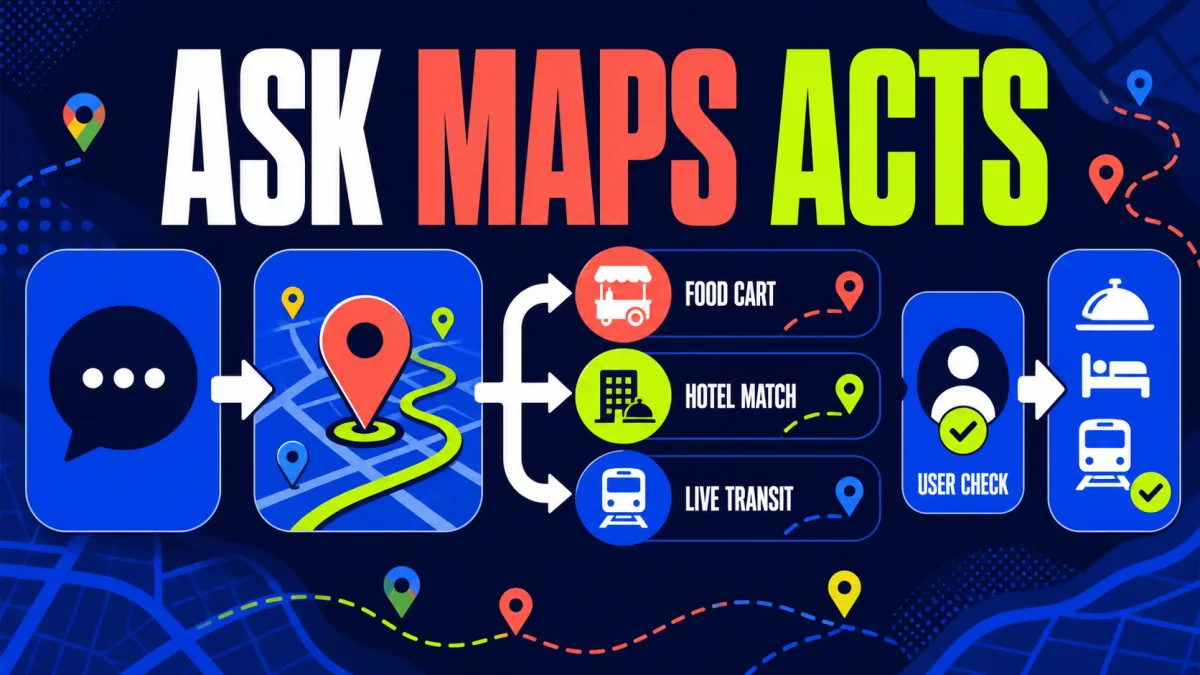
Google Maps is turning Ask Maps from a conversational search layer into an assistant that can coordinate real-world tasks. In its August 6 announcement, TechCrunch reported that Ask Maps can now find food, prepare an order cart, compare hotels, surface event tickets, use personal travel context, and show live transit information; the practical takeaway is that Maps is moving closer to task completion, not just place discovery.
Definition: Google Maps' Ask Maps is a conversational assistant that can search local options, use connected context, and hand multi-step tasks to partner services.
Example: A user can ask Ask Maps for a hotel near a conference and restaurants, compare available options, then continue to a partner site to book.
Key takeaway: Ask Maps now coordinates several steps of a local or travel task, while the user still controls payment and final booking.
Business impact: For businesses that depend on discovery, the important change is that a map listing can become the starting point for an order, reservation, or ticket purchase.
What can Google Maps' Ask Maps do now?
Google Maps' Ask Maps can turn a natural-language food request into a shortlist and a prepared cart, which matters when a user has several constraints rather than a single restaurant name. Google says Ask Maps can find open restaurants along a route, account for dietary needs or saved places, and add a selected dish to a cart through partners such as Square and Toast, with Uber Eats coming soon; users should treat the feature as an assisted ordering path and review the cart before paying.
Google Maps' Ask Maps can also compare hotel options and discover nearby events from a conversational request. For a trip, Ask Maps can compare real-time hotel prices and availability against criteria such as budget, location, and nearby amenities; for local plans, it can return concerts or comedy shows with ticket links. The immediate use is narrower than autonomous booking: Ask Maps reduces search and comparison work, then sends the user to a partner website for the final transaction. The connected layers behind this kind of system are outlined in Yowox's AI automation stack explainer.
How does Ask Maps handle a multi-step task?
Ask Maps handles a multi-step task by combining local search, preference matching, and a partner handoff inside one conversation. A food request can move from intent to restaurant discovery to item selection and cart creation, while a hotel request can move from trip constraints to price and availability comparison; because TechCrunch's report says payment and booking continue on supported platforms, users should view Ask Maps as an agentic coordinator with a human checkpoint at the transaction.
That distinction explains why the launch is agentic without claiming that Google Maps independently completes every purchase. An AI agent is defined by its ability to pursue a goal through tools and actions, not by whether it owns the last step; Yowox's AI agent explainer describes that difference between a text answer and a completed workflow. Ask Maps now supplies the planning, retrieval, and handoff layers for selected local tasks, while the connected commerce service remains responsible for checkout.
What does Personal Intelligence add to Ask Maps?
Personal Intelligence lets Ask Maps tailor recommendations using a user's connected travel context, which is useful when the answer depends on information the user has already supplied elsewhere. TechCrunch says Ask Maps can draw on Gmail and Google Calendar for questions about flights, dinner reservations, and hotels, while Google's product announcement specifies Gmail availability now and Calendar support coming; users should therefore check which connected sources their account actually exposes.
Google Maps' Personal Intelligence is off by default, so the personalization feature is permission-based rather than silently enabled. With the connection enabled, Ask Maps can use a hotel reservation or upcoming flight to shape nearby recommendations, and conversation history can let a user resume trip planning; the operational takeaway is convenience with an explicit privacy decision, not an automatic scan of every Google account.
Where are the new features rolling out?
Google is rolling out food ordering, hotel discovery, event discovery, and conversational contributions in the United States first. The same U.S.-first boundary applies to the new commerce and ticketing flows described in the announcement, so businesses and travelers outside the U.S. should not assume that a compatible Google Maps account includes those actions yet.
Google says live transit updates, more personalized responses, and remembered conversations are rolling out wherever Ask Maps is already available. That split means the launch has two availability tracks: transaction-oriented features begin in the U.S., while the transit and personalization improvements have broader coverage; readers should evaluate each feature separately instead of treating “Ask Maps availability” as a guarantee that every capability is live.
Why this matters for local discovery
Google Maps' Ask Maps changes the value of local information by connecting discovery to an action path. A restaurant can be found and have items placed into a partner cart, a hotel can be compared before a booking handoff, and an event can be surfaced with a ticket link; the takeaway for operators is to watch how accurately listings, menus, availability, and partner integrations survive an AI-mediated search.
The launch also shows where consumer agents are gaining traction: inside products that already hold location, travel, and transaction context. Google Maps is not replacing every booking or ordering service in this release, but it is becoming the layer that interprets intent and routes the user to one. The open question is whether that convenience creates more qualified demand for partners or shifts control of the customer relationship toward the assistant.
Frequently asked questions
What can Ask Maps do with the new agentic features?
Ask Maps can find nearby food that matches a natural-language request, add selected items to a cart through supported ordering platforms, compare hotel prices and availability, and surface local events with ticket links. Google is rolling the food, hotel, and event features out in the United States first. Ask Maps still hands the user to a supported platform or partner website for payment or final booking, so the feature coordinates the task without becoming the merchant of record.
Does Ask Maps complete a food order or hotel booking by itself?
No. Ask Maps can search for a suitable restaurant, select matching items, and add them to a cart through partners such as Square and Toast, with Uber Eats coming soon, but the user completes payment on the supported platform. For hotels, Ask Maps compares options and checks availability before the user clicks through to a partner website to book. The useful change is the multi-step discovery and handoff, not fully autonomous checkout.
What does Personal Intelligence add to Google Maps?
Personal Intelligence lets Ask Maps use information from a connected Gmail account to tailor recommendations around flights, dinner reservations, and hotel plans; Google says Calendar support is coming. Ask Maps can also remember prior conversations when the relevant history setting is enabled. Gmail connection is off by default, so users decide whether the assistant can use that personal context.
Where are the new Ask Maps features available?
Google is rolling out food ordering, hotel discovery, event discovery, and conversational contributions in the United States first. Google says live transit updates, more personalized responses, and remembered conversations are rolling out wherever Ask Maps is already available. Availability is therefore feature-specific rather than one global launch switch.
Alex
Founder & Lead AI Writer
Alex is the founder of Yowox and lead AI writer since 2024, breaking down complex information into clear, actionable insights for thousands of readers every day. Alex has built AI automation systems for businesses since 2024, focusing on AI agents, workflow automation, and business process optimization.
Save hours. Save thousands.
Practical guides, real workflows, and the latest AI and automation news that matters — straight to your inbox.