 By Alex
 Databricks Genie One Makes Business Data Actionable
Databricks launched Genie One as an agentic coworker that connects business teams to fragmented data, workflows and governed actions across everyday work tools.
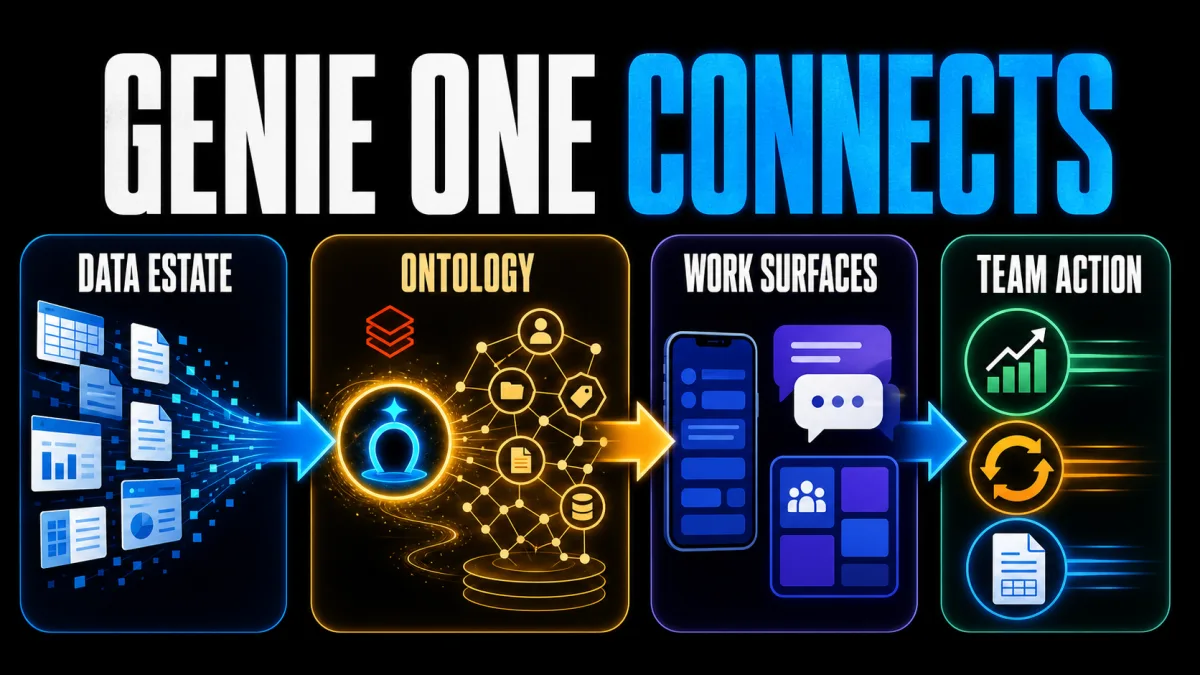
Databricks has launched Genie One as an agentic coworker for turning fragmented business information into answers and workflow actions. The product became generally available after Databricks's Data + AI Summit, alongside Genie Agents and Genie Code, with access through mobile apps, Slack and Microsoft Teams, according to AI Magazine's launch report. For business operators, the important question is whether Genie One's business context layer can make trusted data usable without removing governance.
Definition: Databricks Genie One is an agentic coworker designed to orchestrate workflows across an organisation's structured and unstructured information.
Example: Databricks Genie One lets a sales leader ask for current figures during a CEO meeting, while a marketing team can query which campaigns generated the highest return on investment.
Key takeaway: Genie One's differentiator is the Genie Ontology, which Databricks says connects documents, systems and internal knowledge.
Business impact: The Databricks Genie One launch targets the delay between knowing that data exists and getting a usable answer or action from it.
What did Databricks launch?
Databricks launched Genie One as an agentic coworker for business teams that need to orchestrate work across an entire information estate. The launch story places marketing, finance and sales inside the target audience and says Genie One can work across structured or unstructured data, whether that information sits inside or outside Databricks. The immediate takeaway is to evaluate Genie One as a cross-system work surface, not as a chatbot limited to one dataset.
Genie One reached general availability alongside Genie Agents and Genie Code, extending the launch beyond one product name. The wider suite is available through native iOS and Android apps and inside Slack and Microsoft Teams. For teams assessing adoption, the relevant change is that employees can seek answers within tools they already use rather than being required to move every request into a separate interface.
How does Genie One understand business context?
Databricks says Genie One is powered by the Genie Ontology, a live layer that learns from an organisation's data, systems and internal knowledge. The launch story describes the ontology as a way to understand relationships between documents and systems instead of interpreting prompts or individual files in isolation. The practical test for a buyer is therefore context accuracy: give Genie One a real cross-system question and check whether the answer reflects the organisation's current relationships, not just plausible wording.
Rich Radley, Databricks's EMEA Vice President of Field Engineering, frames the problem as a shift away from model capability alone: “The real challenge now is giving them enough understanding of a business to produce outputs that people can genuinely rely on.” That statement explains the product's intended position, but it is not an independent performance result. Operators should separate Databricks's product claim from the evidence they collect in their own data and workflows.
Which business workflows does Genie One target?
Genie One targets the time employees spend waiting for specialist help to interpret business information. The launch story gives a sales leader who needs current figures during a meeting as one example, and a marketing team asking which campaigns generated the highest ROI as another. The concrete takeaway is to start with questions that already have an authoritative source and a clear business decision behind them, then measure whether Genie One reduces the handoff without weakening review.
The same pattern applies to fragmented information. Databricks argues that employees often switch among dashboards, documents, email and collaboration tools before they can make a decision. Genie One is designed to provide one plain-language point of interaction for finding information, updating a report or automating part of a workflow. Teams should map the systems behind one high-value question before assuming that a single interface removes every underlying data dependency.
Can Genie One widen data access without losing oversight?
Databricks positions Genie One as a way to put trusted data into the hands of non-technical employees while retaining governance and security controls. That balance matters because broader access changes who can discover, interpret and potentially act on company information. It is also a wider AI automation stack question: context, tools, permissions and monitoring still surround the model and interface. The operational takeaway is to test permissions, source freshness and escalation rules together; faster answers are useful only when the organisation can still explain what data informed them and what actions were allowed.
Rich Radley describes this as democratisation with controls rather than unrestricted access. The source's argument is that people who understand the business best should be able to explore data and automate routine tasks without always depending on technical colleagues, while governance scales alongside adoption. That makes Genie One's rollout as much a data-architecture and accountability question as a user-interface launch.
What should operators watch after the launch?
Genie One's launch story points to a broader agentic-AI constraint: an agent is only as useful as the data, systems and governance underneath it. The source does not publish an independent benchmark, a measured ROI result or a detailed list of supported actions for Genie One. Operators should therefore treat the announcement as a product-positioning signal and run a bounded evaluation using one workflow, one authoritative data path, explicit permissions and a human review point.
An evaluation of Databricks Genie One should distinguish three outcomes: an answer that is factually current, an action that is permitted and correctly executed, and a workflow that is measurably faster for the responsible team. Databricks is betting that a live ontology and familiar work surfaces can connect those outcomes. The next evidence will come from how reliably Genie One performs across the messy systems that business teams already depend on.
Frequently asked questions
What is Databricks Genie One?
Databricks Genie One is an agentic coworker designed to help business teams work across an organisation's information estate. The source describes it as a system for orchestrating workflows and automating work-related tasks across structured and unstructured data, whether the information sits inside or outside Databricks. Genie One reached general availability alongside Genie Agents and Genie Code, and the suite is available through native iOS and Android apps as well as Slack and Microsoft Teams.
How is Genie One different from a standard AI assistant?
Genie One is positioned around business context rather than prompt interpretation alone. Databricks describes its Genie Ontology as a live layer that learns from an organisation's data, systems and internal knowledge, then models the relationships between documents and systems. The practical claim is that answers can reflect how a business works instead of treating each prompt or file in isolation. The source does not provide an independent benchmark, so teams should test that claim against their own workflows.
Which business teams can use Genie One?
The launch story names marketing, finance and sales as examples of teams that can use Genie One. A sales leader could retrieve current figures during a CEO meeting, while a marketing team could ask which campaigns produced the highest return on investment. These examples describe faster access to data and analysis without waiting for a specialist, not a promise that every business process becomes fully autonomous.
Where can employees access Genie One?
The Genie One suite is offered through native iOS and Android apps and can be used inside Slack and Microsoft Teams. That means employees can request information from familiar work surfaces rather than switching to a separate application. The source presents this as an access and workflow advantage; it does not specify a complete list of supported integrations or the permissions required for each action.
Why does governance matter for Genie One?
Genie One is intended to widen access to business data, so governance and security must remain in place as more employees use it. Databricks says the system keeps existing governance and security controls while helping teams work with data more directly. For an operator, the useful test is whether access, actions and oversight remain understandable for each workflow before the system is given broader authority.
Alex
Founder & Lead AI Writer
Alex is the founder of Yowox and lead AI writer since 2024, breaking down complex information into clear, actionable insights for thousands of readers every day. Alex has built AI automation systems for businesses since 2024, focusing on AI agents, workflow automation, and business process optimization.
Save hours. Save thousands.
Practical guides, real workflows, and the latest AI and automation news that matters — straight to your inbox.