 By Alex
 ContextFusion: Smarter Context for LLM Apps
ContextFusion is an open-source context compiler that selects, compresses, and formats information for LLM and agent workflows under a token budget.
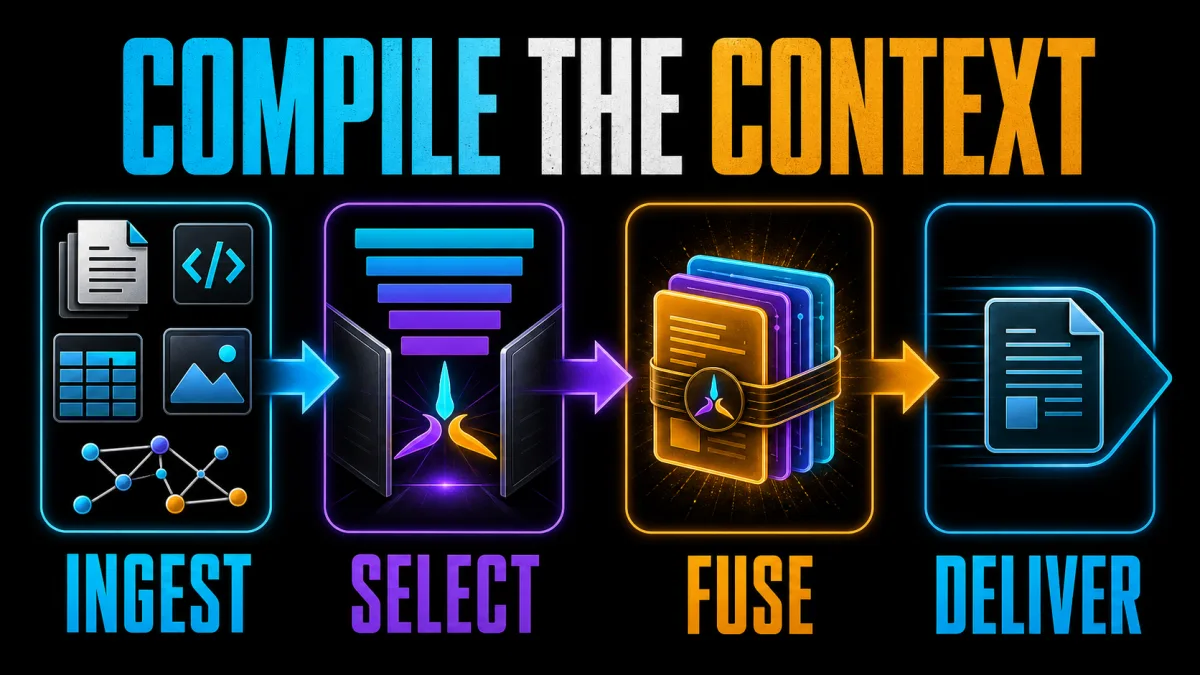
ContextFusion is an open-source context compiler that sits between an LLM application and the model request: it gathers information, chooses useful representations, and assembles a provider-specific context packet under a token budget. A Towards AI report on ContextFusion says the project targets a familiar production problem: prompts grow as applications combine instructions, conversation history, retrieved documents, and tool results.
Definition: ContextFusion is a context-optimization layer for LLM and agent applications that turns mixed sources into budget-constrained, provider-ready context.
Example: A document assistant can pass PDFs, code, spreadsheets, and tool output through one pipeline before sending only the selected representations to a model.
Key takeaway: ContextFusion focuses on deciding what context reaches the model, not merely increasing the model's context window.
Business impact: The project claims that better context selection can reduce token payloads and latency while keeping the answer-quality target unchanged, but those results still need to be checked against a team's own workload.
Why is ContextFusion becoming an application layer?
ContextFusion addresses an application-layer problem that appears when one request combines information with different value, freshness, risk, and cost. ContextFusion's source describes the common failure mode as prompt bloat: a system sends too much history, too many retrieved chunks, or repeated tool output because the application has no explicit selection policy. For teams building AI agents, the practical response is to measure the context sent per task and define what can be omitted, summarized, cached, or retained.
ContextFusion is presented as a response to that problem rather than as another general-purpose chatbot. Its pipeline accepts heterogeneous inputs, normalizes them into ContextBlock objects, prepares compact representations, and assembles a final packet for a model provider. That separation gives developers a place to change context policy without rewriting every prompt template, although the resulting quality still depends on the sources, scoring weights, and application checks around it.
How does ContextFusion choose context under a token budget?
ContextFusion treats context selection as a constrained optimization problem: the planner weighs utility, risk, token cost, latency, cacheability, and diversity while keeping the selected token count within the configured budget. The project's public repository describes a pipeline that ingests sources, normalizes them, precomputes variants, retrieves candidates, reranks them, and then chooses a representation for each block before provider-aware assembly.
The design goes beyond sending the top few semantically similar chunks. ContextFusion's documented flow includes lexical retrieval, fast reranking, deduplication, and task-specific representations such as universal summaries, extractive question-answering context, code signatures, and condensed agent memory. For a business workflow, the useful takeaway is to make the selection criteria visible: a block can be valuable because it is relevant, fresh, trusted, diverse, or cheap to include, not only because it is close to a query embedding.
| Manual prompt assembly | ContextFusion-style assembly |
|---|---|
| Concatenates instructions, history, retrieval, and tools | Normalizes those inputs into structured blocks |
| Often repeats or truncates context by fixed rules | Selects representations under a token budget |
| Prompt format is commonly tied to one provider | Compiles provider-specific payloads |
| Context changes are handled by the application | Delta and cache-aware assembly are explicit features |
Why does ContextFusion's delta fusion matter for AI agents?
Delta fusion addresses repeated context in multi-turn AI agent workflows by tracking what was added, updated, removed, or left unchanged between packets. The source illustrates the cost problem with a ten-turn example in which an agent repeatedly carries a 4,000-token context budget; ContextFusion's proposed answer is to reuse stable material and transmit only the changed portion when the workflow allows it.
In ContextFusion's agent mode, the assembled packet can separate stable content — such as system instructions, citation maps, and cacheable blocks — from dynamic content that changes with the current turn. The application still has to decide what may safely be reused and how a provider interprets cached or referenced material. The concrete operational test is therefore not whether delta fusion exists, but whether it lowers tokens and latency without dropping a fact the agent needs for its next action.
Which integrations does ContextFusion expose?
ContextFusion lists provider adapters for OpenAI, Anthropic, Ollama, and OpenAI-compatible runtimes, plus packers for chat, question answering, code, and agent modes. The repository also documents a command-line interface, a local Web UI for inspecting selected blocks and token statistics, precomputation for offline preparation, an MCP-style server, and wrappers for LangChain and LlamaIndex. These are integration points described by the project; they do not remove the need to test authentication, permissions, citations, and tool behavior in the surrounding application.
ContextFusion's MCP-style server is relevant because it makes the context pipeline callable by an MCP client: the documented endpoints cover ingestion, compilation, context resources, and delta computation. That places ContextFusion alongside the broader Model Context Protocol ecosystem rather than treating context compilation as a private prompt helper. In production, ContextFusion's server would still need the same access controls, validation, logging, and deployment boundaries as any other tool service.
What performance does ContextFusion report?
The Towards AI source reports 60–99% token reduction with identical answer quality and says its benchmarks used Claude Sonnet 4.6 on production-like workloads. That is a project-reported result, not a guarantee for every corpus: teams should reproduce the comparison with their own questions, source permissions, model, and quality tests before treating the percentage as a business case.
ContextFusion's source also reports 50–200 milliseconds of optimization overhead and says the planner can run in under 100 milliseconds for typical workloads when indexing and heuristics are used. The trade-off is straightforward: ContextFusion adds work before inference, while shorter prompts may reduce the model-side payload and latency. A ContextFusion production evaluation should record both sides of that equation — tokens, latency, answer quality, citation behavior, and failure cases — instead of measuring only the optimizer or only the final model response.
How does ContextFusion fit beside RAG?
ContextFusion does not replace RAG; it is described as a layer after retrieval. A RAG system finds candidate evidence, while ContextFusion can select among candidate blocks and representations, account for risk and token cost, preserve citations, and assemble the result for a specific provider. That distinction matters because retrieval quality and context-packing quality are separate failure points: an optimizer cannot recover evidence that retrieval never found.
The same boundary applies to prompt engineering. Prompt engineering improves instructions and wording, while context engineering decides which information is present, how it is represented, and what can be reused across turns. ContextFusion's news value is therefore architectural: it treats context as a managed input with budgets and policies instead of leaving every application to concatenate strings until the model request becomes expensive or noisy.
When should operators consider ContextFusion?
ContextFusion is a plausible fit for multi-provider applications, document-heavy workloads, coding assistants, and long-running agent conversations where the source reports repeated context and token pressure. It may be less useful for a small single-turn question with tiny documents, an existing RAG system whose costs and quality are already acceptable, or a workload that requires sub-100-millisecond streaming behavior because the source reports 50–200 milliseconds of optimization overhead.
The next sensible step is a bounded comparison, not an immediate platform migration. Choose one representative workflow, record the original token count, latency, answer quality, citation behavior, and failure cases, then compare the same questions with ContextFusion enabled. The project's central claim is that context should be compiled before inference; whether that is valuable depends on the evidence from the application's own traffic and evaluation set.
Frequently asked questions
What is ContextFusion?
ContextFusion is an open-source context compiler and optimization layer for language-model and agent applications. It accepts heterogeneous sources such as documents, code, structured data, and images, converts them into a common representation, selects useful content under a token budget, and compiles the result for supported model providers. It is designed to sit between application logic or retrieval and the final model request. The project is not presented as a replacement for a vector database; its role is to decide which available context and representation should reach the model.
Does ContextFusion replace RAG?
No. ContextFusion is described as a layer after retrieval rather than a replacement for retrieval itself. A RAG system can find candidate passages from a knowledge base, while ContextFusion can rank, deduplicate, compress, and format those candidates alongside instructions, memory, or tool results. Teams still need an appropriate retrieval system and should evaluate whether the additional optimization improves their own answers, latency, and cost. The source specifically positions ContextFusion as complementary to systems such as Pinecone, Weaviate, pgvector, and FAISS.
Which model providers does ContextFusion support?
The project lists adapters for OpenAI, Anthropic, Ollama, and OpenAI-compatible runtimes. It also exposes task-oriented packers for chat, question answering, code, and agent workflows. This provider-neutral design means an application can keep one context pipeline while compiling provider-specific request payloads. Support for a provider adapter does not by itself prove that every model feature behaves identically, so teams should test the exact provider, model, context format, and tool-calling path used in production.
When is ContextFusion most useful?
ContextFusion is most useful when an application repeatedly handles large or mixed context: multi-provider deployments, document-heavy workflows, coding assistants, or long-running agent conversations. The source also identifies cost-sensitive workloads and latency requirements as potential fits because the system precomputes representations and can send only changed context in an agent loop. It may be unnecessary for a small single-turn question with tiny documents, or when an existing RAG pipeline already meets its cost and quality targets. The reported optimization overhead is 50–200 milliseconds.
Alex
Founder & Lead AI Writer
Alex is the founder of Yowox and lead AI writer since 2024, breaking down complex information into clear, actionable insights for thousands of readers every day. Alex has built AI automation systems for businesses since 2024, focusing on AI agents, workflow automation, and business process optimization.
Save hours. Save thousands.
Practical guides, real workflows, and the latest AI and automation news that matters — straight to your inbox.