 By Alex
 Gemini 3.8 Flash targets long-horizon coding agents
Google’s Gemini 3.8 Flash targets long-horizon software engineering and autonomous agents at introductory Flash pricing, while Gemini 3.8 Flash Cyber is reserved for trusted defenders.
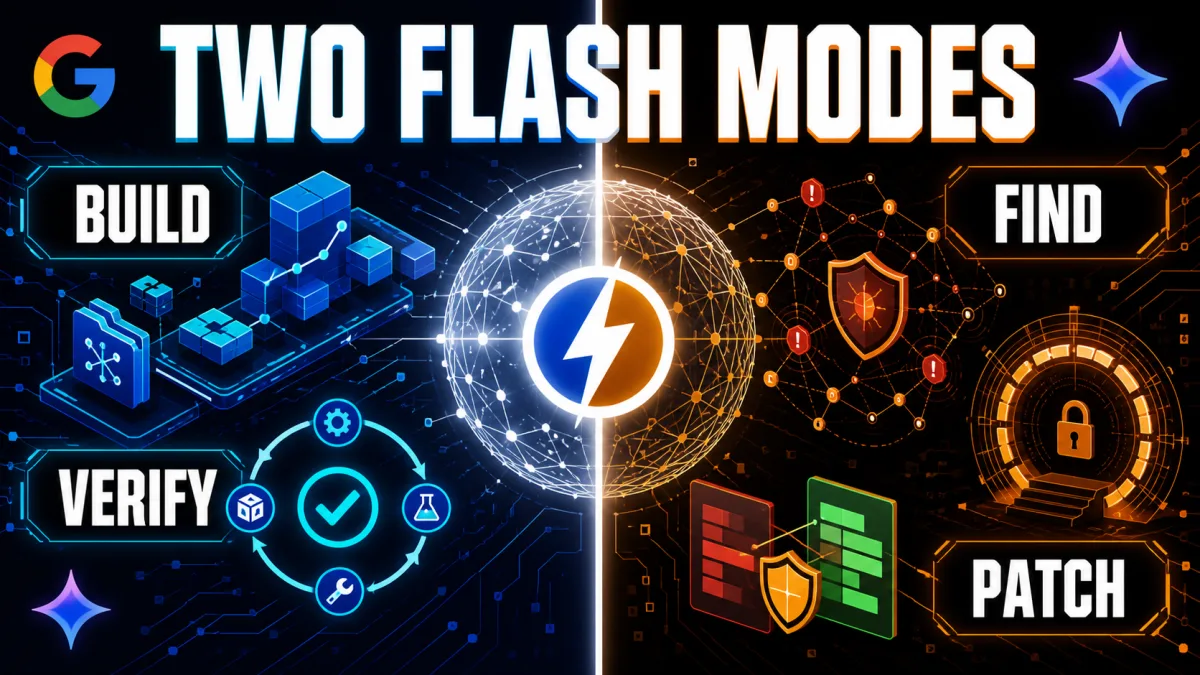
Google has introduced Gemini 3.8 Flash for long-horizon coding and autonomous agents, alongside Gemini 3.8 Flash Cyber for trusted defenders. In its September 2 announcement, Google positions Gemini 3.8 Flash as a more capable workhorse at the same introductory Flash price, while the Cyber variant focuses on vulnerability discovery and patching under controlled access. The practical change is not simply a new model number: Google is targeting agentic systems that can reason, call tools and keep working through a multi-step objective.
Definition: Gemini 3.8 Flash is Google’s general-purpose model for long-horizon software engineering, autonomous agents and complex enterprise workflows; Gemini 3.8 Flash Cyber is its restricted defensive-cyber variant.
Example: Gemini 3.8 Flash is designed for tasks that require iterative reasoning, tool calls and verification instead of one short answer.
Key takeaway: The release makes sustained execution—not only single-turn intelligence—the center of Google’s Flash strategy.
Business impact: Teams can test more capable agentic workflows without immediately moving to a higher-cost model tier, but they still need workflow-level measurements for quality, latency, token use and permissions.
What are the two Gemini 3.8 Flash models?
Gemini 3.8 Flash is the broadly available model for software engineering, autonomous agents and enterprise work, while Gemini 3.8 Flash Cyber is a specialized model for defensive cybersecurity. Google says both variants share the same foundational intelligence and benefit from long-running agentic loops, but they serve different deployment environments. For operators already learning what an AI agent is, the distinction is important: the model is only one part of a system that also includes tools, authorization, state and verification.
| Model | Primary job | Availability | Announced pricing or access |
|---|---|---|---|
| Gemini 3.8 Flash | Coding, autonomous agents and enterprise workflows | Generally available through Google’s developer and enterprise products | $0.75 / 1M input tokens and $3.75 / 1M output tokens through Dec. 31, 2026 |
| Gemini 3.8 Flash Cyber | Vulnerability discovery, patching and defensive research | Trusted defenders through the Fairwind Program | Controlled program access; no general public price stated in the announcement |
Gemini 3.8 Flash is therefore the model most developers can evaluate directly, while Gemini 3.8 Flash Cyber is a governed capability for organizations with a defensive need and the controls to support it. Google’s announcement names Google AI Studio, the Gemini API, Android Studio, Stitch, Gemini Enterprise and consumer Gemini products as access routes for Gemini 3.8 Flash; it separately directs cyber organizations to apply through Fairwind.
Why is Gemini 3.8 Flash built for long-horizon coding?
Gemini 3.8 Flash is built for long-horizon coding because Google says it can take additional reasoning steps, call tools iteratively and refine its work on complex tasks. Google reports that Gemini 3.8 Flash outperforms most larger frontier models on DeepSWE v1.1, a long-horizon software-engineering benchmark, while keeping the introductory price of a Flash model. The result is a vendor-reported benchmark claim, so engineering teams should treat it as a reason to test multi-file tasks rather than as a guarantee for an unfamiliar codebase.
The design choice has a direct cost and latency trade-off. Gemini 3.8 Flash may use more tokens on difficult tasks because it is intended to verify intermediate results and continue working when a first attempt is not enough. Google says developers can lower the model’s effort level when compute efficiency matters, or keep using Gemini 3.7 Flash for efficiency-first workloads. In practice, the right comparison is cost per successful task: a longer run can be worthwhile when it prevents repeated human repair, but wasteful when a short deterministic workflow already works.
The model’s demonstrations show the intended operating style. Google presents a 3D game built with a looping instruction in Google Antigravity, a playable DOS version of Google Maps made in one prompt, a topographic visualization using U.S. Geological Survey data, and a Three.js hardware visualizer created in Google AI Studio. These examples show the breadth of tasks Google wants Gemini 3.8 Flash to handle; they do not independently establish production reliability, security or the amount of human intervention behind each demonstration.
What does Gemini 3.8 Flash add for enterprise agents?
Gemini 3.8 Flash targets enterprise agents by combining deeper reasoning with tunable execution effort, a large context window and built-in tool support. Google’s Gemini API documentation lists a 1-million-token context window, a maximum output of 64,000 tokens, low, medium and high thinking levels, and general availability for production use. For a business, those controls make it possible to use one model family across fast responses, complex code analysis and longer-running orchestration—provided each workflow has its own budget and success test.
Google says Gemini 3.8 Flash improves on Gemini 3.7 Flash in specialized domains including finance and legal work, and reports a 54.9% score on HLE-Verified. Those figures are useful signals about the intended scope of the model, but benchmark labels do not define a company’s acceptance criteria. An enterprise agent should still be tested on the organization’s documents, data quality, tool permissions, escalation rules and factual error costs.
The pricing is attractive for teams experimenting with agentic workflows, but token pricing is not the same as workflow economics. The introductory Gemini 3.8 Flash rate is $0.75 per million input tokens and $3.75 per million output tokens until December 31, 2026, after which Google’s developer documentation lists $1.50 and $7.50 respectively. Because the model may reason longer and call tools repeatedly, operators should record tokens, retries, tool calls, latency and human rework for each completed task.
How capable is Gemini 3.8 Flash Cyber?
Gemini 3.8 Flash Cyber is designed to find vulnerabilities and help defenders patch them, with Google reporting frontier-level results on both discovery and remediation tasks. On CyberGym, Google says the model surpasses Gemini 3.5 Flash Cyber and larger frontier models; on an internal benchmark spanning 20 programming languages, Google reports a vulnerability-discovery success rate above 70%. Those are Google’s reported evaluations, so a security organization should reproduce the relevant test on authorized repositories before granting the model access to operational systems.
Patching is a separate capability from finding a weakness. Google reports a 47.2% pass@1 result for Gemini 3.8 Flash Cyber on CWE-Bench, close to a leading frontier model at 47.8% but at significantly lower cost. A patching agent still needs compilation, tests, security review and rollback around it: a plausible diff is not proof that the vulnerability is fixed without introducing a new failure.
Google also describes early use inside its own security work. The company says Chrome’s security team saw 2.6 times more correct vulnerability patches than with the best commercial models it compared, Wiz saw 7.5–9.7% higher recall at 2.3–5.2 times lower cost on an internal penetration-testing benchmark, and Google Cloud Vulnerability Research found a critical foundational vulnerability in less than two hours. These examples indicate the kinds of operational outcomes Google is pursuing, but they are company-reported results with limited public methodological detail in the announcement.
Who can use Gemini 3.8 Flash Cyber?
Gemini 3.8 Flash Cyber is not presented as a general-purpose public model; Google makes it available to trusted defenders through the Fairwind Program. Fairwind prioritizes governments, critical-infrastructure operators and core technology platforms, and Google says applicants are vetted for ethical operations and security history. The program’s stated purpose is to give defenders early access to advanced capabilities before new threats arrive, not to distribute an unrestricted offensive tool.
The access model reflects the dual-use risk of cybersecurity AI. Fairwind requires controls such as user-level authentication, phishing-resistant multi-factor authentication, applicable access restrictions and employee-use tracking, while limiting access to internal cybersecurity, incident-response or penetration-testing teams. Google also says permitted work includes authorized threat simulation, reverse engineering and malware analysis for defensive or academic research, while malicious tasks such as malware creation are not permitted.
Google’s broader safety position matters for Gemini 3.8 Flash as well. The announcement says the models ship with safeguards for cyber offense and CBRN misuse, and reports an improvement in prompt-injection robustness measured by Gray Swan. These safeguards reduce risk but do not replace application-level controls: an agent connected to source code, secrets or production infrastructure still needs least-privilege credentials, a clear approval boundary and an audit log.
What should operators test before rollout?
Start with a bounded workflow, not a general “autonomous employee.” Gemini 3.8 Flash is intended for multi-step work, but the evidence Google publishes is benchmark- and demonstration-based. Choose one reversible task, define success before testing, cap spend and latency, and compare the model with Gemini 3.7 Flash, a simpler model or deterministic automation. This approach measures whether extra reasoning produces a useful business result rather than rewarding a more impressive demo.
Measure the loop, not only the answer. Gemini 3.8 Flash may call tools repeatedly and spend more tokens on difficult work, so evaluation should include completion rate, retries, tool-call errors, time to completion, token cost and human correction. A workflow that produces a strong final answer after five failed tool calls may still be worse than a simpler workflow that succeeds predictably in one pass.
Keep authority narrower than capability. Gemini 3.8 Flash Cyber’s Fairwind controls illustrate the principle: sensitive cyber capabilities require vetted users, authentication, monitoring and permitted defensive purposes. The same logic applies to ordinary enterprise agents. Let Gemini 3.8 Flash analyze, draft or propose before allowing it to send, change or delete; require explicit approval for irreversible actions and preserve a human escalation path for ambiguous cases.
What remains uncertain about Gemini 3.8 Flash?
Gemini 3.8 Flash is a significant product release, but the announcement does not establish a universal error rate, independent replication of every benchmark, or reliability across every tool ecosystem and business domain. Google provides strong performance claims and product specifications, while the developer documentation provides API details; neither source can substitute for a company’s own test set and operational controls.
The clearest signal is strategic: Google is making sustained agentic execution a core model property and offering a lower-cost Flash variant for that work, while separating higher-risk cyber capabilities behind a trusted-defender program. Businesses should watch the cost per completed task, the quality of verification and the boundary between model reasoning and real-world authority. Those measurements will decide whether Gemini 3.8 Flash is a useful component of an AI automation stack or simply a more capable model waiting for a well-designed workflow.
Frequently asked questions
What is Gemini 3.8 Flash?
Gemini 3.8 Flash is Google’s newest general-purpose Flash model, designed for long-horizon software engineering, autonomous agents and complex enterprise workflows. Google describes it as its most intelligent Flash model and says it is generally available through the Gemini API. The model supports a 1-million-token context window, up to 64,000 output tokens and adjustable thinking levels. Those specifications describe the product’s current interface; teams still need to test reliability, latency and cost on their own tasks before treating the model as a production default.
How much does Gemini 3.8 Flash cost?
Gemini 3.8 Flash has an introductory price of $0.75 per million input tokens and $3.75 per million output tokens through December 31, 2026, according to Google’s developer documentation. Google says standard pricing of $1.50 per million input tokens and $7.50 per million output tokens starts on January 1, 2027. Actual workflow cost can be higher than the headline rate because complex tasks may use more reasoning tokens and make repeated tool calls. A business should measure cost per completed workflow, not just cost per API token.
What is Gemini 3.8 Flash Cyber?
Gemini 3.8 Flash Cyber is a cybersecurity-focused variant for vulnerability discovery, automated patching and defensive research. Google says it is available to trusted defenders through the Fairwind Program rather than as ordinary unrestricted model access. The program is intended for governments, critical-infrastructure operators, technology platforms and other vetted partners, with controls around authentication, access, monitoring and permitted defensive work. The model’s benchmark results are vendor-reported, so security teams should validate them against authorized internal code and clearly defined human-approval boundaries.
Should a company move every AI workflow to Gemini 3.8 Flash?
No. Gemini 3.8 Flash is aimed at difficult, multi-step work, but Google explicitly says developers can lower the thinking effort for latency-sensitive tasks or continue using Gemini 3.7 Flash for efficiency-first workloads. A sensible migration test uses one reversible workflow, a fixed evaluation set, explicit tool permissions, a spending limit and an independent verifier. Compare the new model with the existing model and with deterministic automation. Move more work only if the measured quality improvement justifies the extra tokens, latency and operational complexity.
Alex
Founder & Lead AI Writer
Alex is the founder of Yowox and lead AI writer since 2024, breaking down complex information into clear, actionable insights for thousands of readers every day. Alex has built AI automation systems for businesses since 2024, focusing on AI agents, workflow automation, and business process optimization.
Save hours. Save thousands.
Practical guides, real workflows, and the latest AI and automation news that matters — straight to your inbox.