 By Alex
 Context Engineering vs Prompt Engineering: Harness Wins
Prompt engineering is not disappearing: context engineering contains it, while harness engineering determines whether an AI agent can execute, verify and recover.
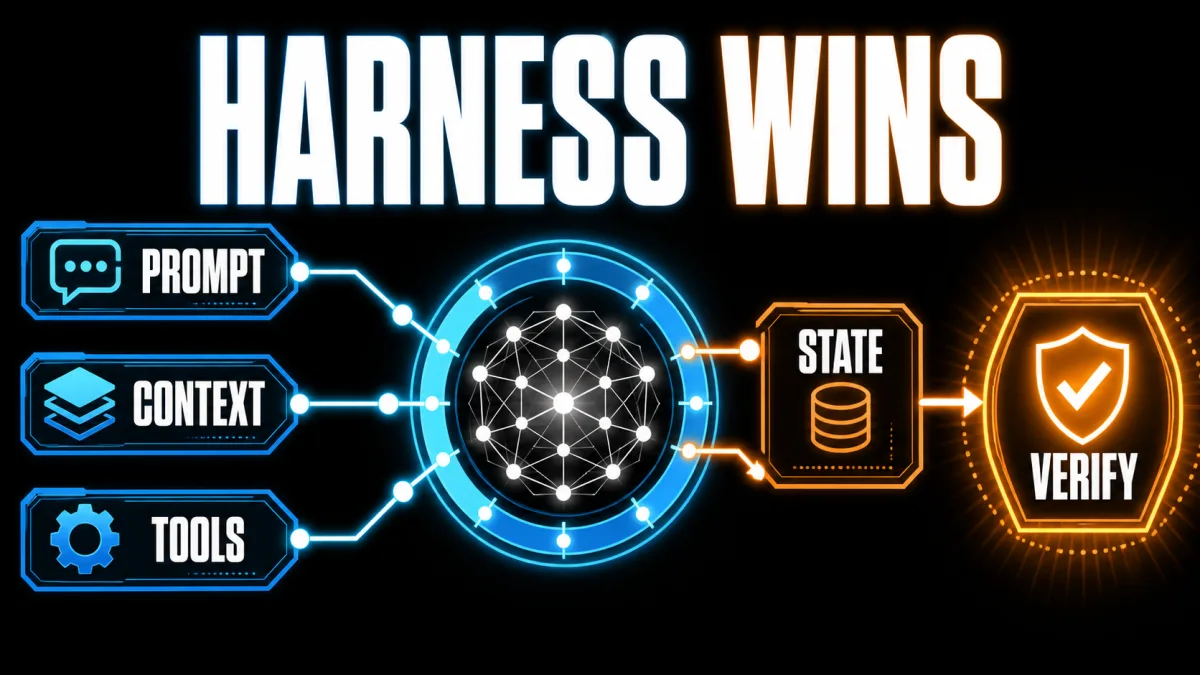
The practical winner in the prompt-versus-context debate is not context engineering alone: it is the harness around the model. Prompt engineering still controls the instruction, context engineering controls the information entering the model, and harness engineering controls execution, verification and recovery. A recent Towards AI analysis argues that the industry is asking a three-layer systems question as if it were a two-way contest.
Definition: Prompt engineering shapes one instruction; context engineering curates the model's changing input; harness engineering designs the execution system around model calls.
Example: A coding agent may receive a concise task prompt, retrieve only the relevant files, run tools in a sandbox and verify the patch before it stops.
Key takeaway: Context is essential for agent reliability, but the harness decides how context is delivered and whether work is checked.
Business impact: Teams that optimize only prompts or retrieval can miss the tool failures, missing state and unverified actions that prevent an AI system from completing real work.
What changed from prompt engineering to context engineering?
Prompt engineering focuses on the wording and structure of an instruction, while context engineering manages the full set of tokens available at inference time. The distinction became prominent after Andrej Karpathy described context engineering as the work of filling a model's context window with the right information for the next step. For a single-turn classifier, the prompt may be most of the input; for a multi-step agent, the system also has to manage tools, state, history, retrieved data and compaction.
Anthropic describes context engineering as the natural progression of prompt engineering rather than its replacement. Anthropic separates the discrete task of writing a prompt from the iterative task of deciding what to pass to the model on each turn. The practical takeaway is to keep prompt design inside the larger context-management problem instead of treating the two disciplines as rival job titles.
| Layer | Main question | Typical engineering work | Failure it addresses |
|---|---|---|---|
| Prompt engineering | What should the model be told? | Instructions, examples and output constraints | Ambiguous or inconsistent responses |
| Context engineering | What should the model see now? | Retrieval, memory, history, compression and tool-result selection | Missing, stale or distracting information |
| Harness engineering | How should the system operate? | Orchestration, tools, state, retries, sandboxes and verification | Early stopping, unhandled failures and untrusted completion |
Why context still matters for agent reliability
Context engineering remains a core reliability discipline because model performance can decline as input length grows. Chroma's context-rot study evaluated 18 language models under controlled long-context tasks and reported non-uniform performance degradation as more tokens were added. The study also stresses that common needle-in-a-haystack tests measure a narrow retrieval capability, not the full reasoning burden of real applications. The action for an AI team is concrete: treat context as a finite resource, measure distractors and keep only information that helps the current step.
A longer context window is capacity, not a guarantee that the model will use every token well. Chroma's experiments varied input length while holding the basic task structure controlled, and the results differed by model and task condition. That evidence does not prove that every extra token is harmful, but it does rule out a simple “more context is always better” assumption. Retrieval ranking, context compression, just-in-time loading and durable notes are engineering decisions, not optional polish for long-running agents.
Why harness engineering is the surprise layer
Harness engineering can change agent outcomes without changing the underlying model. The source article reports LangChain moving its deepagents coding system from 30th place to 5th place on Terminal-Bench 2.0 without changing the underlying model; the reported changes included system prompts, tools, middleware, tracing, time budgeting and a self-verification loop. LangChain's experiment report documents the underlying experiment and presents the result as evidence that the execution system around a model is an important optimization surface, not merely plumbing.
A harness can also change how a model behaves near its operational limits. Cognition reported that Claude Sonnet 4.5 sometimes became more decisive and prematurely wrapped up work as it approached its context limit, a behavior the company called “context anxiety.” In Cognition's report on rebuilding Devin, the team says that enabling a 1-million-token beta while capping actual usage at 200,000 tokens reduced the behavior in its testing. This is a harness-level intervention: the retrieved documents and task prompt were not the main variable; the surrounding context budget and execution policy were.
Verification is a harness capability because a model cannot independently prove that its plausible answer is correct. LangChain's report describes a build-and-verify loop in which the agent plans, implements, runs tests, reads the results and fixes failures before completion. The Terminal-Bench 2.0 leaderboard is a public, time-sensitive record of agent results, but the important engineering lesson is broader than any one rank: benchmark performance depends on the model-and-harness combination being evaluated.
Does harness engineering replace context engineering?
Harness engineering does not replace context engineering; it is the layer that delivers and governs it. A harness decides when to retrieve information, how to expose tools, where to store durable state, when to compress history and what evidence must exist before completion. The Towards AI source's LangChain example shows why this boundary matters: the reported improvement came from changing the surrounding execution system while leaving the underlying model unchanged. Context engineering supplies the information choices, while prompt engineering supplies instructions inside those choices, so teams should trace one task through retrieval, tool dispatch, state and verification before adding more retrieval complexity. Removing any one layer leaves a different class of failure untreated.
The relationship is easiest to see in an AI automation stack. Context is one layer, but an operational system also needs orchestration, integrations, permissions, guardrails and monitoring. A well-ranked document cannot compensate for a broken API retry policy, and a strong retry loop cannot recover information that was never retrieved or preserved. This is also why engineering bounded loops around AI agents matters: the system needs explicit triggers, state, verification and stop conditions beyond the prompt itself.
What should AI engineers audit next?
AI engineering teams should diagnose failures by layer instead of rewriting prompts by reflex. When an agent cites the wrong document, inspect retrieval, ranking and context compression. When it misunderstands the task, inspect the instruction, examples and output contract. When it chooses a sensible action but fails to complete the workflow, inspect tools, state, sandboxing, retries and verification. The three-layer diagnosis turns a vague “model quality” problem into a testable engineering backlog.
A useful audit has three questions. First, can the system identify and load the minimum information required for the current step? Second, can the model understand the task and produce a structured, checkable result? Third, can the harness execute the next action, observe its outcome and stop only when an independent check passes? The answers point to context, prompt or harness work respectively; teams should resist making all three layers more complex at once.
The claim still needs calibration
The evidence supports a stack, not a universal ranking in which harness engineering always beats context engineering. Anthropic's guidance makes context curation central to capable agents, Chroma documents context-length degradation, Cognition reports a model-specific behavior in Devin, and LangChain reports gains from its own harness experiments. Those sources establish important engineering patterns, but they do not constitute one controlled comparison of prompt, context and harness changes across every model and workload.
The strongest conclusion is therefore narrower and more useful: prompt engineering remains necessary, context engineering makes the model's information supply usable, and harness engineering determines whether the full system can act and verify work. The surprise is not that one discipline has died. It is that production reliability is increasingly decided outside the single prompt—and outside the context window too.
Frequently asked questions
Is prompt engineering obsolete?
No. Prompt engineering still defines the instructions, examples and output constraints that guide a model. Context engineering adds the broader job of selecting and maintaining the information available at inference time, while harness engineering adds the execution loop, tools, state, verification and safety boundaries around the model. A production agent still needs clear prompts; it simply cannot depend on prompt wording alone to manage a long, tool-using task.
What is the difference between context engineering and harness engineering?
Context engineering manages what the model sees: instructions, tools, retrieved data, history, memory and other tokens in the context window. Harness engineering manages how the agent operates: tool execution, state, sandboxing, retries, verification, orchestration and stopping rules. The two overlap because a harness delivers context, but they answer different questions. Context asks whether the model receives the right information; a harness asks whether the surrounding system helps the model complete and verify the job.
Why does context quality matter for AI agents?
Context quality matters because longer input does not guarantee better model performance. Chroma's context-rot study evaluated 18 language models and found that performance often degraded as input length increased, with model-specific and non-uniform patterns. For an agent, this means retrieved documents, conversation history and tool outputs should be selected, compressed or offloaded instead of accumulated indiscriminately. A smaller, higher-signal context can be more useful than a larger one.
What should an AI engineering team improve first?
An AI engineering team should first define the task and its acceptance test, then inspect failures across the prompt, context and harness layers. Improve context selection when the model lacks relevant information; improve prompts when instructions or examples are unclear; improve the harness when failures involve tools, state, retries, verification or premature stopping. This staged diagnosis is safer than assuming every failure requires a longer prompt or a more elaborate retrieval pipeline.
Alex
Founder & Lead AI Writer
Alex is the founder of Yowox and lead AI writer since 2024, breaking down complex information into clear, actionable insights for thousands of readers every day. Alex has built AI automation systems for businesses since 2024, focusing on AI agents, workflow automation, and business process optimization.
Save hours. Save thousands.
Practical guides, real workflows, and the latest AI and automation news that matters — straight to your inbox.