 By Alex
 Cloudflare AI Payment Stack: Identity and Spending Limits
Cloudflare is combining agent identity, stablecoin wallets and web-traffic controls to make autonomous payments more bounded and easier for merchants to verify.
Cloudflare is building a bounded payment layer for AI agents, combining optional identity with wallet controls rather than treating autonomous purchasing as an unrestricted handoff of money. The move matters because AI Magazine reports that merchants still need confidence that an agent is authenticated and acting within delegated permissions. The business implication is clear: evaluate the identity, authorization and payment layers separately before letting an agent buy anything important.
Definition: Cloudflare's agent-payment stack links optional agent identity with account-controlled wallet permissions and web-traffic verification.
Example: A business could give an AI agent a Virtual Wallet with a limited allowance and a transaction ceiling, while a merchant checks the agent's declared identity and signed request.
Key takeaway: Autonomous payment is safer when identity proves who is calling and wallet policy limits what the caller can spend.
Business impact: Operators can test machine-to-machine commerce with narrower financial exposure than an agent holding broad account access.
Why is Cloudflare targeting agentic payments now?
Cloudflare's announcement targets a practical bottleneck in agent adoption: AI agents can find it difficult to register for APIs, add payment methods and generate credentials through interfaces designed for humans. The source story connects that bottleneck to merchant trust, citing PSE Consulting's Andrew O'Connor on the need for shared standards for identity, authentication, delegated authority and accountability. For operators, the takeaway is to treat payment enablement as an infrastructure problem, not merely a model-capability problem.
The timing also reflects a wider shift from experiments toward implementation. AI Magazine cites Visa's Trusted Agent Protocol, Mastercard's Agent Pay and Google's Agent Payments Protocol as parallel industry efforts, while also reporting a PYMNTS projection of a US$1.7 trillion agentic-commerce sector. That projection is a market estimate, not a guarantee of adoption; businesses should use the competitive activity as a reason to define controls and evidence requirements now.
How do Cloudflare Wallets limit agent spending?
Cloudflare Wallets separates human funding from agent spending through Account Wallets and Virtual Wallets, according to Cloudflare's Wallets announcement. Account Wallets hold the owner's funds and delegate spend, while Virtual Wallets operate through agent-facing credentials with permissions set by the owner. The practical design is to give each workflow the smallest budget and scope that can complete its job.
Cloudflare says wallet owners will be able to define an allowance, an allow list and a maximum transaction size for Virtual Wallets. Those controls create three different policy questions: how much the agent may spend over time, which services it may call and how large one payment may be. An operator should set all three explicitly, record the reason for each limit and route over-limit requests to a human rather than silently increasing access.
Stablecoin micropayments are part of the proposed operating model. Cloudflare says Wallets will support buying APIs, MCP Tools, content and other services, while its x402-compatible payment approach attaches payment information to web requests. The useful business test is not whether an agent can make a payment once; it is whether the payment, service result, budget consumption and exception path can all be logged and reconciled.
What does cloudflare.pay contribute?
cloudflare.pay adds an optional, human-readable handle to the payment relationship. Cloudflare describes the handle as a way for an agent to identify itself as a delegate of an account, so a merchant could see a persistent name such as a research-agent subdomain instead of only an opaque request. The takeaway for merchants is to use declared identity as one signal in a wider risk policy, not as an automatic approval.
Identity and authorization solve different problems in an agent transaction. A handle can help answer "which account or organization does this agent claim to represent?" A wallet policy answers "which services, amounts and actions may this agent use?" Cloudflare's design is useful precisely because it puts those questions beside each other; operators should still require request logs, spending alerts and a clear escalation path for anomalies. See also Vint Cerf backs DNSid, an identity layer for AI agents.
How does Web Bot Auth strengthen verification?
Cloudflare's Web Bot Auth documentation describes an authentication method that uses cryptographic signatures in HTTP messages to verify automated requests. A bot generates a signing key, publishes a public key through a directory and includes signature metadata in its requests. For a merchant or site owner, the concrete benefit is request-level evidence that the caller is the registered automated client.
Web Bot Auth is an identity check, not a payment authorization engine. A valid signature can show that a known automated client made the request, but it does not establish that the requested purchase is within budget or that the merchant must fulfill it. Businesses should combine signature verification with allow lists, transaction limits, rate controls and post-transaction logs before treating an agent as a trusted buyer.
Where does AI Crawl Control fit?
Cloudflare AI Crawl Control addresses the seller and publisher side of machine-driven traffic. Cloudflare says the service can show which AI services access a site, apply granular allow or block policies, monitor robots.txt compliance and explore pay-per-crawl options. The business takeaway is that an organization can decide how automated systems access content instead of treating every crawler as an indistinguishable visitor. Background: Cloudflare Kitesurf cuts browser memory by up to 7x.
AI Crawl Control is related to agent commerce because access itself can become a paid, permissioned transaction. A publisher may want to allow one class of AI service, block another and require payment for a third; the control plane must therefore sit alongside identity and payment rails. Owners should document which content is available to which automated clients and verify that crawler policy, merchant policy and payment records tell the same story.
What remains unresolved for autonomous AI payments?
Trust remains the central unresolved issue. AI Magazine quotes Andrew O'Connor saying that merchants need confidence an agent is authenticated and acting within delegated consumer permissions, while also pointing to fraud and regulatory-compliance concerns. The practical response is to keep high-impact purchases behind explicit ceilings, review exceptions and preserve enough evidence to explain what the agent attempted.
Standards are still developing across identity, delegated authority and accountability. Cloudflare's Wallets announcement presents several capabilities in future-oriented terms, and Web Bot Auth itself is documented around evolving protocol drafts. Businesses should therefore start with low-value, reversible transactions, test failure handling and avoid treating an emerging protocol or product announcement as a complete compliance program.
What should business operators do next?
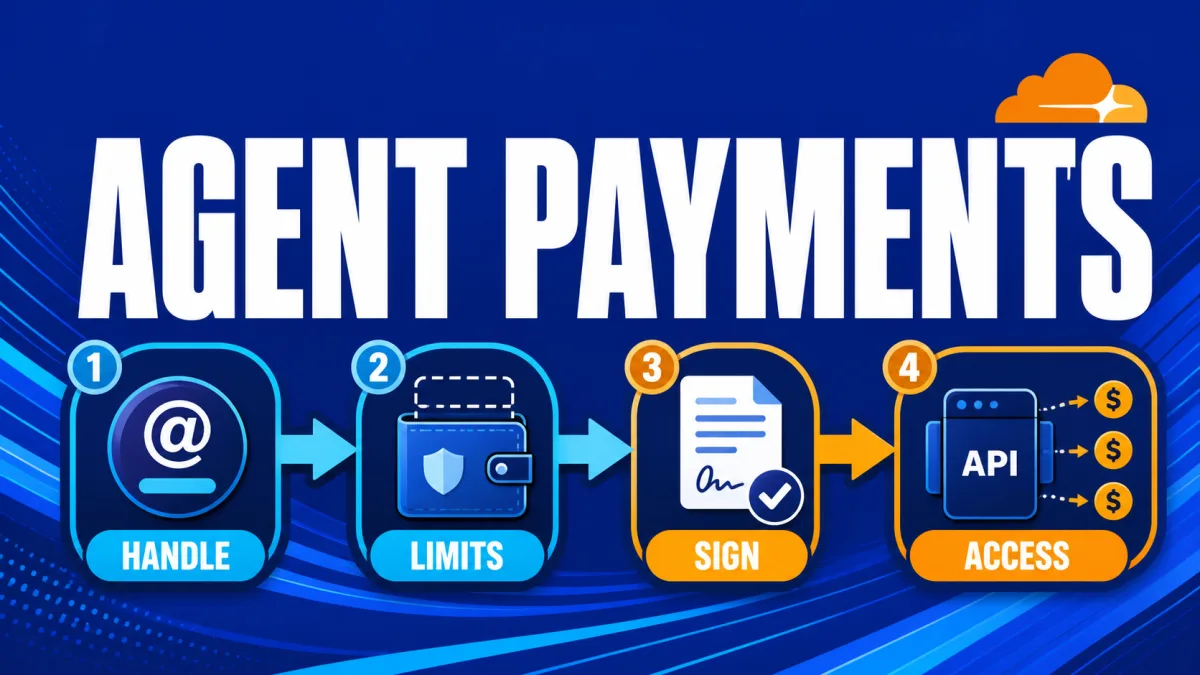
Business operators evaluating autonomous payments should begin with one narrow workflow, one approved service list and a small transaction ceiling. Cloudflare's Wallets, cloudflare.pay, Web Bot Auth and AI Crawl Control point to four separate controls: money, identity, request verification and access policy. The safest next step is to map each control to an owner, an audit record and an escalation rule before expanding the agent's permissions.
The broader lesson is that autonomous commerce depends less on an agent's ability to click "buy" than on the infrastructure around that action. Cloudflare is assembling pieces that can make machine-to-machine transactions more identifiable and bounded, but merchants still decide what evidence is sufficient and what risk they will accept. A staged rollout with measurable limits is more defensible than unrestricted autonomy presented as a security feature.
Frequently asked questions
What is Cloudflare Wallets designed to do?
Cloudflare Wallets is designed to give AI agents a way to pay for APIs, content and other online services through stablecoin-enabled wallets. Cloudflare describes Account Wallets as the human-controlled funding layer and Virtual Wallets as the agent-facing layer. The owner can set an allowance, an allow list and a maximum transaction size, so an agent can act without receiving unrestricted access to the account balance. The practical use is machine-to-machine commerce with a defined spending boundary rather than a payment card copied into an agent prompt.
How does cloudflare.pay help identify AI agents?
cloudflare.pay gives a Cloudflare Wallet a human-readable handle that an agent can optionally use when interacting with merchants. Cloudflare says the handle can connect the agent to a Cloudflare account and make the agent's delegated relationship easier to understand. The identity is not a guarantee that an agent is safe, and Cloudflare leaves it to businesses whether to prioritize agents that identify themselves. It is therefore an attribution layer that can complement authentication and authorization, not a replacement for either one.
What does Web Bot Auth add to autonomous commerce?
Web Bot Auth adds cryptographic verification to automated web requests. An agent or bot signs requests with a key, publishes the corresponding public key through a directory and sends the signature metadata with the request. Cloudflare can then verify that the request came from the registered automated client. This helps a merchant distinguish a signed agent request from anonymous automation, but it does not by itself decide what the agent may buy or how much it may spend. Those decisions still require explicit policy and payment controls.
Are Cloudflare's agent-payment tools fully autonomous today?
The source story describes Cloudflare's tools as an implementation path, not proof that autonomous commerce has solved trust, compliance or fraud. Cloudflare's own Wallets announcement uses future-oriented language for several capabilities, including paying for APIs and content and creating Virtual Wallets. Businesses should therefore treat the tools as emerging infrastructure: test identity, permissions, payment limits and audit behavior in a controlled workflow before allowing an agent to transact at scale.
Alex
Founder & Lead AI Writer
Alex is the founder of Yowox and lead AI writer since 2024, breaking down complex information into clear, actionable insights for thousands of readers every day. Alex has built AI automation systems for businesses since 2024, focusing on AI agents, workflow automation, and business process optimization.
Save hours. Save thousands.
Practical guides, real workflows, and the latest AI and automation news that matters — straight to your inbox.