 By Alex
 A six-line fix for Claude Code's unnoticed mistakes
Anthropic’s Claude Opus 4.8 update makes a revealing promise: fewer of its own coding mistakes pass unnoticed. The practical fix is not blind trust in a stronger model, but a fresh, read-only verification context.
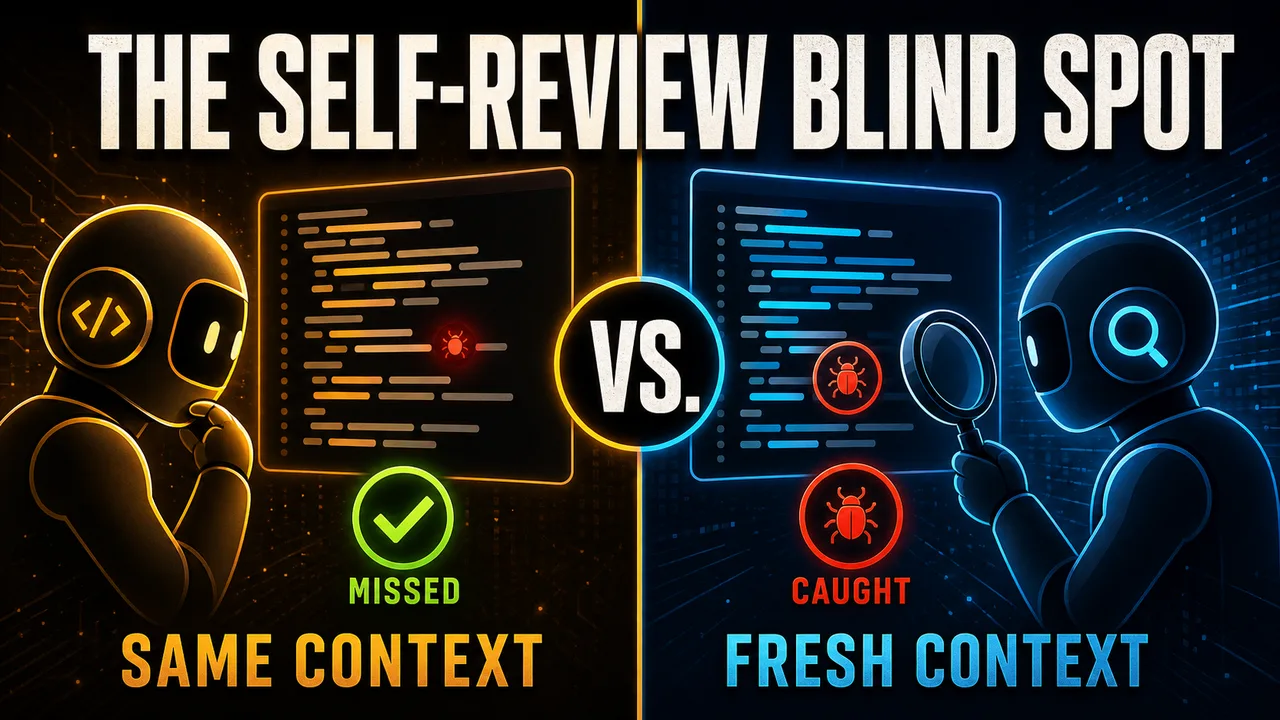
Definition: Same-context self-review is when a coding agent evaluates changes using the conversation and assumptions that produced those changes.
Example: Claude reports that a patch is complete, but the same hidden assumption that caused the defect also shapes its review.
Key takeaway: A fresh read-only verifier can challenge the authoring context instead of repeating it.
Business impact: Separating implementation from verification can reduce silent defects without requiring a new model or a large review platform.
Anthropic’s announcement about Claude Opus 4.8 contains an uncomfortable kind of progress report. According to the Towards AI story, Opus 4.8 is around four times less likely than its predecessor to let flaws in code it wrote pass without comment.
That is good news for coding agents. It is also an admission that “the agent wrote it, the agent ran the tests, the agent said done” is not the same as independent review. A lower escape rate is not an escape rate of zero.
The six-line fix in the story is valuable because it points at the real variable: review context. The goal is not to make the author agent repeat its own conclusion more confidently. The goal is to make another model inspect the resulting artifact without inheriting the author’s entire narrative.
The weakness is not simply model intelligence
A coding agent does more than generate a patch. It builds a working explanation of the repository, chooses an implementation, runs tools, interprets test output and decides whether the task is complete. That accumulated context is useful for implementation. It can become a liability during self-review. See also How to get more coding productivity with LLMs.
The authoring session knows why a line was added. It has already resolved ambiguities in one direction. It may interpret a failing edge case as outside scope because that interpretation helped the patch pass the original task. When the same session reviews the diff, it is not starting from the code. It is starting from a story about the code.
That creates a familiar human failure mode in an automated loop: confirmation bias without a second set of eyes.
What Anthropic’s “four times less likely” actually says
The claim is about relative likelihood, not guaranteed correctness. If one model allows a class of self-written flaws through less often than its predecessor, the improvement matters. But the remaining failures still matter when the code touches payments, permissions, customer data, infrastructure or production deployment.
The safe interpretation is therefore:
| Claim | What it means | What it does not mean |
|---|---|---|
| Fewer flaws pass unremarked | The model’s coding and self-checking behavior improved | Every defect will be found |
| Four-times-lower likelihood | A relative reduction against a predecessor | A four-times-higher guarantee of safety |
| Better coding model | A stronger author and reviewer in some workloads | An independent reviewer with no shared assumptions |
| Six-line fix | A small integration can create a second review context | Six lines replace tests, permissions or human approval |
This distinction is the part worth carrying into production. Model quality helps. Context independence addresses a different failure mode.
The fix: separate authoring from verification
The practical pattern has two phases:
- Author: let the primary agent inspect the repository, edit files and run the task’s normal checks.
- Verify: start a separate reviewer with a narrow prompt, the final diff and read-only tools. Ask it to look for defects, missing tests, unsafe assumptions and scope violations.
The verifier should not receive a flattering summary such as “I implemented the fix correctly.” It should receive evidence: the diff, the files that changed, the relevant tests and the acceptance criteria. The question should be closer to “What is wrong or unproven here?” than “Does this look good?”
Claude Code’s subagent documentation describes the underlying mechanism: a subagent runs in its own context window with its own system prompt, tool access and permissions, then returns results to the parent. The built-in Explore and Plan subagents are explicitly read-only, and custom subagents can use focused prompts and tool restrictions.
That is the important architectural move. The verifier is not merely another turn in the original conversation. It is a fresh inspection boundary.
Why read-only is part of the design
A reviewer that can edit the repository can blur the evidence. It may fix a problem before reporting it, change a test to match its interpretation or leave the worktree in a state that no longer matches the reviewed diff.
Read-only verification creates a cleaner contract:
- the author owns implementation;
- the verifier owns findings;
- the diff remains the object under inspection;
- a human or controlled follow-up step decides whether to change it.
Read-only does not mean powerless. A verifier can search the repository, inspect configuration, read tests, trace call paths and reason about edge cases. It simply returns observations instead of mutating the subject.
What a useful verifier should receive
A fresh context is only useful when it receives enough evidence to do its job. A minimal review packet contains:
- the exact final diff;
- the task or acceptance criteria;
- files directly changed by the patch;
- relevant tests and their output;
- repository instructions that apply to the changed code;
- explicit instructions to report uncertainty rather than approve by default.
The packet should not contain the whole authoring transcript unless the transcript itself is the object of review. Too much inherited narrative recreates the same anchoring problem the second context is meant to avoid.
A practical review request can ask for three outputs: confirmed defects, plausible risks that need a test, and areas the verifier could not establish from read-only evidence. That structure is more useful than a binary “LGTM.”
Where the six-line idea is enough—and where it is not
A small hook or wrapper can launch the verifier after an implementation task. That is enough to make independent review habitual. It is not enough to define a complete software assurance program.
The pattern does not replace:
- unit, integration and end-to-end tests;
- dependency and security scanning;
- type checking and static analysis;
- protected branches and required human approvals;
- sandboxing and least-privilege credentials;
- rollback and observability for production changes.
It also does not guarantee that the verifier is right. The second model can misunderstand the requirement, miss a defect or raise a false alarm. The benefit comes from diversity of context and an explicit challenge, not from assuming that two model calls equal truth.
The operational trade-off is small but real
Independent verification adds latency and model cost. For a one-line typo, a second agent may cost more than the risk justifies. For an authentication change, data migration or destructive automation, the extra review is cheap compared with the recovery path.
A useful policy is risk-based:
| Change type | Fresh verifier | Human gate |
|---|---|---|
| Formatting or obvious text edit | Optional | Usually unnecessary |
| Business logic or API behavior | Recommended | Team-dependent |
| Authentication, permissions or payments | Required | Required |
| Data deletion or production infrastructure | Required | Required, with explicit target review |
The verifier can also be targeted. Ask a security-focused subagent to inspect permissions, a test-focused one to search for missing cases or a reliability-focused one to challenge retries and failure handling. The official Claude Code docs support custom subagents with focused prompts and restricted tools; the point is to make the review question specific.
The larger lesson for coding-agent teams
Coding agents are increasingly good at producing plausible work. That makes the final review problem more important, not less. A plausible patch can be harder to challenge than an obviously broken one because it gives the same context a satisfying explanation for why it should pass.
The strongest workflow is therefore not “use the smartest model and trust its final sentence.” It is:
- give one agent enough context to implement;
- preserve the exact artifact it produced;
- give a separate verifier the artifact without the authoring story;
- keep the verifier read-only;
- route findings through tests, a human or a controlled follow-up agent.
Anthropic’s Opus 4.8 improvement makes the author better at catching its own mistakes. The six-line idea makes the system less dependent on self-review. Those are complementary improvements, not competing ones.
FAQ
Is Claude Opus 4.8 still useful if it can miss its own bugs?
Yes. A lower rate of unnoticed flaws is a meaningful improvement, especially when combined with tests and independent review. The claim should be read as evidence of progress, not as a reason to remove safeguards.
Does a fresh verifier need a different model?
Not necessarily. The key change is the context boundary, prompt and permissions. A different model can add diversity, but a same-model verifier in a clean read-only context may still challenge assumptions that the authoring session had normalized.
Should the verifier see the author’s explanation?
Usually only after it has inspected the diff independently. Start with the acceptance criteria and evidence, ask for findings, then provide the author’s rationale if a disputed point needs adjudication. Leading with the explanation can anchor the review.
What is the safest first implementation?
Start with a read-only verifier on a non-production repository. Give it the final diff, relevant tests and a focused defect-finding prompt. Measure useful findings and false alarms before connecting the pattern to protected branches or production automation.
A stronger coding model is useful. A second context is often cheaper than another round of confidence. The practical fix is to make independent review a default boundary instead of an optional afterthought.
Frequently asked questions
What weakness does the Claude Code story expose?
The weakness is same-context self-review. The model that wrote a change also carries the assumptions, intentions and prior explanations that shaped the change. It can still miss a defect while reporting that the work is complete.
What is the fresh-context verifier pattern?
After the authoring agent finishes, a separate read-only verifier receives the diff and the relevant repository context without inheriting the authoring conversation. It checks the artifact independently and reports findings before merge.
Does a stronger model eliminate coding mistakes?
No. Anthropic’s reported improvement is a reduction in the rate at which flaws pass unremarked, not proof that every bug is found. Independent verification remains useful because it changes the review context, not only the model version.
Why should the verifier be read-only?
Read-only access keeps the reviewer from silently changing the evidence it is checking. The verifier should inspect files, the diff, tests and relevant configuration, then return findings for the author or a human to act on.
Alex
Founder & Lead AI Writer
Alex is the founder of Yowox and lead AI writer since 2024, breaking down complex information into clear, actionable insights for thousands of readers every day. Alex has built AI automation systems for businesses since 2024, focusing on AI agents, workflow automation, and business process optimization.
Save hours. Save thousands.
Practical guides, real workflows, and the latest AI and automation news that matters — straight to your inbox.