 By Alex
 Circles lifts telco ARPU 22% with AI personalization
Circles says its OpenAI-powered telco stack raised Singapore ARPU 22%, cut churn 9%, and resolved 65% of supported customer-service interactions autonomously.
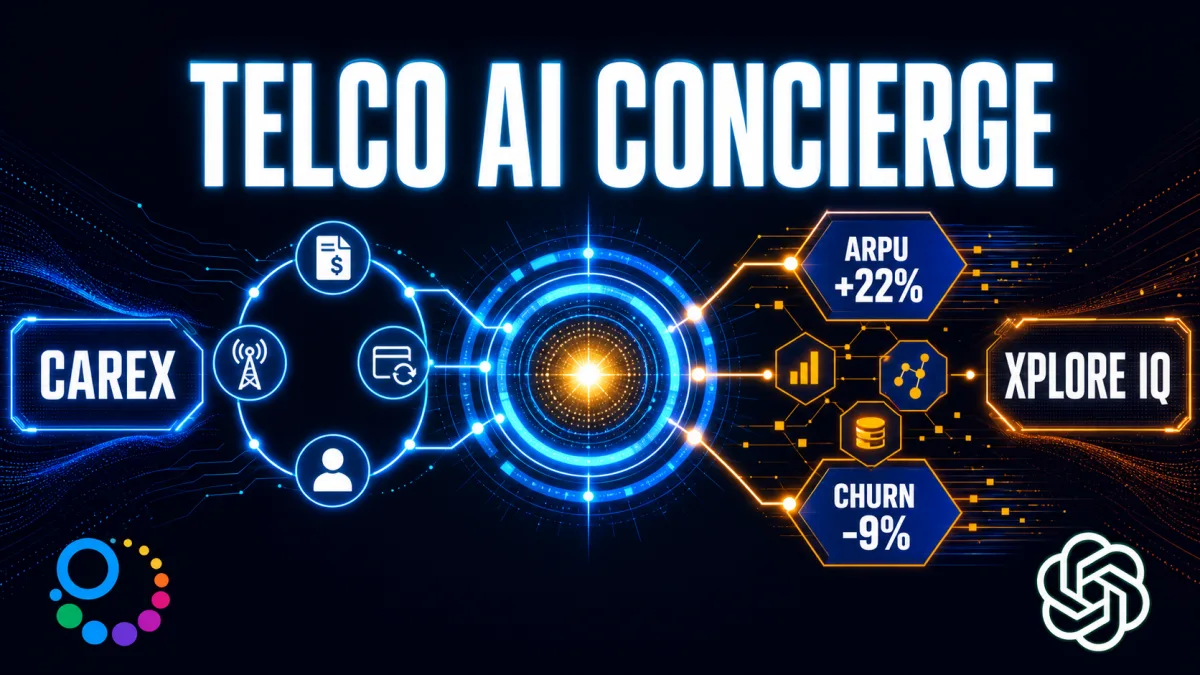
Circles says its OpenAI-powered telco stack increased Singapore ARPU by 22% and reduced churn by 9% while CareX, its multi-agent customer-support architecture, reached a 65% autonomous resolution rate across supported workflows, according to OpenAI's August 3 customer story. The result is a move from reactive support toward a conversational system that can use customer context, recommend an action and complete parts of the workflow.
Definition: Circles' AI Concierge is a conversational telco interface built on the OpenAI API and connected to support, account, search and personalization workflows.
Example: A customer checking a roaming option or disputing a bill can be routed to a specialist agent with the relevant account and app context instead of repeating the same information through separate menus.
Key takeaway: Circles combines CareX for support resolution with Xplore IQ for next-best-action recommendations, making the telco stack responsible for both service and customer value.
Business impact: The company reports a 22% ARPU increase and 9% churn reduction in Singapore, plus a 65% autonomous resolution rate across supported customer-service workflows.
What does Circles' AI Concierge change for telcos?
Circles' AI Concierge changes telco support by connecting customer context to an action instead of treating the interaction as a standalone question. The OpenAI-powered system can combine search, account management, support and recommendations when a customer is browsing roaming options or investigating a billing issue. For operators, the practical shift is to design one controlled journey around the customer's current intent; the difference between an AI agent and a chatbot explains why routing and tool use matter beyond generated text.
Circles' AI Concierge is also positioned as an operational layer across a telco's existing signals, not as a new chat window detached from them. OpenAI describes Circles as working with usage, billing, network-activity and location signals, while the company operates across 14 countries and six continents. That combination gives the system more context to act on, but it also makes permission boundaries and data handling part of the product design rather than a later add-on.
How does CareX resolve customer-service issues?
CareX resolves telco service requests by pairing an orchestration agent with specialist agents for billing, subscriptions, network management and account services. When a customer raises a billing issue, the orchestration layer combines the app context, account history and current request before sending only the needed information to the relevant specialist. Circles says CareX now resolves 65% of customer-service interactions autonomously across supported workflows, so operators evaluating the approach should measure completed resolutions and safe escalations—not chatbot answer volume alone.
CareX also keeps a human handoff inside the workflow rather than treating escalation as a failure outside the system. If a specialist agent cannot complete the request, Circles says the case can move to a human agent with the full context attached. That design addresses a common support cost: the customer explains the issue once to an automated system and then has to start again with a person. Circles is expanding CareX into real-time voice support and targeting 95% autonomous resolution across text and voice, but that figure is a stated target rather than the current reported result.
The architecture makes CareX a multi-agent system rather than a single general-purpose assistant. Each specialist has a narrower operational role, and the orchestration layer decides where the request belongs. That division can make testing and permissions more explicit: an operator can evaluate billing actions separately from network-management actions, while the customer-support AI agent workflow offers a broader framework for starting with bounded, measurable support tasks.
How does Xplore IQ personalize telco offers?
Xplore IQ personalizes telco offers by combining customer behavior, account history and real-time signals to select a relevant next action. Circles describes recommendations such as roaming packs, plan upgrades and add-on subscriptions, with the goal of replacing broad campaigns with a timely offer tied to the customer's situation. In Singapore, Circles says the AI-recommendation group achieved a 22% ARPU increase and helped reduce churn by 9% compared with customers who did not receive the recommendations.
The reported Xplore IQ results matter because they connect personalization to two operator metrics rather than only engagement. ARPU measures revenue per user, while churn measures customers leaving; the two numbers describe different outcomes from the same recommendation system. For teams assessing a similar program, the relevant next step is to define the comparison group, record which recommendation was shown, and separate accepted offers from revenue or retention that would have happened without the intervention. Circles' published figures establish its result, not a guaranteed result for every operator.
Where does Codex fit in Circles' AI stack?
Codex improves Circles' internal engineering workflow rather than serving telco customers directly. OpenAI says Circles uses Codex across design, coding assistance and unit testing, with engineers and specialists retaining responsibility for validation and final review. Circles reports a 29% increase in development efficiency from that use, which broadens the story from customer-facing automation to the engineering work needed to maintain an AI-native telco platform.
The Codex example shows that Circles is applying AI at two different layers: CareX and Xplore IQ change the customer and operator experience, while Codex supports the teams building and operating those systems. That distinction is useful for business owners comparing AI investments: customer-facing autonomy should be measured by resolution, revenue and retention outcomes, while internal coding assistance should be measured by validated delivery work rather than generated lines of code.
What controls does Circles use for telco AI governance?
Circles says it governs its telco AI stack by protecting personal information before model processing and limiting each specialist agent's access to the data required for its task. The company describes identifying and encrypting personally identifiable information before it reaches large language models, then combining scoped access with human escalation, phased rollouts, rate limits, rollback mechanisms and commercial safeguards. For a telecom operator, the takeaway is to treat privacy, permissions and recovery paths as part of the agent workflow.
Those controls are especially relevant because the AI Concierge can connect several sensitive domains at once: account identity, billing, network status, usage and location. Circles' stated approach is to avoid giving every specialist unrestricted access to the full customer profile. Operators considering similar systems should therefore map every agent to the minimum data and action scope it needs, then test the escalation and rollback paths before expanding autonomy.
What is Circles building next?
Circles is expanding CareX's observability and introducing real-time voice support, according to OpenAI's customer story. The company says the longer-term aim is a conversational, context-aware telco experience that helps operators engage customers proactively instead of forcing them through traditional app navigation. The current evidence is concrete—22% higher Singapore ARPU, 9% lower churn and 65% autonomous resolution in supported workflows—while the 95% text-and-voice figure remains a target for the expanded system.
The broader signal is that telco AI is moving beyond a customer-service bot toward a coordinated operating layer. Circles' approach joins support resolution, personalized monetization, engineering assistance and governance in one AI-native stack, but the published metrics remain company-reported results from specific deployments. Operators should use them as a case to study, then validate their own data quality, permissions, escalation rates and business outcomes before treating autonomy as the goal.
Frequently asked questions
What did Circles build with OpenAI?
Circles built an AI-native telco stack around an AI Concierge powered by the OpenAI API. The system combines customer support, account management, search and personalized recommendations in one conversational experience. Its CareX architecture routes requests between an orchestration agent and specialist agents for billing, subscriptions, network management and account services. Circles says the design is intended to understand a customer's context and take an appropriate action, rather than only return a text answer.
What results did Circles report from AI personalization?
Circles reports that AI-powered personalization in Singapore increased average revenue per user, or ARPU, by 22% and reduced churn by 9%. Circles attributes those results to Xplore IQ, an OpenAI API-based engine that combines customer behavior, account history and real-time signals to recommend actions such as roaming packs, plan upgrades and add-on subscriptions. The reported figures describe Circles' comparison between customers who received AI recommendations and those who did not.
How autonomous is Circles' telco support system?
Circles says CareX currently resolves 65% of customer-service interactions autonomously across supported workflows. The architecture gives each specialist agent only the information required for its task and can pass a case to a human agent with the conversation context attached when needed. Circles is also expanding CareX toward real-time voice support and says it is targeting 95% autonomous resolution across text and voice workflows.
How does Circles govern its AI telco systems?
Circles says it identifies and encrypts personally identifiable information before customer data reaches its language-model layer. Specialist agents receive scoped access rather than an unrestricted customer profile, while human escalation, phased rollouts, rate limits, rollback mechanisms and commercial safeguards provide additional control. These measures are part of Circles' stated approach to scaling AI-powered telco experiences without removing operational oversight.
Alex
Founder & Lead AI Writer
Alex is the founder of Yowox and lead AI writer since 2024, breaking down complex information into clear, actionable insights for thousands of readers every day. Alex has built AI automation systems for businesses since 2024, focusing on AI agents, workflow automation, and business process optimization.
Save hours. Save thousands.
Practical guides, real workflows, and the latest AI and automation news that matters — straight to your inbox.