 By Alex
 Airbnb tests AI search after cutting launch time by 60%
Airbnb is testing a natural-language AI search toggle while Brian Chesky says AI has cut concept-to-launch time by as much as 60% and lifted feature output nearly 80% year over year.
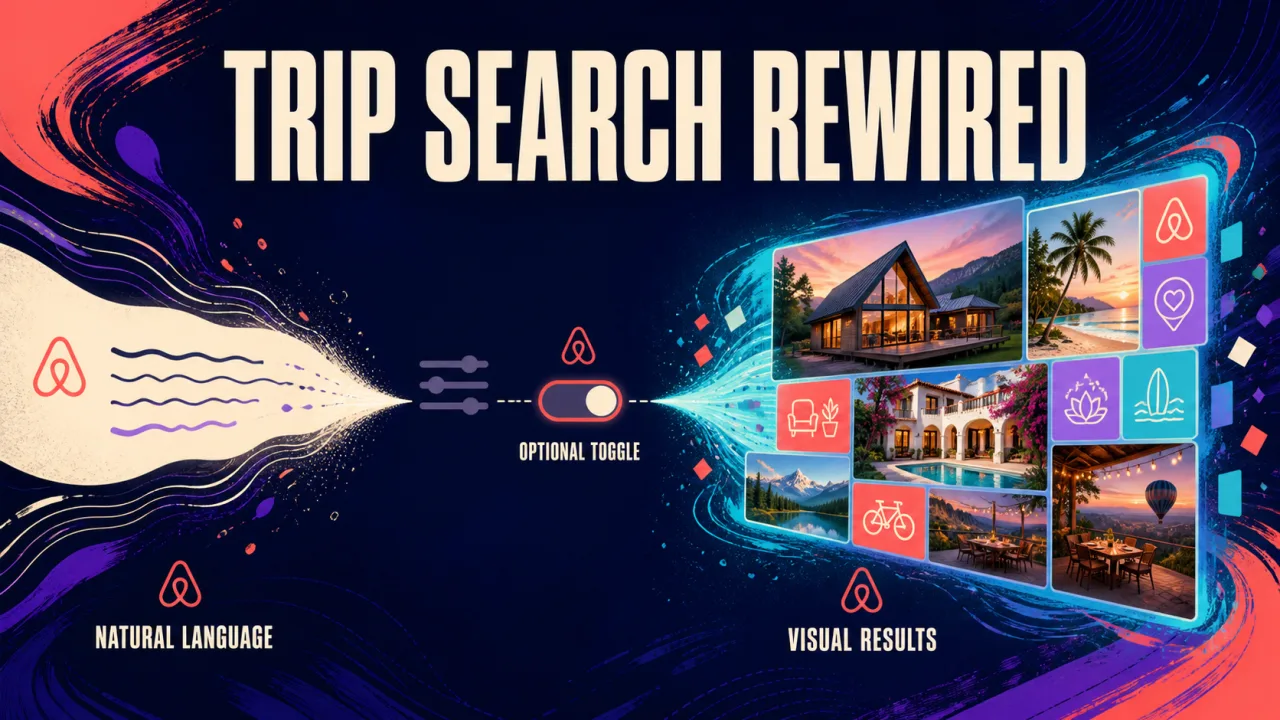
Airbnb is testing an optional AI search mode while saying AI has reduced concept-to-launch time by as much as 60 percent. The test lets guests write natural-language requests and receive visual results, while Airbnb keeps its familiar search and filters available; TechCrunch reports that the move comes as CEO Brian Chesky credits AI with faster product iteration and nearly 80 percent more shipped features year over year.
Definition: Airbnb's AI search test is an optional natural-language interface for finding stays and other travel options, alongside the existing search-and-filter experience.
Example: A guest can describe the kind of trip they want in ordinary language, then review a visual set of results instead of starting with a fixed filter sequence.
Key takeaway: Airbnb is testing AI search as a new discovery layer, not forcing every guest to abandon the current interface.
Business impact: Airbnb's rollout shows how a consumer company can use AI internally to accelerate shipping while introducing customer-facing AI behind an explicit choice.
What is Airbnb testing in AI search?
Airbnb is testing a natural-language search experience that guests can open with a toggle. The reported design keeps Airbnb's familiar search and filters in place, while the AI mode accepts conversational requests and returns results in a more visual format. The practical takeaway for Airbnb guests is that the experiment changes how they express intent, not whether they can still use the current search flow.
Airbnb's AI search is also intended to produce more conversational presentation around the results. Brian Chesky said titles could be AI-generated and conversational, while listing-page highlights could be generated in real time and personalized to the guest. The reported test therefore combines natural-language input with a more adaptive results layer; it is not simply a text chatbot placed on top of Airbnb's existing listings.
Why is Airbnb keeping the old search interface?
Airbnb is keeping its existing search-and-filter experience because travel discovery has needs that a chat-only interface may not handle well. Chesky has argued that travel interfaces need strong visual presentation, direct manipulation and easy comparison, while a conventional chatbot tends to produce too much text and makes large option sets harder to compare. The toggle lets Airbnb test the new interaction without making that unresolved design trade-off universal.
The Airbnb toggle is therefore an adoption strategy as much as a product-control decision. Guests who prefer filters can continue with the established flow, while guests willing to describe a trip in natural language can try the AI experience. Airbnb has announced a test, not a final result showing that AI search converts better, increases bookings or replaces filters.
How is Airbnb using AI beyond search?
Airbnb is applying AI across the guest and host journey, not only to the search box. TechCrunch reports Airbnb has used AI in search and discovery, sign-up, checkout and payments, while also rolling out review summaries and listing highlights. Airbnb's AI support assistant is available in more than 50 languages, and that support layer is an AI agent because it starts with a customer issue and can resolve it without a human handoff. For operators, the pattern is a portfolio of smaller product improvements rather than one standalone chatbot launch.
Airbnb said nearly 45 percent of issues that begin with its AI assistant are resolved without a human agent, while customer-support cost per booking declined approximately 16 percent year over year in Q2. Those figures give the customer-support rollout a measurable operating signal, although Airbnb attributes the cost change only in part to improvements in the AI assistant. The takeaway is to evaluate customer-facing AI by completed outcomes and operating cost, not by interface novelty alone.
| Area | Airbnb's reported AI use | Status described in the reporting |
|---|---|---|
| Product development | AI helps build, test and iterate features faster | Concept-to-launch time reduced by as much as 60% on key initiatives |
| Search and discovery | Natural-language search and visual presentation | AI search is being tested with an optional toggle |
| Listing information | Review summaries and listing highlights | Already used in Airbnb's consumer-facing experience |
| Checkout and payments | AI-assisted booking-flow improvements | Airbnb says AI helped in checkout and payments |
| Customer support | AI assistant handles issues and supports more than 50 languages | Nearly 45% of starting issues resolved without a human agent |
What does Airbnb's faster shipping claim show?
Airbnb says AI reduced the time from concept to launch by as much as 60 percent across some key initiatives and helped the company ship nearly 80 percent more features and improvements than during the same six-month period a year earlier. The figures come from Airbnb's own Q2 communication and describe internal product output; they should be read as a company-reported result, not as a general productivity benchmark.
For Airbnb, the value of AI is therefore tied to throughput across many surfaces: search, sign-up, checkout, payments, host tools and support. The important distinction is between generating code or text and completing a product loop from idea through testing and release. Airbnb's claim is about that broader loop, which is why the company connects internal AI adoption to the pace of customer-facing improvements.
That distinction matters for business operators evaluating AI. A faster draft is not the same as a shipped, measured improvement. Airbnb's own rollout pairs faster internal iteration with controlled customer experiments, such as an AI search toggle, and with operating measures such as support resolution and cost per booking. The broader AI automation stack puts that measurement beside models, tools and guardrails. The useful evaluation pattern is to connect AI usage to delivery time, adoption, conversion, resolution or cost rather than stopping at model activity.
What should Airbnb product teams watch next?
The next meaningful signal from Airbnb will be whether guests choose the AI search mode and whether the visual, conversational results improve discovery without making comparison harder. The current reporting establishes that Airbnb is testing the interaction and preserving the old path; it does not yet establish a broad rollout or a public conversion result. Product teams can use the same sequence: keep a reliable baseline, expose the new interaction to a defined group, and measure completed outcomes before replacing the old flow.
Airbnb's news is best read as two connected moves. Internally, the company says AI is compressing the time needed to build and ship product. Externally, Airbnb is applying that faster iteration to a cautious search experiment that keeps customer choice intact. The result is not an AI takeover of travel search yet; it is a live test of whether AI can make a visual, comparison-heavy marketplace easier to navigate.
Frequently asked questions
What AI search feature is Airbnb testing?
Airbnb is testing an AI-powered search experience that lets guests switch from the familiar search-and-filter interface to a natural-language search mode. The test is designed to return visual results, with conversational titles and personalized, AI-generated listing highlights. Airbnb is presenting this as an optional experiment rather than a forced replacement for its existing search experience.
Will Airbnb remove its current search and filters?
No. Airbnb's current AI search test includes a toggle so guests can choose between the existing search-and-filter experience and the new natural- language mode. That preserves the current interface for guests who prefer direct manipulation and conventional filters while Airbnb measures how people respond to the alternative.
How much faster does AI make Airbnb product development?
Airbnb CEO Brian Chesky said the company reduced time from concept to launch by as much as 60 percent across some key initiatives. Airbnb also said it shipped nearly 80 percent more features and improvements in the first half of 2026 than in the same period a year earlier. Those figures describe Airbnb's reported internal output, not a universal benchmark for every product team.
Where else is Airbnb using AI?
Airbnb is using AI across search and discovery, listing and review highlights, and customer support. Its AI assistant is available in more than 50 languages, and nearly 45 percent of issues that start with the assistant are resolved without a human agent. Airbnb also said customer-support cost per booking fell about 16 percent year over year in Q2, partly because of improvements to the assistant.
Alex
Founder & Lead AI Writer
Alex is the founder of Yowox and lead AI writer since 2024, breaking down complex information into clear, actionable insights for thousands of readers every day. Alex has built AI automation systems for businesses since 2024, focusing on AI agents, workflow automation, and business process optimization.
Save hours. Save thousands.
Practical guides, real workflows, and the latest AI and automation news that matters — straight to your inbox.