 By Alex
 Agentic Coding Is Replacing Junior Tasks, Not Engineers
Agentic coding is improving quickly, but reliability, evaluation, verification, and hiring evidence still separate task automation from replacing junior engineers.
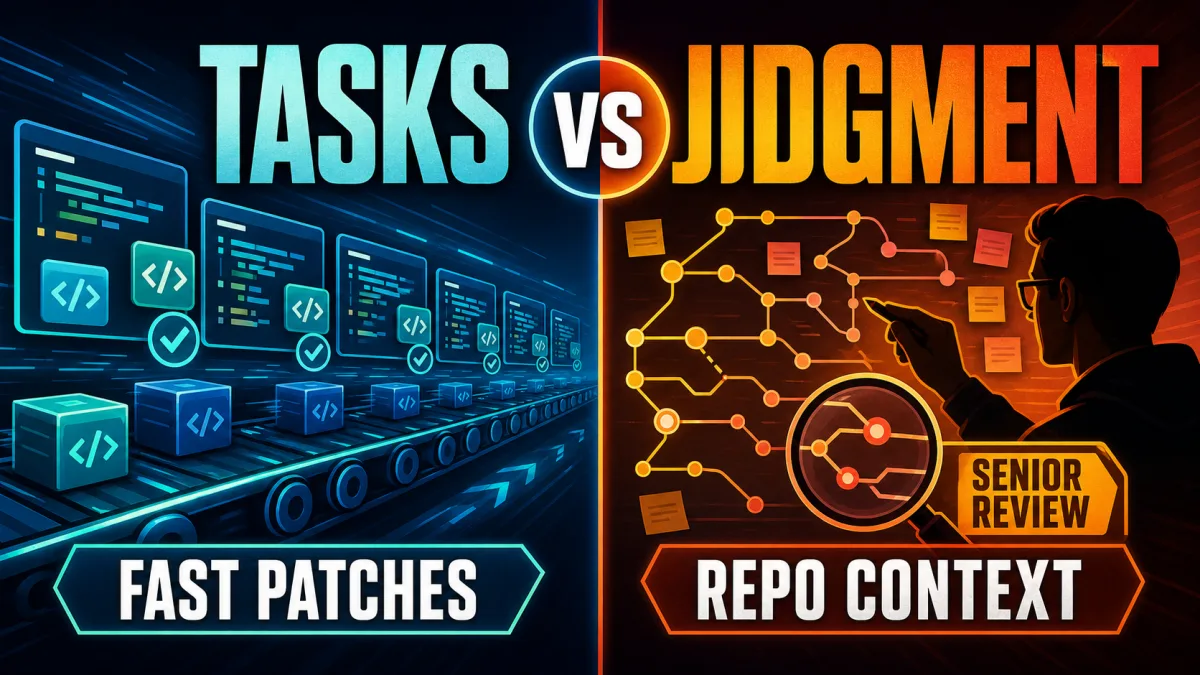
Agentic coding is getting better at producing software, but that is not the same as replacing a junior engineer. The central question is not whether an agent can write a function; it is whether a company can trust the agent with the full chain of context, implementation, verification, and judgment that turns a coding task into useful work. MarkTechPost’s analysis frames that question as a set of conditions. The evidence points to a split verdict: capability is advancing, measurement is unsettled, verification remains expensive, and hiring is already changing for younger workers.
Definition: Agentic coding means delegating a multi-step software task to an AI system that can inspect a repository, edit files, run tools, and iterate toward an outcome.
Example: A coding agent may implement a feature, run tests, and prepare a pull request, but a junior engineer still has to learn why the codebase is structured that way and whether the change fits its unstated constraints.
Key takeaway: Replacing junior tasks is easier than replacing the context and judgment that junior engineers are meant to develop.
Business impact: A company that removes entry-level work without measuring learning, review capacity, and long-term staffing may reduce today’s task cost while weakening tomorrow’s senior pipeline.
What would replacement actually require?
Agentic coding could replace junior engineers only if one system reliably handled the work juniors do, not merely the code they type. That system would need to complete repository tasks at a high success rate, work with prior context, survive independent evaluation, cost less to verify than to delegate to a person, and fit a company’s staffing model. The four requirements are useful for operators because failure in any one of them turns “replacement” into supervised task automation rather than role substitution.
The AI-agent explainer on Yowox describes the practical difference between an agent and a chatbot: an agent plans, uses tools, and verifies an outcome. Coding-agent replacement raises the same standard one level higher. A model that produces plausible code is not enough; the surrounding agent must preserve context, choose the right actions, expose uncertainty, and leave a human with evidence that the result is correct.
Can coding agents handle the length of junior tasks?
METR’s time-horizon research shows that AI agents are improving rapidly on multi-step software and reasoning tasks, but the metric is a probability curve rather than a staffing promise. The original METR time-horizon study found that the human-equivalent length of tasks frontier agents could complete with 50% reliability had doubled approximately every seven months over the measured period. For an operator, the actionable reading is to track reliability at the confidence level a production workflow needs, not to treat a 50% point as a safe handoff threshold.
METR’s updated Time Horizon 1.1 release expanded the task suite from 170 to 228 tasks, increased tasks estimated at eight hours or longer from 14 to 31, and moved the evaluation infrastructure from Vivaria to Inspect. METR says the broader suite generally tightens estimates, while the trend is somewhat sensitive to task composition. A company testing an agent should therefore record the task definition, context supplied, success threshold, and evaluation harness alongside the result.
The harder limitation is task shape. METR says its tasks are self-contained and well-specified, framed around what someone with no prior context could finish. A junior engineer’s real work includes learning which service owns a behavior, why an abstraction exists, how local conventions work, and whom to ask when the specification is incomplete. The benchmark is informative about autonomous execution under controlled conditions, but it does not measure the apprenticeship itself; teams should test repository context and clarification behavior separately.
Does the benchmark measure the job?
Coding benchmarks can show progress without proving that a model can do a job, because the benchmark controls the problem statement, repository state, tests, and definition of success. OpenAI’s February 2026 analysis of SWE-bench Verified found that at least 59.4% of an audited 138-problem subset contained material issues in test design or problem descriptions, and it found evidence that frontier models could reproduce gold patches or verbatim problem details. OpenAI stopped reporting the benchmark and recommended SWE-bench Pro instead; buyers should treat headline scores as signals that require local validation.
The lesson is not that every benchmark is useless. The lesson is that a benchmark result inherits the weaknesses of its task distribution and scoring rule. A company deciding whether to remove junior work should run the same agent against representative repositories, require tests and documentation, and have a reviewer judge whether the change matches the product intent. A green benchmark score cannot establish that the agent understood an undocumented dependency or made the right trade-off.
Yowox’s earlier coding-agent scaffold-to-PR comparison makes the same operational distinction from a product angle: a workflow that includes scaffolding, tests, fixes, and a pull request is more informative than a single code-generation score, but it still needs the team’s own repository and review criteria. The replacement question is therefore empirical: how often does the complete workflow finish correctly, and how much human time remains after the agent says it is done?
Is verification cheaper than hiring?
Verification is the economic gate that benchmark discussions often skip. An agent can make generation cheap while leaving senior engineers responsible for reading the diff, reconstructing the context, checking edge cases, running tests, and deciding whether the result is safe to merge. If that review work costs more than assigning the task to a junior engineer, delegation has not replaced the role; it has moved the work to a scarcer reviewer.
The strongest direct evidence is METR’s randomized trial of AI-assisted development. In the METR study, 16 experienced open-source developers completed 246 real issues in repositories they knew, with AI access randomized. Developers expected a 24% speedup and later estimated they had been 20% faster, but measured completion time was 19% slower when AI was allowed. The tools were from early 2025, the sample was small and specialized, and METR does not claim the result generalizes to all software work; the durable warning is the gap between perceived and measured productivity.
The adoption data shows why the gap matters. Stack Overflow’s 2025 survey reports that 84% of respondents use or plan to use AI tools in development, while 46% distrust the accuracy of the output and 33% trust it. The survey’s professional-developer breakdown reports 50.6% using AI daily, but usage is not the same as autonomous acceptance. For a team, the useful metric is not “how many people use an agent?” but “how much correction and review time remains per accepted change?”
That is also why a green test suite cannot settle the question. Yowox’s analysis of agent-written tests explains how mocks, implementation-coupled assertions, and coverage targets can create visible progress without proving behavioral correctness. If an agent writes both the implementation and the tests, the reviewer still needs to ask what realistic failure would make the suite turn red.
What does the hiring evidence show?
Hiring is the uncomfortable gate because firms can reduce junior hiring before agentic coding is capable of replacing the entire role. The Stanford Digital Economy Lab’s August 2026 revision reports that employment for workers ages 22–25 in highly AI-exposed occupations stood about 19% below the comparison path as of June 2026, versus a 15% shortfall at the July 2025 vintage. Stanford says the adjustment appears to operate mainly through reduced hiring rather than increased separations, but also emphasizes that the patterns are descriptive, not causal estimates.
The same Stanford work distinguishes codified knowledge from tacit knowledge. Employment declined among young workers in occupations relying more heavily on formal, standardized knowledge, while experienced workers did better in occupations relying more on practice, mentorship, and repeated exposure to real situations. For software teams, this is a warning about pipeline design: coding agents may absorb codified implementation tasks while companies continue to require the tacit judgment those tasks once helped juniors acquire.
This evidence does not prove that AI caused every hiring change, and it does not prove that junior engineers are disappearing. It does show that the organizational condition for substitution can arrive before the technical condition is settled. An operator should therefore separate two decisions: whether an agent can complete a task, and whether the company is willing to stop hiring the people who would have learned from that task.
What should companies measure instead of making a prediction?
Companies should run an agent-assisted staffing experiment with a fixed task set and an explicit learning measure. The task set should include a self-contained change, a repository-context task, a cross-file refactor, a failing test investigation, and a review or documentation change. For each run, record first-pass correctness, test failures, clarification requests, unrelated edits, human review minutes, rework, and whether the final change survives normal CI.
The comparison should include people, not only models. Keep a baseline from previous work or a parallel human-led sample, then measure whether junior engineers with agents reach independent judgment faster, slower, or not at all. That design answers a more useful question than “will AI replace juniors?”: does the agent reduce repetitive work while preserving a path to the context and judgment the organization will need later?
Teams that already use multiple coding agents can also borrow the lesson from Yowox’s fresh-context analysis without copying any product ranking: compare complete workflows on the same repository, not marketing claims on different benchmarks. The unit of evaluation should be an accepted change with known review cost, not a code block or a percentage detached from the work.
What would change this verdict?
The case for replacing junior engineers would become much stronger if five signals moved together: high-confidence reliability on full-day tasks with prior context; strong results on privately authored, uncontaminated long-horizon evaluations; measured productivity gains that match developer perceptions; sustained improvements in delivery stability while adoption remains high; and a narrowing of the young-worker employment gap as AI exposure rises. These are falsification tests, not forecasts, so a company can monitor them without pretending the future is already known.
The current conclusion is narrower and more actionable. Agentic coding is replacing some tasks that junior engineers used to receive, while the evidence does not yet show that it can replace the context-building, verification, and judgment-development function of the role. Businesses should automate the work they can measure, keep review responsibility explicit, and test whether agents accelerate apprenticeship rather than quietly removing it.
Frequently asked questions
Is agentic coding ready to replace junior engineers?
No—not on the evidence discussed here. METR’s time-horizon work shows rapid progress on self-contained software tasks, but its 50% success measure is not a staffing guarantee and its tasks remove much of the repository context a junior engineer must learn. OpenAI also stopped reporting SWE-bench Verified after finding flawed tests and signs of training contamination. The strongest near-term conclusion is narrower: agentic coding can absorb some junior-level tasks, while humans still carry context, verification, and judgment.
Why are coding benchmarks not enough to predict junior-engineer replacement?
A benchmark measures the task and scoring rule it defines, not an entire job. METR’s software tasks are self-contained and well-specified, while real junior work includes learning a codebase, finding the right owner, interpreting local conventions, and responding to review. OpenAI’s retirement of SWE-bench Verified adds a second warning: a benchmark can contain flawed tests or problems seen in model training. Use benchmark results as capability signals, then measure the agent on your own repositories and acceptance criteria.
What is the biggest bottleneck in agentic coding today?
Verification is the clearest bottleneck in the evidence reviewed here. In METR’s randomized trial, experienced developers using early-2025 AI tools took 19% longer on the studied tasks even though they expected a 24% speedup and later believed they had been 20% faster. The study is narrow and dated, so it is not a universal productivity estimate. It does show why generation speed cannot be treated as delivered output: someone still has to understand, test, review, and correct the change.
How should companies use coding agents without breaking the junior pipeline?
Treat the agent as a capability to measure, not as a reason to remove the learning path by default. Keep tasks small enough to review, give junior engineers real repository context, and record correctness, review time, test failures, and the judgment they gain over time. Compare an agent-assisted cohort with a previous cohort instead of relying on a launch benchmark. The goal is to learn whether agents help people reach senior judgment faster while preserving a route for acquiring the context and tacit knowledge that current benchmarks do not measure.
Alex
Founder & Lead AI Writer
Alex is the founder of Yowox and lead AI writer since 2024, breaking down complex information into clear, actionable insights for thousands of readers every day. Alex has built AI automation systems for businesses since 2024, focusing on AI agents, workflow automation, and business process optimization.
Save hours. Save thousands.
Practical guides, real workflows, and the latest AI and automation news that matters — straight to your inbox.