 By Alex
 Agent Sandboxes in 2026: Latency, Billing, and Egress
A source-led comparison of E2B, Daytona, Modal, Cloudflare and Vercel sandboxes across burst latency, idle cost, persistence and network controls.
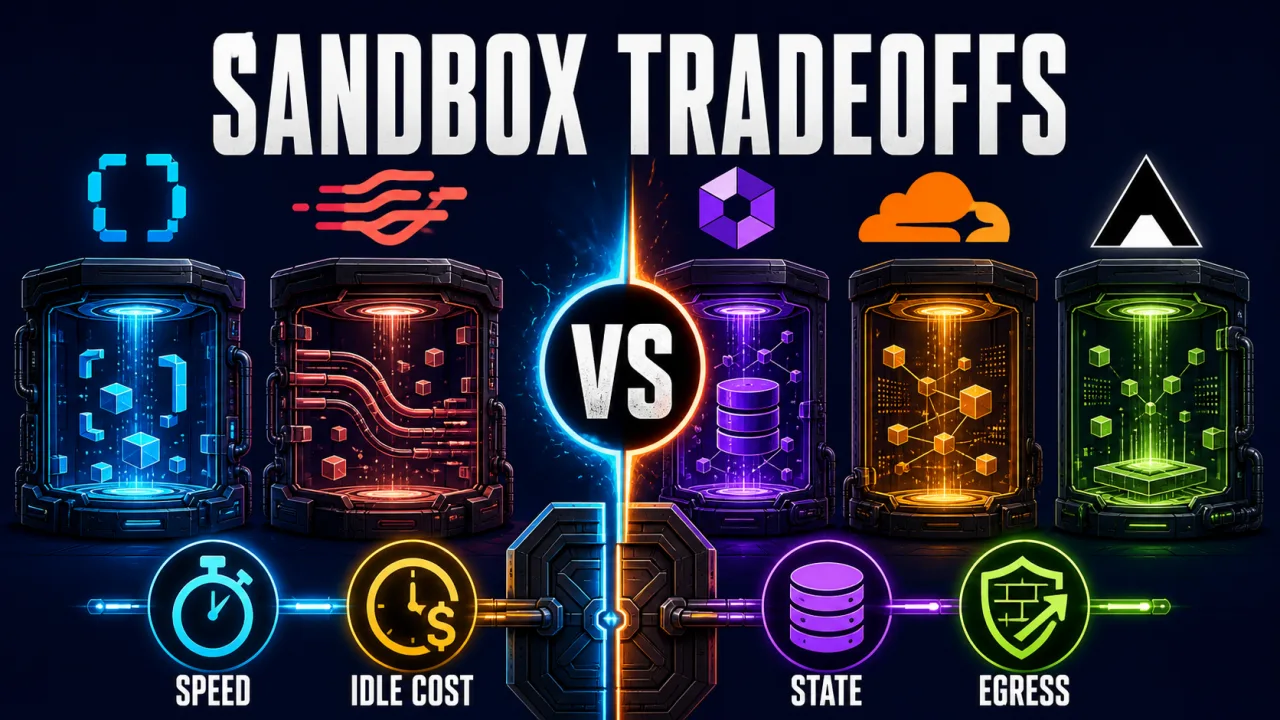
Agent sandboxes have become an infrastructure decision, not a simple code-execution feature. In the August 27, 2026 comparison from MarkTechPost, E2B, Daytona, Modal, Cloudflare and Vercel diverge most on concurrent startup, idle billing, state restoration and outbound-network policy. The practical takeaway is to choose the platform around the constraint your agent cannot move, then measure the real workload rather than trusting a headline cold-start number.
Definition: An agent sandbox is an isolated environment where an AI agent can execute code, access files and interact with selected services.
Example: A coding agent may create a sandbox, install dependencies, run tests, keep the filesystem between turns and call an API through a controlled egress path.
Key takeaway: The fastest sandbox is not automatically the cheapest or safest when agents run concurrently and wait between tool calls.
Business impact: Treating latency, billing, persistence and egress as separate design variables reduces the risk of selecting a platform that looks efficient only in a demo.
Which four sandbox properties change the architecture?
Concurrent cold start, filesystem persistence, egress control and idle billing are the four properties that most change an agent-sandbox architecture. The comparison separates them because an agent may create thousands of environments, return to the same environment across turns, process untrusted code or spend most of its lifetime waiting on a model. Teams should score providers on these four dimensions before comparing secondary SDK or plan preferences.
An AI agent is more than a model response: it observes context, selects tools and continues through feedback. That makes the execution environment part of the agent system rather than a disposable implementation detail. Teams mapping the broader AI automation stack should therefore treat the sandbox as the layer that enforces execution boundaries, state and network permissions.
Which provider starts fastest under concurrency?
Vercel had the strongest combination of burst speed and completion rate in the cited August 21, 2026 test, while Daytona had the lowest median but a sharply lower success rate. ComputeSDK measured Time to Interactive from sandbox creation to the first successful command, using 100 concurrent iterations from a 4 vCPU host in Northern Virginia. Teams should use the result as a workload-shaped baseline, not as a universal ranking.
| Provider | Median TTI | P95 | P99 | Success rate |
|---|---|---|---|---|
| Vercel Sandbox | 0.67s | 1.04s | 1.12s | 100% |
| Modal | 0.88s | 1.00s | 1.08s | 100% |
| E2B | 1.61s | 1.77s | 1.81s | 100% |
| Cloudflare | 5.06s | 6.04s | 6.48s | 100% |
| Daytona | 0.27s | 0.43s | 0.44s | 37% |
The ComputeSDK sandbox leaderboard shows why median alone is misleading: Daytona’s 0.27-second median came with 37 successful attempts out of 100, while Vercel, Modal, E2B and Cloudflare completed every attempt in the cited run. Teams designing an agent launch path should record both time to interactive and failed-create behavior, then size retries and concurrency around the tail.
Vendor startup claims describe different tests. Daytona’s published pricing page advertises sandbox creation in milliseconds, while the comparison notes that other sub-second claims may describe sequential creates, cached images or different readiness points. Teams should pin image, region and concurrency, and measure the first useful command rather than API acknowledgment.
How does per-second billing change the cost ranking?
Idle-heavy agent loops make billing basis more important than the nominal CPU rate. The source comparison models 1,000 executions with a 2 vCPU / 4 GiB sandbox and no plan floor, egress or other platform charges. Teams should model both a short code-tool burst and a session in which the sandbox stays open while a model thinks.
| Platform | CPU rate | Memory rate | Billing shape |
|---|---|---|---|
| E2B | $0.0504 / vCPU-hr | $0.0162 / GiB-hr | Wall-clock, per second |
| Daytona | $0.0504 / vCPU-hr | $0.0162 / GiB-hr | Wall-clock, per second |
| Modal Sandbox | ~$0.0710 / vCPU-hr equivalent | $0.0240 / GiB-hr | max(request, actual), per second |
| Vercel Sandbox | $0.128 / vCPU-hr active CPU | $0.0212 / GB-hr | Active CPU plus wall-clock memory |
| Cloudflare Sandbox | $0.072 / vCPU-hr active CPU | $0.009 / GiB-hr | Active CPU plus provisioned resources |
The source model puts the short 90-second, 50%-CPU workload at $4.14 per 1,000 executions for E2B or Daytona, $5.32 for Vercel, $5.95 for Modal and $3.70 for Cloudflare. Teams should use those figures only as scenario outputs because Cloudflare’s modeled instance uses fixed 2 vCPU / 8 GiB / 16 GB resources, while the other assumptions are not identical.
The idle-heavy 10-minute, 5%-CPU scenario changes the order: E2B and Daytona rise to $27.60 per 1,000, Modal to $39.66 and Vercel to $16.27, while Cloudflare reaches $13.87. The Modal pricing page separately lists higher Sandbox CPU and memory rates than standard Modal compute, so teams should not substitute the headline function rate for sandbox economics.
Which platforms preserve state between turns?
E2B offers the clearest memory-preserving pause path, while Cloudflare requires explicit durability planning when a sandbox sleeps. The E2B persistence documentation says pausing preserves filesystem and memory, but its default timeout action is kill, which is terminal; teams that need resume behavior must configure the lifecycle deliberately.
Daytona preserves files by default, but the source comparison distinguishes container, VM and GPU sandbox behavior. Modal supports filesystem and memory snapshots with different retention characteristics. Vercel snapshots persistent sandboxes on stop. Teams should test whether the next turn needs only files, a running process, a loaded model or an entire memory image, because “persistent” does not describe the same state on every platform.
Cloudflare’s sandbox model is the most consequential for sleep behavior: the source comparison says a sleeping container can restart from a fresh image disk. Teams using Cloudflare should plan backups, R2 mounts or another durable state path rather than assuming a stopped sandbox is a durable workspace.
How do egress policies differ?
All five platforms can restrict outbound access, but policy precedence and credential handling differ enough to change the security design. E2B allows internet access by default and supports deny, allow and domain rules; Daytona’s limits depend on tier; Modal exposes blocked-network and allowlist controls; Cloudflare offers host rules and outbound handlers; Vercel supports allow-all, deny-all and user-defined policies. Teams should test the exact policy after every provider change.
E2B’s network documentation says allow rules take precedence over deny rules and warns that blocked TCP connections can appear successful before application traffic is filtered. Teams should assert on an HTTP response, TLS handshake or expected protocol bytes, not only on whether connect() returned successfully.
Vercel resolves the same class of overlap differently: its sandbox firewall documentation says denied ranges take precedence over allowed domains and address ranges, and its policies can change at runtime without restarting the process. A policy copied from E2B to Vercel therefore needs a semantic rewrite, not a field-by-field translation.
Cloudflare’s outbound-handler design adds a separate credential boundary. The Cloudflare Sandbox documentation describes handlers running outside the sandbox with access to Workers bindings, so a handler can attach a secret without exposing it to sandbox code. For prompt-injected or otherwise untrusted agents, keeping credentials outside the execution environment may matter more than shaving a second from startup.
Which sandbox fits each constraint?
Vercel fits an idle-heavy agent that values active-CPU billing and tight measured burst latency; E2B fits microVM isolation, memory-preserving pause and a self-host path; Daytona fits stateful workspaces when capacity variance is acceptable. These recommendations follow the comparison’s measured results and documented product differences, so teams should validate them against their own region, image, concurrency and data-handling requirements.
| Binding constraint | Starting point from the comparison | Why it fits |
|---|---|---|
| Model waiting dominates compute | Vercel Sandbox | Active CPU is separated from wall-clock memory billing. |
| Kernel isolation and self-hosting | E2B | Firecracker microVMs, pause/resume state and documented infrastructure options. |
| Persistent workspaces and forking | Daytona | Multiple lifecycle modes and persistent-by-default behavior. |
| GPU execution inside the sandbox | Modal | The comparison identifies Modal as the option with a full GPU rate card. |
| Workers-based egress security | Cloudflare Sandbox | Outbound handlers can keep credentials in the Workers runtime. |
Runloop also appears in the source comparison as a coding-agent option with suspend/resume and evaluation tooling, but its pricing page places suspend and resume in the Pro plan. Teams evaluating it should include the plan floor alongside the compute rate rather than comparing CPU prices alone.
What should operators measure next?
Operators should benchmark the first useful task, not just sandbox creation. The source comparison recommends measuring install, file access, execution and artifact return separately, while pinning region and image and publishing sequential and concurrent series. Teams should add their own agent wait time, retry behavior, snapshot overhead, egress checks and cost per completed task before committing to a provider.
The category is changing quickly: the comparison says rates and behaviors were checked on August 27, 2026, while the latency run was from August 21, 2026. Operators should re-check vendor pricing and documentation before purchase, especially for GPU rates, plan floors, retention periods and network-policy availability. The durable decision is not a universal winner; it is a sandbox whose failure modes match the workflow’s risk and timing budget.
Frequently asked questions
Which agent sandbox has the fastest measured burst cold start?
In the August 21, 2026 ComputeSDK burst test cited by the comparison, Daytona recorded the fastest median Time to Interactive at 0.27 seconds, but completed only 37% of 100 concurrent attempts. Vercel recorded 0.67 seconds with a 100% success rate, while Modal recorded 0.88 seconds with a 100% success rate. The practical answer is therefore not simply “Daytona”: teams should compare both latency and completion rate under their own concurrency pattern.
Which sandbox billing model is better for an AI agent that waits on a model?
Active-CPU billing is generally more favorable when an agent spends much of its wall-clock time waiting for model or network responses. Vercel measures active CPU separately from provisioned memory, and Cloudflare separates active CPU from provisioned resources. E2B, Daytona and Modal charge for different forms of resource time while the sandbox is alive, so an idle-heavy session can cost more than a short burst with the same compute work. The correct choice depends on session duration, memory allocation and whether the orchestrator can suspend the sandbox.
Which sandbox preserves state between agent turns?
E2B can preserve both filesystem and memory state when a sandbox is paused, while Daytona persistence depends on whether the sandbox is a container or a VM. Modal offers filesystem and memory snapshot primitives, and Vercel can snapshot persistent sandboxes. Cloudflare sandboxes are more ephemeral: a sleeping instance can restart with a fresh disk from its image unless the application uses a backup or an external storage pattern. A team should test its exact resume path rather than treating “persistent” as a universal product behavior.
What is the most important network-policy difference?
The most important difference is how a provider resolves overlapping allow and deny rules and whether credentials can stay outside the sandbox. E2B gives allow rules precedence over deny rules, while Vercel gives denied ranges precedence. Cloudflare outbound handlers run outside the sandbox and can attach credentials held in the Workers runtime. For an agent processing untrusted input, teams should test application-level responses and credential exposure, not only whether a TCP connection appears to open.
Alex
Founder & Lead AI Writer
Alex is the founder of Yowox and lead AI writer since 2024, breaking down complex information into clear, actionable insights for thousands of readers every day. Alex has built AI automation systems for businesses since 2024, focusing on AI agents, workflow automation, and business process optimization.
Save hours. Save thousands.
Practical guides, real workflows, and the latest AI and automation news that matters — straight to your inbox.