 By Alex
 Siebel 26.6 adds RAG search for repeat support tickets
Siebel CRM 26.6 adds RAG-powered Service Request Similarity Search with hybrid semantic and keyword retrieval, OpenSearch indexing, and in-context knowledge access. Here is what changes for support teams—and what still requires judgment.
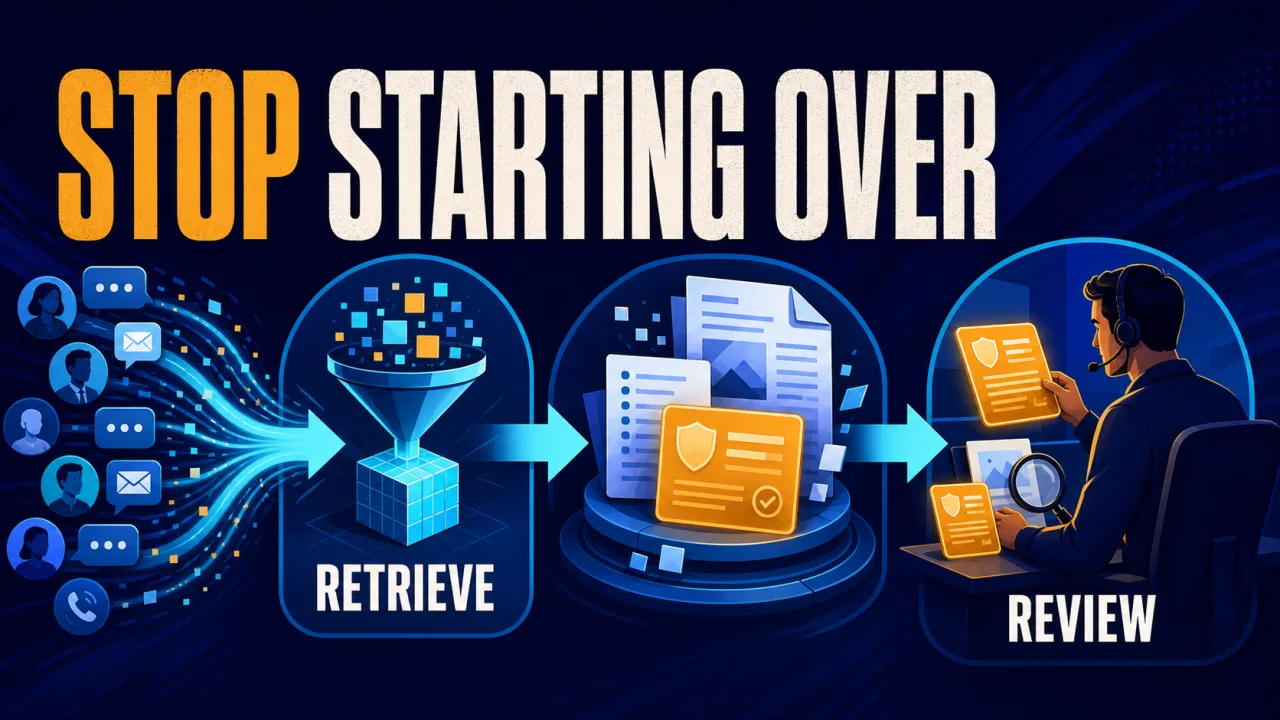
Definition: Siebel 26.6’s Service Request Similarity Search uses RAG plus hybrid semantic and keyword retrieval to find previously resolved cases that may describe the same problem in different words.
Example: “The app freezes right after login” can be matched with an older request saying “the system hangs before the dashboard loads.”
Key takeaway: The feature reduces rediscovery work, but it does not remove the support rep’s responsibility to judge whether a prior resolution fits.
Business impact: A solved-ticket archive becomes a reusable operational memory instead of a pile of records that only exact keywords can find.
A support representative reads two tickets:
- “The app freezes right after I log in.”
- “The system hangs before the dashboard loads.”
A human can suspect the same root cause. Traditional keyword search may not. One ticket says freezes, the other says hangs; one says login, the other says dashboard. The second representative can end up rebuilding the first representative’s investigation from scratch.
Siebel CRM 26.6 attacks that specific failure mode with Service Request Similarity Search, a new feature that combines Retrieval-Augmented Generation (RAG) with hybrid semantic and keyword search. Oracle describes it as a way for service agents to find similar, previously resolved Service Requests directly inside Siebel screens, using both standard and custom Service Request fields.
The result is not an autonomous support bot. It is a search layer that makes the organization’s solved work easier to reuse.
What changed in Siebel 26.6?
Oracle’s Siebel CRM 26.6 release notes describe Service Request Similarity Search as an AI-assisted feature for locating similar cases in the queue. The feature uses RAG and hybrid search, and it is embedded in the Service Requests screens and views that agents already use.
That combination matters because it joins three things that are often separated in enterprise AI projects:
| Layer | Role in the support workflow |
|---|---|
| Service Request fields | Describe the current issue using standard or custom data |
| Hybrid retrieval | Finds both exact terms and related meanings |
| Agent interface | Presents ranked evidence without making the rep leave the case |
The release also includes a broader Siebel AI RAG framework. Oracle says it can support existing Siebel deployments across cloud and on-premises environments, with configuration for data, vector indexing, prompts and interaction modes.
The headline is not “Siebel added a chatbot.” The headline is “Siebel made previously solved support work searchable by meaning.”
How the retrieval loop works
Oracle’s Siebel CRM product walkthrough describes a compact workflow:
- The current Service Request is summarized.
- The summarized request is used for semantic similarity search.
- Historical Service Requests are searched in OpenSearch.
- The agent receives a ranked list of similar cases.
- The agent drills into prior troubleshooting steps and resolutions.
- The agent decides whether the evidence applies to the current customer.
The important step is not the embedding by itself. It is the conversion of a messy case into a retrieval-ready representation, followed by a ranked result inside the workflow where the decision is made.
That is the practical shape of RAG: retrieve relevant enterprise knowledge first, then use it to improve the next reasoning step. In this case, the retrieved material is not just a paragraph for a generated answer. It can be a prior Service Request, its resolution, and a knowledge-base article that helps the rep investigate safely.
Why semantic search beats another keyword box
Keyword search remains useful. Product names, error codes, account identifiers and exact phrases are often the strongest evidence a ticket contains. The problem is assuming that exact words are the whole meaning of a request.
A semantic retriever can connect different language that points to a similar incident. Hybrid search adds the two approaches together: exact matches can remain important while related meanings become discoverable.
This is especially useful in support archives because customers and agents describe symptoms differently. A customer reports what they saw. A support engineer may record the component, workaround or internal error name. The resolution may contain none of the customer’s original wording.
The search system is therefore answering a better question than “where does this phrase occur?” It is trying to answer “which previous cases are most relevant to this situation?”
That is a ranking problem, not a truth oracle.
The agent stays in the loop
The strongest design choice in the feature is that the retrieved cases remain evidence for a human support decision. Oracle’s walkthrough describes agents reviewing matched cases, examining troubleshooting steps and deciding whether the prior resolution applies.
That boundary is important. A high similarity score does not prove that two Service Requests have the same root cause. A prior resolution may be obsolete, scoped to a different deployment, or safe only under conditions that the current ticket does not satisfy.
A good support interface should make comparison easy:
- show why a case was retrieved;
- expose the fields and text that drove the match;
- make the prior resolution easy to inspect;
- distinguish a resolved case from an unresolved discussion;
- preserve links to the original record and its permissions;
- let the rep reject a misleading match without hiding it from evaluation.
The feature can reduce repeated investigation without pretending that retrieval has replaced diagnosis.
The search reaches beyond old tickets
Oracle says the solution also retrieves relevant articles from the Fusion Knowledge Base. This expands the searchable memory from “what a rep previously did” to “what the organization has documented.”
That distinction helps with two common gaps:
- A historical ticket may contain the right fix but weak explanation.
- A knowledge article may contain the approved procedure but no ticket that uses the customer’s language.
Combining both gives the rep a path from symptom to precedent to documented practice. The interface can also support drill-down into multiple results and, according to Oracle’s product description, associate an existing Service Request as a parent record when that relationship makes sense.
Those relationships matter operationally. Support history is not only a bag of text. It is a graph of customers, products, incidents, child requests, escalations and resolutions. Retrieval is more useful when the agent can preserve that context instead of copying an answer into a new ticket.
What OpenSearch is doing here
The semantic layer depends on an index that can represent more than literal terms. Oracle’s walkthrough names OpenSearch as the store searched for historical Service Requests, while the release notes describe the broader hybrid-search feature.
At a high level, the pipeline looks like this:
| Stage | Operational question |
|---|---|
| Ingest | Which Service Request and knowledge fields are allowed into search? |
| Summarize | How is the current issue represented for retrieval? |
| Embed and index | Which vector and lexical fields are maintained in OpenSearch? |
| Retrieve | Which exact and semantically related records are candidates? |
| Rank | Which cases should appear first, and why? |
| Review | Can the agent inspect enough context to make a safe decision? |
The index is part of the product capability, not a magic background detail. If the wrong fields are indexed, if resolved and unresolved records are mixed carelessly, or if visibility rules are not preserved, a more sophisticated retriever can make the wrong evidence easier to find.
The integrated framework lowers architecture work
Many enterprise teams can describe a RAG architecture. Fewer can connect it to the system where the actual support record lives, preserve permissions, maintain an index and give agents a usable review flow.
Oracle says Siebel CRM provides an integrated framework for configuring RAG rather than requiring customers to assemble a separate stack from scratch. The 26.6 release notes describe support for uploading structured or unstructured samples, tuning chunking and vector-index parameters, configuring prompts and choosing application-UI or API interaction.
That does not make deployment automatic. It changes where the work happens. The team can spend less time wiring a generic retrieval demo and more time deciding:
- which records are trustworthy enough to retrieve;
- which fields need cleaning or normalization;
- how to handle stale or contradictory resolutions;
- how role-based visibility applies to retrieved text;
- how to measure whether a match actually helps the rep;
- which actions remain gated by approval.
The framework is a starting point for production configuration, not permission to skip production evaluation.
Why data quality becomes a product issue
RAG makes the support archive more valuable, but it also makes its weaknesses more visible. If old tickets contain incomplete resolutions, inconsistent product names or copied troubleshooting text, retrieval may surface those defects at exactly the moment a rep needs confidence.
Teams should separate at least three questions:
Is the ticket relevant?
Does the retrieved Service Request describe the same customer problem, not merely a similar phrase?
Is its resolution still valid?
Has the product, environment, dependency or policy changed since the case was closed?
Is the agent allowed to see and reuse it?
Does the current user have the right visibility, and can the record be used as guidance for this customer?
A semantic match can help with the first question. It cannot answer all three by itself.
The cost and compliance trade-off
Summarization and embedding introduce more processing than a literal database query. The organization must decide which data is sent to which model, where representations are stored, how long indexes persist, and how access restrictions are enforced during retrieval.
The 26.6 feature is attractive partly because it is connected to Siebel’s existing deployment model. That does not eliminate architecture and compliance review. It gives those reviews a product boundary.
Before rollout, teams should document:
- the source fields included in summaries and embeddings;
- whether customer identifiers are masked or retained;
- where OpenSearch indexes live;
- how deletion and re-indexing work;
- how visibility is applied at query time;
- what is logged for audits;
- what happens when the model or index is unavailable.
A support rep cannot benefit from a fast match that violates the organization’s data policy.
How to measure whether reps stop repeating work
“Faster search” is not enough as a success metric. A retrieved case can be fast and wrong, or fast and irrelevant. Measure the complete support loop.
| Metric | What it reveals |
|---|---|
| Time to first useful prior case | Whether retrieval reduces initial searching |
| Resolution time | Whether evidence changes the full workflow |
| Reopen or escalation rate | Whether reused resolutions actually hold up |
| Match acceptance rate | Whether ranked results are useful to reps |
| False-match rate | Whether similar wording is misleading agents |
| Search abandonment | Whether results are too slow or noisy |
| Knowledge-article reuse | Whether documented procedures become discoverable |
| Human correction | How often reps must override the retrieved guidance |
Start with a held-out set of messy historical tickets. Include shorthand, misspellings, product migrations, duplicate incidents and cases with incomplete closing notes. A clean demo archive will overstate the value of semantic retrieval.
The first target should not be a perfect answer. It should be a measurable reduction in repeated investigation without increasing unsafe reuse.
What support leaders should ask before rollout
Before enabling the feature broadly, ask the implementation team:
- Which Service Request fields are included in similarity computation?
- Are custom fields supported in the same retrieval path as standard fields?
- How are resolved, unresolved and duplicate requests labeled?
- Can agents inspect the evidence behind a ranking?
- How are Fusion Knowledge Base articles selected and updated?
- Are role and record-visibility rules applied to every retrieved result?
- What is the re-indexing process when a resolution is corrected?
- How are latency and OpenSearch failures surfaced to the rep?
- Which feedback is captured when a rep accepts or rejects a match?
- What evaluation set will determine whether the rollout is working?
These questions turn “we have RAG” into an operational plan.
The bigger takeaway
Siebel 26.6’s RAG-powered search is a useful example of enterprise AI where the winning feature is not a conversational front end. It is a better retrieval path inside an existing decision workflow.
The system can summarize a current Service Request, search historical cases in OpenSearch, combine semantic and keyword evidence, retrieve Fusion Knowledge Base content and present ranked candidates in the Siebel interface. That gives support reps a chance to reuse solved work instead of solving the same ticket twice.
But the durable advantage comes from the loop around retrieval: clean records, controlled visibility, inspectable evidence, feedback from reps and evaluation on real archives. RAG can make organizational memory easier to access. It cannot make poor memory correct.
The right rollout goal is therefore modest and measurable: help a rep find the right prior investigation faster, while keeping the rep responsible for deciding whether the old resolution belongs to the new customer.
FAQ
Is Siebel 26.6’s Service Request Similarity Search just keyword search with an LLM?
No. Oracle describes a hybrid approach that combines semantic and keyword search, using RAG to help compute similarity from standard or custom Service Request fields.
Does the feature search only previous Service Requests?
No. Oracle’s product blog says the workflow can also retrieve relevant Fusion Knowledge Base articles, so agents can compare historical cases with documented procedures.
Does RAG automatically close or resolve a Service Request?
No. It returns ranked evidence. The service agent reviews the match, checks the troubleshooting history and decides whether the resolution applies.
Is OpenSearch a separate product that every Siebel customer must build from scratch?
OpenSearch is part of the described retrieval pipeline, but Oracle presents Siebel CRM 26.6 as providing an integrated framework for configuring RAG and supporting cloud and on-premises deployments. The exact deployment and data configuration still need to be validated in the target environment.
What is the biggest implementation risk?
Treating semantic similarity as proof. Poor data quality, stale resolutions, missing visibility controls or unmeasured false matches can turn faster retrieval into faster propagation of bad advice.
Frequently asked questions
What is Siebel 26.6 Service Request Similarity Search?
It is a Siebel CRM 26.6 feature that uses Retrieval-Augmented Generation and hybrid semantic and keyword search to find similar Service Requests from standard or custom fields. The results are embedded directly in Service Request screens and views for service agents.
How does the RAG-powered search work?
The system summarizes the current Service Request, creates a semantic representation, searches historical Service Requests in OpenSearch, and returns ranked matches. Oracle also describes retrieval from the Fusion Knowledge Base so agents can compare prior cases with documented procedures.
Does Siebel 26.6 automatically solve support tickets?
No. Similarity Search provides ranked evidence and prior resolutions. The support representative still decides whether a historical fix applies to the current customer, checks the details, and chooses the next action.
Does Siebel’s RAG framework require a separate RAG stack?
Oracle says Siebel CRM 26.6 provides an integrated framework for configuring RAG, with support for cloud and on-premises deployments. Administrators can upload structured or unstructured data, tune chunking and vector-index parameters, configure prompts, and choose application or API interaction.
What are the risks of RAG-powered support search?
The feature depends on the quality and access controls of the underlying service-request and knowledge data. Teams should validate retrieval on messy historical archives, measure false matches and latency, and treat rankings as decision support rather than proof that two tickets have the same resolution.
Alex
Founder & Lead AI Writer
Alex is the founder of Yowox and lead AI writer since 2024, breaking down complex information into clear, actionable insights for thousands of readers every day. Alex has built AI automation systems for businesses since 2024, focusing on AI agents, workflow automation, and business process optimization.
Save hours. Save thousands.
Practical guides, real workflows, and the latest AI and automation news that matters — straight to your inbox.